
WORKFORCE • GOVERNANCE • PROFESSIONAL SERVICES
KPMG and Deloitte have reportedly enhanced redundancy terms as they reduce UK headcount after unusually low employee turnover.
The offers expose pressure inside a business model historically built on 15% to 20% annual attrition.
For affected professionals and talent markets that depend on Big Four training, the reset raises urgent questions about fairness, skills and responsible restructuring.
Enhanced Exits Signal a Deeper Workforce Reset
KPMG and Deloitte are offering enhanced redundancy terms to UK employees as the Big Four firms cut roles in response to unusually low staff turnover, slower market conditions and pressure to align payrolls with demand.
City AM reported on July 17 that KPMG guaranteed affected employees at least eight weeks’ basic salary, including statutory redundancy pay, while waiving the normal two-year service requirement and calculating eligible payments using actual weekly salary rather than the £751 statutory cap.
Deloitte, meanwhile, reportedly offered eight months of full pay in a voluntary audit redundancy round, with acceptances due by July 10 and departures expected by month-end.
The terms soften the landing, but they do not change the central fact: qualified professionals are leaving institutions that helped shape their careers. For an assistant manager balancing rent, professional obligations or visa uncertainty, a large payment is both protection and a deadline—the runway before the next role must be found.
Low Attrition Breaks the Pyramid Model
The Big Four have traditionally relied on a staffing pyramid in which large graduate cohorts enter, gain qualifications and then leave in significant numbers.
City AM said annual attrition historically ran at about 15% to 20%. A tighter jobs market has reduced voluntary departures, leaving more middle-tier staff in place while firms face slower growth and changing client demand.
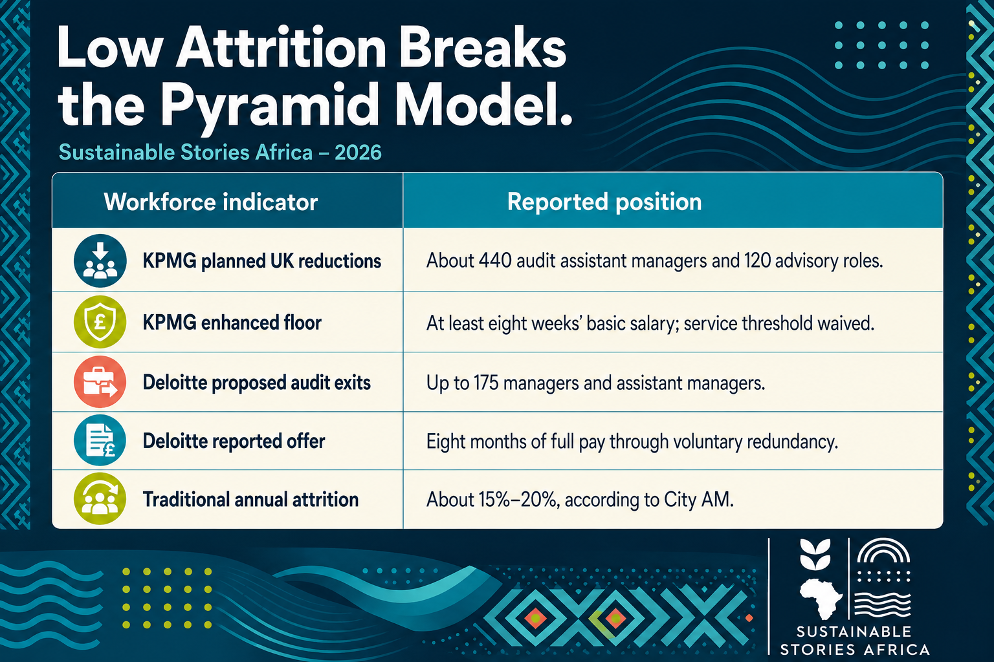
KPMG’s March proposal could remove roughly 440 audit staff, about 6% of its 7,100-person UK audit workforce, plus around 120 advisory roles.
Deloitte’s programme could affect up to 175 managers and assistant managers, fewer than 3% of its audit and assurance workforce.
KPMG confirmed that it enhanced its package after collective consultation; Deloitte previously confirmed voluntary exits in response to low attrition, although the reported eight-month term has not been made public by the firm.
Fair Transitions Can Preserve Workforce Trust
Enhanced packages can give departing employees time to retrain, search and avoid accepting the first available role.
They may also reduce conflict and compulsory dismissals. However, fairness depends on more than headline generosity.
City AM reported dissatisfaction among some long-serving KPMG staff who felt their packages were too similar to those offered to junior colleagues.
For African and other Global South markets, the UK reset matters because Big Four networks are major training grounds and cross-border talent pipelines.
There is no evidence in the reports that equivalent cuts are planned across African member firms.
However, leaders should assess whether automation, slower advisory demand and reduced mobility could narrow entry-level opportunities or return experienced professionals to local markets without sufficient transition support.
Big Four Must Manage Exits Responsibly
The firms should publish clear selection criteria, explain how service and performance influence payments, protect visa-dependent staff, and disclose how they will preserve audit quality after departures.
- Boards must also test whether reductions disproportionately affect particular grades, genders, ethnic groups or caregiving profiles.
- Regulators and clients should watch workload, supervision and staff-retention indicators, not only financial savings.
- Responsible restructuring means pairing severance with career coaching, references, mental-health support and credible routes into emerging areas such as sustainability assurance, data governance and AI-enabled audit.
Path Forward – Transparent Workforce Planning Must Shape Restructuring
KPMG and Deloitte’s packages buy time for individuals; they cannot substitute for a workforce strategy.
The immediate priority is transparent consultation, fair treatment and assurance that audit quality will not weaken as teams become leaner.
Across African professional services, firms should plan earlier: map future skills, retrain before roles disappear and report workforce impacts alongside technology investment.
In this way, restructuring can support the social dimension of ESG instead of treating people as a delayed cost adjustment.
Culled From: Revealed: KPMG and Deloitte offer bumper redundancy packages to slash headcount