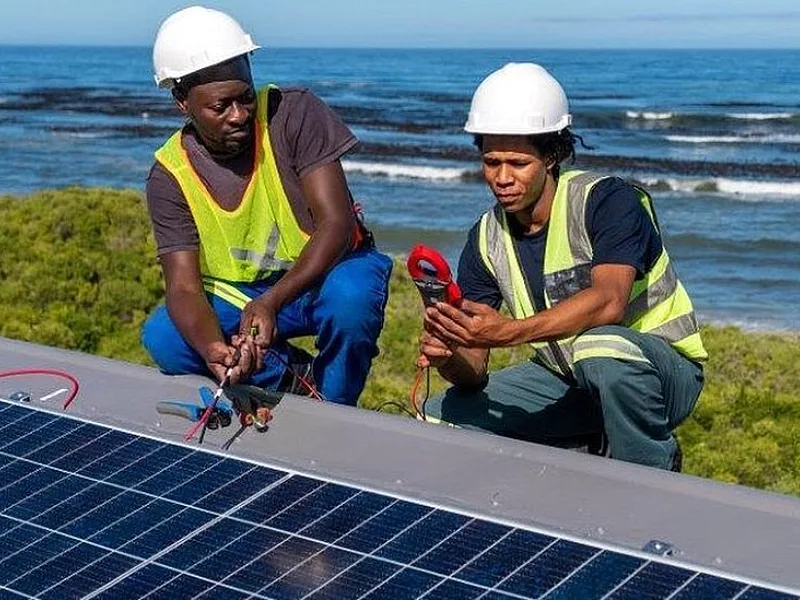
Africa added more than 88 GW of renewable energy projects and 19 GWh of battery storage to its development pipeline in six months.
The expansion spans 37 countries, but 70% is concentrated in South Africa, Egypt and Ethiopia, revealing momentum alongside persistent market imbalance.
For households, clinics, factories and mines, the promise will matter only when planned megawatts are connected, affordable and reliable electricity.
Africa’s Renewable Pipeline Expands at Record Pace
Africa’s renewable energy pipeline has expanded by more than 88 GW in six months, as developers pursue larger solar, wind and hybrid projects supported by increasingly significant battery storage.
According to a Renewables-Rising July 17 analysis, approximately 80 GW of the tracked capacity remained at the planning stage, while 8.3 GW was under construction and 2.6 GW had been completed.
The developments span 37 African countries and include 19 GWh of battery storage, a sign that storage is becoming integral to project design rather than an optional addition.
The distinction between announcement and delivery, however, remains critical. A proposed solar park does not refrigerate vaccines, irrigate crops or keep a small factory running during an outage.
For communities and businesses, the development story begins when financing closes, construction finishes and dependable electricity reaches the meter.
Storage and Industrial Demand Reshape Project Economics
The emerging pipeline reflects more than a race to add generating capacity.
Projects are becoming larger, batteries are being incorporated to manage intermittency, and developers are increasingly targeting mines, factories, data centres and business parks with substantial, predictable electricity demand.
However, expansion remains uneven. South Africa, Egypt and Ethiopia account for 70% of the tracked pipeline.
That concentration reflects their larger procurement programmes, stronger developer ecosystems and comparatively mature power markets; however, it also exposes the danger of a two-speed transition in which weaker markets attract fewer bankable projects.
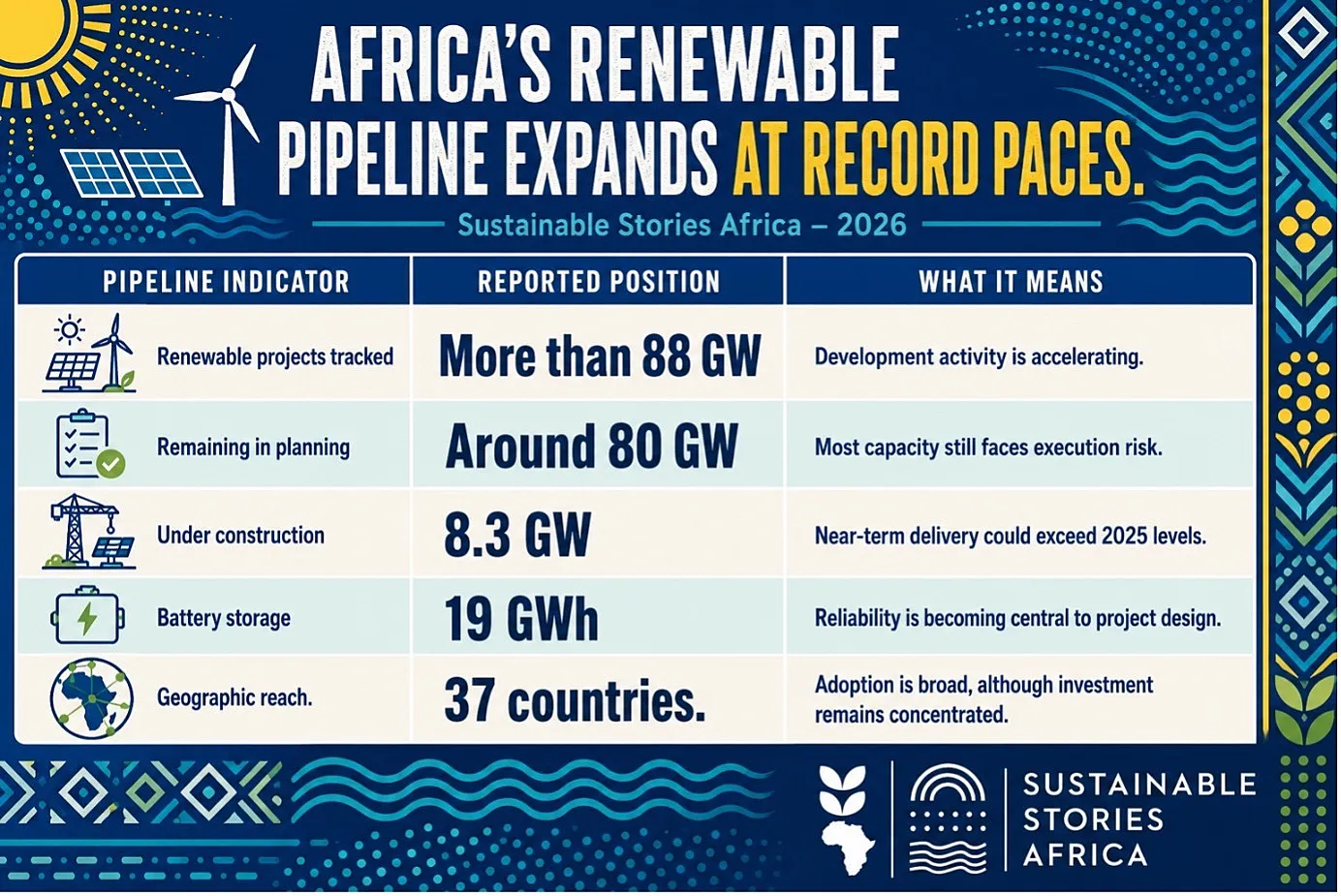
GW measures generation capacity, while GWh measures the energy that batteries can store and discharge.
The figures build on Africa’s strongest year for solar deployment. The continent installed approximately 4.5 GW of solar photovoltaic capacity in 2025, up 54% from 2024, according to the Global Solar Council.
However, its ten largest markets still supplied about 90% of those additions.
Delivery Could Power Jobs, Industry and Resilience
If the projects reach operation, the benefits could extend well beyond additional electricity.
Reliable renewable power can reduce diesel dependence, protect businesses from fuel price volatility and improve the competitiveness of African manufacturing, mining and digital services.
Battery-backed systems can also keep clinics, schools and commercial facilities operating due to grid failures.
For industrial users, longer-duration storage can shift solar electricity into evening production hours and reduce costly interruptions.
The opportunity remains urgent. Almost 600 million Africans still lack access to electricity, according to the International Energy Agency.
Meanwhile, Mission 300 reported in June that more than 50 million people across 40 countries had gained access through the initiative.
“Electricity is not just about power,” World Bank President Ajay Banga said when announcing that milestone. The real dividend lies in the jobs, healthcare, education and enterprise that electricity enables.
Capital, Grids and Policy Must Converge
Governments must now convert viable announcements into transparent procurement schedules, financeable power purchase agreements and time-bound grid connections.
Faster permitting will help, but speed must not weaken environmental safeguards, community consultation or land-rights protections.
Utilities also need credible transmission plans and clearer information about available grid capacity.
Building generation without strengthening substations, distribution networks and system operations risks producing stranded assets or curtailment.
Financiers should expand guarantees, blended-finance instruments and local-currency lending to reduce foreign-exchange exposure.
The IEA estimates that universal electricity access in Africa by 2035 will require about $15 billion annually, compared with less than $2.5 billion committed for new connections in sub-Saharan Africa in 2023.
Developers, meanwhile, must demonstrate local value through skills development, participation of the African supply chain, fair community benefits and measurable social outcomes.
Otherwise, the continent could accumulate an impressive catalogue of planned projects without closing its electricity deficit.
PATH FORWARD – Bankable Projects Must Become Reliable Power
Africa’s immediate priority is conversion: moving credible projects from planning to financial close, construction and grid connection.
Transparent milestones, competitive procurement, stronger utilities and local-currency risk instruments should make every gigawatt accountable.
Success should be measured not by announcements alone, but by affordable connections, reliable service, skilled local jobs and demonstrable community benefits.
That is how the pipeline can advance energy access, industrial resilience and a just transition while supporting Africa’s environmental, social and governance objectives.
Culled From: Africa adds 88 GW to its renewables pipeline in six months