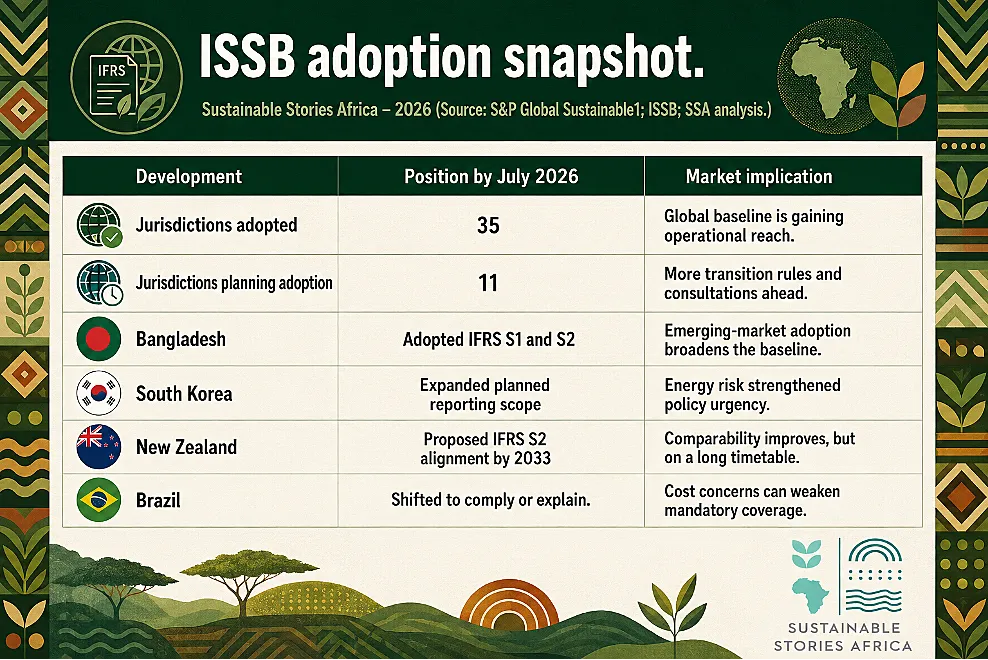
Thirty-five jurisdictions had adopted ISSB standards voluntarily or mandatorily by 22 July 2026, with another 11planning adoption, S&P Global reports.
Bangladesh adopted IFRS S1 and S2, while South Korea expanded its planned scope and New Zealand proposed later alignment.
However, Brazil and other major markets are easing requirements, testing whether global comparability can survive local cost pressures.
Adoption grows, but pathways keep diverging
Global use of the International Sustainability Standards Board's disclosure framework is expanding; however, not through a single regulatory route.
S&P Global reported that 35 jurisdictions had adopted the standards voluntarily as of 22 July, while 11 more intended to adopt them.
The ISSB issued IFRS S1 and IFRS S2 in June 2023 to create a global baseline for investor-focused sustainability and climate disclosures.
During the second quarter of 2026, Bangladesh adopted both standards after consultation, and South Korea moved to expand the range of companies expected to report.
Local modifications complicate global comparability
Jurisdictions are adjusting scope, timing and legal language to local markets.
- New Zealand proposed aligning its existing climate framework with IFRS S2 while incorporating locally relevant modifications; mandatory application would not begin until 2033.
- That approach may make implementation more realistic, but it also creates long transition periods during which investors still receive inconsistent information.
The direction is not uniformly toward tougher mandates.
- Brazil moved from mandatory reporting to a comply-or-explain approach, citing the balance between transparency and cost.
- The European Union has reduced the number of companies within its sustainability-reporting net, while the United States has proposed withdrawing federal climate rules.
- South Korea, by contrast, accelerated its roadmap as Middle East conflict increased energy-price risk.
Africa needs capacity as well as rules
For African markets:
- ISSB alignment can improve access to capital by making climate and sustainability risks easier for international investors to compare.
- It can also reduce the burden on groups operating across borders, provided regulators avoid creating multiple overlapping templates.
The harder challenge is implementation.
- Companies need governance, emissions data, scenario analysis, internal controls and assurance-ready records.
- Regulators and professional bodies need trained reviewers. Smaller suppliers may be outside formal scope but still face information requests from banks and multinational customers. If capacity lags, compliance can become a polished annual-report exercise rather than decision-useful disclosure.
Regulators must protect credible convergence
Governments should publish phased roadmaps, proportional relief and clear definitions while preserving the core comparability of IFRS S1 and S2.
Companies should begin with governance, material risks, data ownership and controls rather than waiting for final deadlines.
Investors must also use the disclosures.
- Asking for hundreds of immaterial data points increases cost without improving allocation.
The global baseline will succeed when comparable information changes pricing, engagement and strategy, not merely when another jurisdiction announces adoption.
Path Forward – Build Comparable Reporting Without Weakening Ambition
Regulators should align local rules with the ISSB baseline, phase requirements by company capacity and invest in training, systems and assurance readiness.
Companies should establish accountable data owners and test controls before mandatory dates.
Investors should demand material, comparable information while resisting unnecessary duplication, helping emerging markets gain credibility without turning sustainability reporting into an unaffordable compliance ritual.
Culled from: August 2026 – Where does the world stand on ISSB adoption? | S&P Global