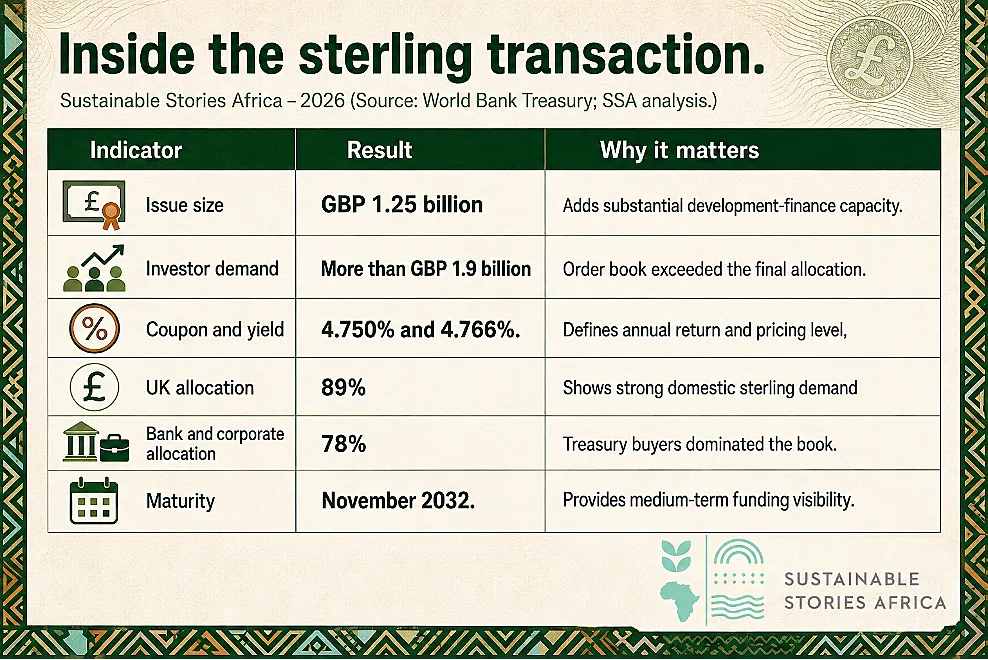
The World Bank has priced a GBP 1.25 billion Sustainable Development Bond due in November 2032 after orders exceeded GBP 1.9 billion.
UK investors took 89% of the issue, while banks, treasury desks and corporates accounted for 78%.
The transaction shows continued demand for highly rated development debt, but its ultimate impact depends on how efficiently capital translates into measurable outcomes.
Sterling demand delivers large benchmark issue
The World Bank's International Bank for Reconstruction and Development priced a 6.3-year sterling benchmark on 26 August, raising GBP 1.25 billion to finance sustainable development activities in member countries.
- The bond carries a 4.750% annual coupon, a 4.766% yield and matures in November 2032.
Orders exceeded GBP 1.9 billion, allowing the transaction to price 9.9 basis points over the 4.250% UK Gilt due June 2032.
Lead managers said this was IBRD's tightest fixed-rate sterling spread on both gilt and SONIA mid-swap measures.
- Barclays, Citi and Santander arranged the deal, which will list in Luxembourg.
Concentrated buyers back development mandate
The investor book was heavily concentrated in the United Kingdom, which took 89% of allocations.
Europe, the Middle East and Africa received 6%, and the Americas 5%.
Banks, bank treasuries and corporates bought 78%; asset managers, insurers and pension funds took 20%; and central banks and official institutions received 2%.
World Bank Treasurer Jorge Familiar said investor confidence translates into financing for programmes that improve lives, expand opportunities and build resilience.
The credit strength behind the bond matters:
- IBRD carries top-tier Aaa/AAA ratings and raises funds in capital markets to support lending and development activity.
Market confidence must become public value
For African member countries, the significance lies beyond the bond desk.
- Multilateral funding can support infrastructure, health, education, climate resilience and institutional reform where commercial capital may be too expensive or short-dated.
- A deep investor book can also help the World Bank maintain predictable access to funding during volatile periods.
However, a sustainable-development label is not an outcome in itself.
- Stakeholders need clear information on how the World Bank allocates resources, what projects deliver, and who benefits.
- Governments receiving finance must publish procurement, debt and implementation information, while projects should be measured against service access, affordability, resilience and inclusion.
Development finance requires accountable delivery
Investors should continue assessing both credit quality and development reporting.
- The World Bank can strengthen confidence by connecting issuance-level communications to portfolio results, including avoided emissions, improved services, jobs and resilience where methodologies allow credible measurement.
Borrowing governments must ensure that funds move from approval to functioning services without avoidable delay, cost escalation or exclusion.
- Strong demand in London becomes meaningful in Lagos, Lusaka or Kigali only when people experience more reliable systems and better opportunities.
Path Forward – Convert Investor Demand Into Measurable Development
The World Bank should maintain transparent allocation and impact reporting that links capital raised to credible development results across member countries.
Recipient governments should pair financing with open procurement, delivery milestones and public accountability.
Investors can then judge not only whether the bond pays on time, but whether the development mandate behind it produces durable social and environmental value.
Culled from: Strong Sterling Investor Demand Drives World Bank's GBP 1.25 Billion 6-Year Benchmark Bond