
Seven in ten sustainability professionals expect their companies to scale back at least one commitment as tighter resources and regulatory demands reshape corporate priorities.
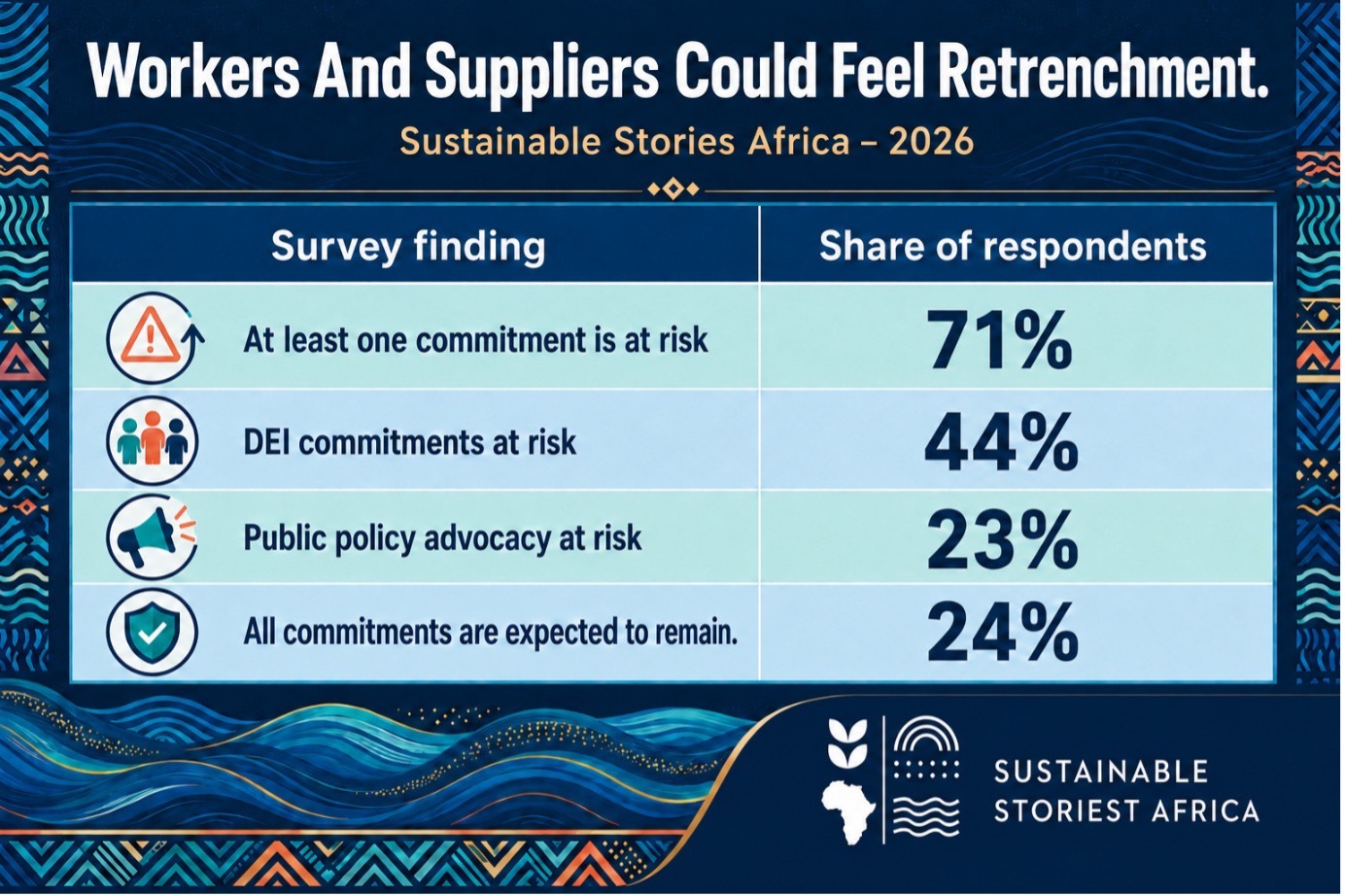
Diversity, equity and inclusion programmes face the greatest pressure, followed by public policy advocacy.
For African markets, the retreat could affect workers, suppliers and communities unless companies replace broad promises with fewer, measurable commitments embedded in business strategies.
Corporate Sustainability Enters A More Selective Era
Corporate sustainability is moving from expansive promises to difficult choices, with 71% of sustainability professionals warning that at least one commitment at their company could be scaled back.
New research from GlobeScan and Business for Social Responsibility, or BSR, shows that only 24% of respondents expect their organisations to maintain every existing sustainability commitment. Diversity, equity and inclusion programmes are the most exposed, identified by 44% of respondents, followed by public advocacy on sustainability policy at 23%.
The findings were drawn from an online survey of 124 sustainability professionals working at companies with annual revenues exceeding $1 billion. Conducted in April and May 2026, the study covered different sectors, regions and seniority levels.
Its central message is not that sustainability has disappeared. Instead, corporate leaders are narrowing their agendas as they face competing regulatory requirements, limited resources and stronger demands to demonstrate commercial value.
Workers And Suppliers Could Feel Retrenchment
Corporations spent years layering ambitious commitments across net-zero targets, responsible sourcing, gender representation, human rights, biodiversity and advocacy pledges made when financing was cheaper, and stakeholders rewarded bold positioning.
That environment has shifted. Sustainability teams now navigate intricate disclosure rules while justifying budgets against initiatives that promise faster financial returns, with supply-chain standards, climate-transition investment, biodiversity commitments and human-rights due diligence increasingly vulnerable to cuts.
These rollbacks carry human costs. Weakened sourcing standards can strip cocoa cooperatives, textile producers, and mineral suppliers of support for safety and environmental upgrades.
The shrinking DEI programmes narrow recruitment pipelines and workplace opportunities for underrepresented groups.
African operations face particular exposure, often managed remotely from headquarters, where global cost reviews can eliminate local programmes, such as supplier training, water stewardship, and women-led enterprise support, that communities depend on.
Still, scaling back isn't always retreat; it may reflect sharper prioritisation. The real question is whether it deepens impact or merely disguises abandonment.
Fewer Commitments Could Deliver Greater Impact
A more focused sustainability agenda can create value when commitments are selected through rigorous materiality assessments and integrated into operating decisions.
For a bank, this may mean concentrating on financial inclusion, climate risk management and responsible lending.
- A mining company may prioritise worker safety, water use, community relations and rehabilitation liabilities.
- A consumer-goods business may focus on packaging, agricultural sourcing and supply-chain labour standards.
Clear priorities allow companies to assign budgets, executives, and measurable performance indicators for each objective.
They also reduce the risk of “commitment inflation”, while announcing more targets than an organisation can realistically finance, monitor or deliver.
The danger arises when companies protect the commitments that are easiest to report rather than those with the greatest human or environmental consequences.
DEI, human rights and biodiversity programmes may generate benefits over longer periods, making them vulnerable when boards demand immediate returns.
Walking away also carries financial costs. Customers, employees, investors and regulators can compare earlier promises with present performance. Once stakeholder trust is lost, it is difficult and expensive to rebuild.
Boards Must Separate Focus From Retreat
- Boards should require management to disclose which commitments are being revised, why they are changing and how affected stakeholders will be protected.
Material adjustments should not be hidden within new language, distant deadlines or reduced public communication.
- Companies should connect each surviving commitment to business risks and opportunities, including energy costs, supply chain disruption, workforce productivity, access to capital and regulatory compliance.
Executive accountability and capital allocation should follow.
- African regulators, stock exchanges and institutional investors also have a role.
Consistent sustainability disclosure can prevent companies from quietly abandoning material obligations while rewarding businesses that convert commitments into verifiable performance.
- For corporate leaders, the question is no longer how many sustainability promises they can announce.
It is about which promises are essential to resilience, and whether they are prepared to finance and deliver them.
Path Forward – Turning Fewer Promises Into Measurable Progress
Companies should protect commitments connected to material risks, stakeholder welfare and long-term value. Any revision must be transparent, evidence-led and approved through credible governance processes.
For African markets, stronger disclosure, local stakeholder engagement and measurable executive accountability can ensure that corporate prioritisation does not shift costs to workers and communities.
Sustainability will retain credibility only when fewer promises produce deeper, independently verifiable results.
Culled From: Companies Are Making Hard Choices on Sustainability Commitments