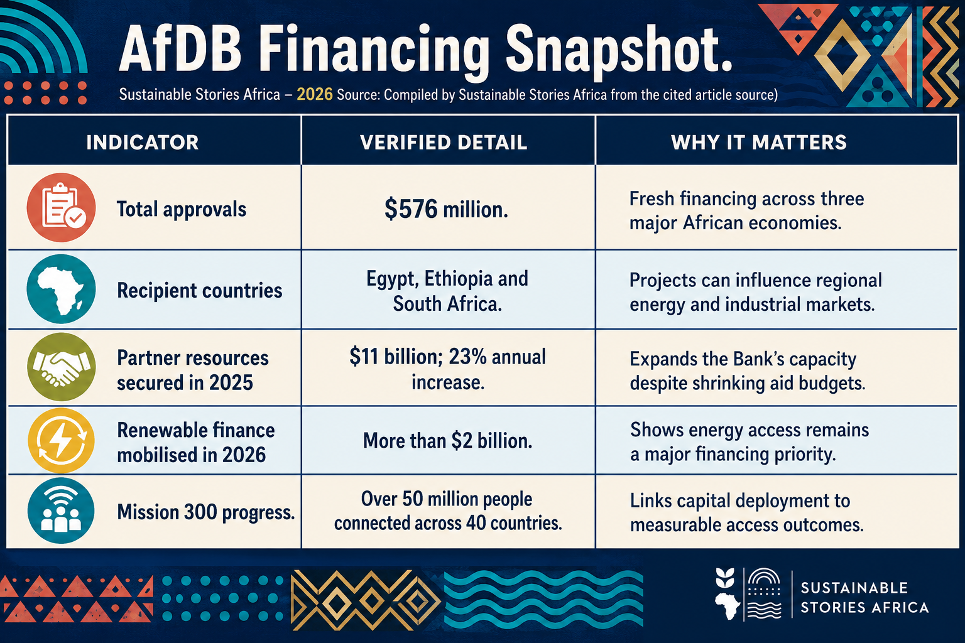
The African Development Bank has approved $576 million across Egypt, Ethiopia and South Africa, concentrating fresh development finance in three of the continent’s largest economies.
The approvals arrive as aid budgets are tightened and Africa’s energy and infrastructure needs continue to outpace available public capital.
The test is whether the Bank can turn its own balance sheet into a bridge for institutional investment, jobs and reliable services.
Development Finance Moves Despite Global Retreat
The African Development Bank has approved $576 million in financing across Egypt, Ethiopia and South Africa, a one-week burst of commitments that places the continent’s development lender at the centre of efforts to keep infrastructure and energy investment moving as international aid budgets contract.
The approvals matter beyond their headline value. Egypt, Ethiopia and South Africa are large, strategically important economies where electricity, transport and productive infrastructure shape regional trade and employment.
Fresh financing can therefore travel farther than national borders, through supply chains, power pools, industrial demand and new private investment.
A Larger Financing Machine Takes Shape
The commitment follows a record year in which the Bank secured $11 billion from partners, 23% more than the previous year despite the withdrawal of major contributors including the United States, according to Renewables Rising.
The Bank has also mobilised more than $2 billion for renewable energy in 2026.
That record gives the AfDB room to play two roles at once: lender to projects that markets may consider too risky, and convenor of investors that need guarantees, credible preparation and long-term policy certainty.
Mission 300, backed by the AfDB and World Bank, illustrates the scale. More than 50 million people have reportedly been connected across 40 African countries, against the wider ambition of connecting 300 million Africans by 2030.
For households, the financing question is practical. It determines whether access to electricity consistently reaches a clinic, whether a small manufacturer can run without diesel, and whether a city can expand without locking in costly, high-carbon infrastructure.
Public Capital Can Unlock Private Scale
Africa’s infrastructure gap cannot be closed by sovereign borrowing alone.
However, a development bank can absorb early risk, fund project preparation, and provide guarantees that make grids, storage and clean generation investable for pension funds, insurers and commercial lenders.
If the new approvals are paired with transparent procurement, local-content strategies and measurable development outcomes, they can crowd in capital while strengthening domestic capability.
The prize is not simply completed assets. It is a pipeline of bankable projects, better public services, stronger regional integration and jobs linked to construction, operations and manufacturing.
Mobilisation Must Reach Local Economies
The continental question is how much additional capital each AfDB dollar attracts and how much value remains in local economies.
- Projects financed mainly through imported equipment and foreign-currency debt may deliver infrastructure while leaving countries exposed to exchange-rate pressure and limited domestic capability.
- Procurement can instead build African engineering, construction, maintenance and manufacturing capacity.
Governments should also protect fiscal space.
- Concessional finance remains valuable, but debt sustainability depends on project revenues, economic spillovers and disciplined selection.
- Public disclosure of co-financing, currency exposure and expected outcomes would help citizens and investors distinguish transformative assets from expensive announcements.
- Regional projects deserve particular attention because their benefits often exceed what a single national balance sheet can capture.
Make Every Development Dollar Mobilise More
The AfDB and recipient governments should publish clear implementation milestones, expected beneficiaries, climate safeguards and mobilisation targets for each operation.
Investors need predictable regulation and credible counterparties; citizens need evidence that approvals become functioning infrastructure.
African governments should also deepen local-currency financing, strengthen utilities and standardise project documentation.
Those reforms can reduce foreign exchange risk and help domestic institutional investors participate in assets suited to their long-term liabilities.
Path Forward – Turn Commitments Into Durable African Assets
The next priority is execution: timely procurement, transparent reporting and financing structures that multiply the AfDB’s contribution rather than substitute for private capital.
Success will be measured by reliable services, productive jobs and resilient infrastructure, rather than announcements.
Well done, the $576 million package can show how African-led development finance keeps essential investment moving through a tougher global funding cycle.
Culled From: AfDB commits $576 m in three African countries