Ten European Union states have asked Brussels to reconsider ETS2, the planned carbon market for road transport and building-heating fuels.
Their intervention exposes the political fault line between climate ambition, household affordability and industrial competitiveness.
The outcome will influence how governments everywhere, including African carbon-market designers, balance credible price signals with a just transition.
Carbon Pricing Meets Household Politics
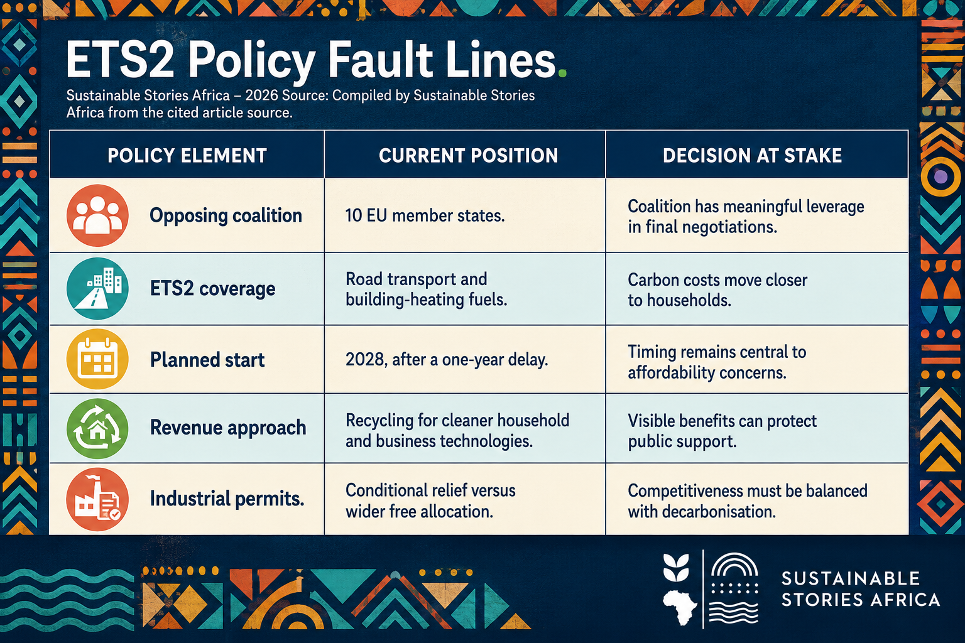
Ten European Union member states, including Italy and Poland, have urged Brussels to reconsider a planned carbon price on transport and heating fuels before a wider overhaul of the bloc’s emissions market.
The coalition argues that citizens should not face new climate taxes amid cost-of-living and geopolitical pressure.
Italy, Poland, Bulgaria, Cyprus, the Czech Republic, Estonia, Greece, Hungary, Romania and Slovakia signed the statement.
Together, they have enough institutional weight to complicate negotiations with supporters including Germany and Sweden.
ETS2 Extends The Market Into Homes
ETS2 extends carbon pricing beyond power plants and heavy industry to fuel suppliers serving road transport and buildings.
Suppliers would pay for the emissions embedded in fuels, with much of the cost expected to reach motorists and households.
The scheme is due to begin in 2028 after already being delayed by one year.
Supporters say the price is necessary to make electric vehicles, heat pumps and efficiency investments more competitive.
They also point to revenue recycling designed to help households and businesses adopt cleaner technologies.
Opponents question timing and distribution. Energy spending consumes a larger share of income in many lower-income member states, making a uniform carbon signal politically unequal in practice.
The same coalition is seeking more free carbon permits for industry without broad conditions, while the European Commission favours linking relief to decarbonisation investment.
Fair Design Can Protect Climate Credibility
Carbon pricing works best when people can see an affordable alternative. Revenue invested early in public transport, home insulation and clean heating can reduce exposure before bills rise.
Targeted support can protect vulnerable households without abandoning the emissions signal.
For African policymakers developing carbon markets and fuel reforms, Europe’s dispute offers a lesson: technical elegance is not enough.
Reform must account for income, energy access and infrastructure. A poorly sequenced price can provoke resistance; a transparent social contract can turn revenue into cleaner, cheaper service.
Europe’s Dispute Offers Wider Lessons
African governments are watching carbon pricing while managing a very different starting point: lower historical emissions, large energy-access gaps, widespread informality and limited fiscal room for household compensation.
That makes distributional design even more important. A fuel levy introduced before public transport or clean-cooking alternatives exist can deepen poverty without producing rapid substitution.
At the same time, postponing every price signal can lock economies into inefficient technology and future trade exposure.
The practical middle ground is to start with strong measurement, protect essential consumption, recycle revenue transparently and invest in alternatives first.
Europe’s argument demonstrates that political durability is a climate-policy asset. Reform that loses public legitimacy rarely delivers its intended emissions pathway.
Recycle Revenue Before Costs Reach Households
EU negotiators should protect ETS2’s environmental integrity while strengthening price safeguards, targeted compensation and public reporting on revenue use.
Free industrial permits should remain conditional on credible, verifiable transition investment.
Governments must communicate who pays, who receives support and which alternatives will be available.
Without that clarity, opponents can frame carbon pricing as extraction rather than transformation.
Path Forward – Pair Carbon Prices With Visible Fairness
Europe’s decision should preserve a predictable carbon signal while ensuring that households are equipped to respond before costs arrive.
The durable route is not unconditional delay or an unprotected launch. It is a sequenced transition in which revenues finance practical alternatives, industrial relief buys measurable decarbonisation, and fairness becomes part of market design rather than an afterthought.
Culled From: Ten EU States Push to Rethink Fuel Carbon Price Ahead of Market Overhaul