
Central Bank officials are pushing prudential transition plans higher on supervisory agendas as fossil-fuel exposure becomes a systemic financial risk.
The ECB now requires supervised banks to explain how they will manage transition risks, even as wider EU reporting rules are being simplified.
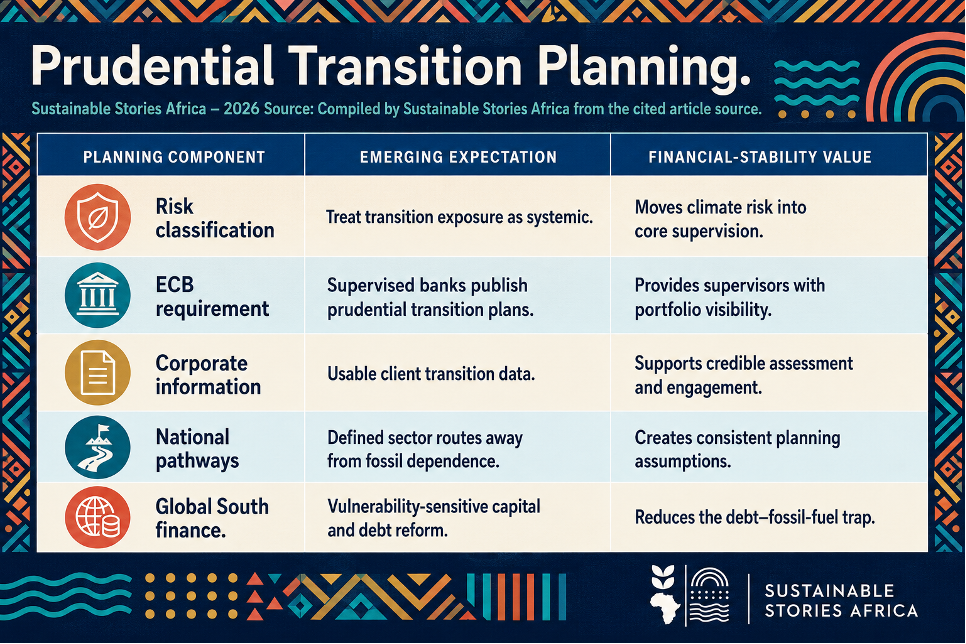
The emerging standard links credible pathways, usable corporate data and financial stability.
Transition Plans Become A Stability Instrument
Prudential transition plans are moving from the margins of sustainability reporting to the centre of financial supervision as central bankers confront the systemic risks of a disorderly move away from fossil fuels.
At a World Resources Institute webinar following the Santa Marta conference, Banco Central do Brasil official Sarah Amorim Torres said climate transition risks should be treated as systemic and addressed now.
The argument is direct: banks need to understand how clients, sectors and portfolios will change, and supervisors need visibility before losses crystallise.
Europe Tests A New Supervisory Requirement
Since January 11, the European Central Bank has required supervised banks to publish prudential plans explaining how they will manage low-carbon transition risks under the amended Capital Requirements Directive VI.
Green Central Banking described the ECB as the first central bank to impose such a requirement through banking regulation.
The rule collides with another policy trend. The European Commission’s sustainability “omnibus” seeks to reduce reporting burdens and the number of companies publishing corporate transition plans.
Banks warn that fewer client disclosures could weaken the data needed for their own risk assessments.
Santa Marta brought more than 50 governments and a dozen stakeholder groups together to develop workstreams on finance and transition roadmaps.
However, China, the United States, India, and major exporters including Russia and Saudi Arabia were absent, exposing the limits of coalition-based progress.
Credible Plans Can Direct Capital Earlier
A useful prudential plan is not a net-zero slogan. It maps sector exposure, client transition capacity, financing needs, governance and risk appetite against plausible pathways.
Well done; it helps banks engage clients before abrupt policy or technology shifts destroy value.
For African countries caught in what former Trinidad and Tobago central-bank governor Jwala Rambarran called a “debt fossil fuel trap,” planning must also address development and sovereign vulnerability.
Transition cannot rest on expensive borrowing while fuel revenues service old debt.
Transition Plans Must Reflect Development
African prudential plans cannot be credible if they treat all fossil exposure as identical or ignore the role of energy access, industrialisation and public revenue.
They should identify which assets face genuine transition risk, which investments enable a lower-carbon system and how workers and communities will be protected. Gas, grids, minerals and transport may carry different pathways across countries.
Data proportionality also matters. Large cross-border banks can support detailed analysis; small lenders may need common scenarios, taxonomies and supervisory guidance.
A phased approach can improve quality without the creation of a compliance exercise detached from decisions.
The objective is a financial system prepared for structural change, not a stack of plans that repeat national targets without testing portfolios.
Align National Pathways, Data And Finance
- Governments should publish credible sector pathways that give banks a reference point for evaluating clients.
- Supervisors should define minimum plan expectations while allowing proportionality for smaller institutions.
- Global financial architecture must provide vulnerability-sensitive finance and avoid forcing emerging economies into false choices between stability and transition.
- Central banks cannot deliver the transition alone; however, they can research macro-critical risks, coordinate policy and ensure financial institutions prepare.
Path Forward – Make Transition Plans Credible And Usable
The next step is coherence: national pathways, corporate information and prudential expectations must reinforce one another rather than create contradictory reporting gaps.
For Africa, plans should connect financial stability with energy access, fiscal resilience and a just transition. Credibility will come from near-term actions, capital allocation and accountability—not distant targets detached from the structure of local economies.
Culled From: Climate risks push prudential transition plans to the top of central bank agendas - Green Central Banking