Climate litigation is no longer a distant legal concern for banks, insurers, pension funds and asset managers, the ECB’s legal chief has warned.
Claims can target financed emissions, disclosure, greenwashing, underwriting and failures to manage foreseeable climate harm.
Financial institutions must now treat legal exposure as part of governance, capital and enterprise risk, rather than reputation alone.
Climate Liability Has Entered The Balance Sheet
Banks, insurers, pension funds and asset managers are already exposed to material climate-litigation risk, according to a warning highlighted by Green Central Banking from the European Central Bank’s legal leadership.
The message strips away a common comfort: that climate lawsuits primarily target governments and fossil-fuel producers.
Financial institutions can be challenged over what they finance, insure, disclose or promise, and legal costs can arrive before a final judgment through discovery, loss of reputation, management distraction and changed market access.
Litigation Expands Across Claims And Defendants
The warning draws on the London School of Economics’ 2026 global trends review, the ninth annual assessment of a field that has grown more complex and mature.
Climate cases increasingly test corporate transition claims, emissions disclosures, directors’ duties and the compatibility of major projects with climate law.
For finance, exposure can be direct or transmitted.
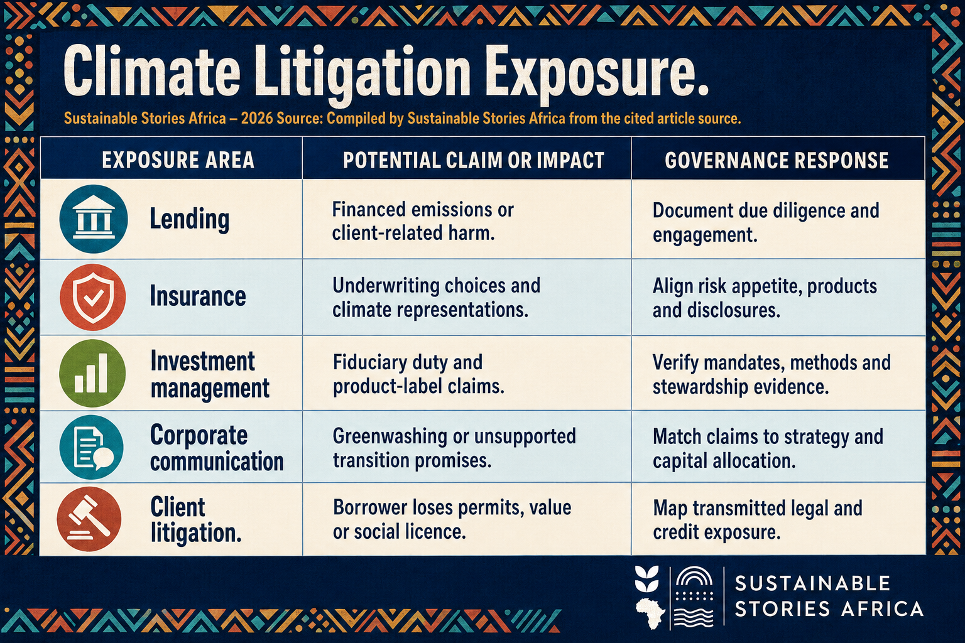
- A bank may face claims tied to financed emissions or misleading sustainable-finance statements.
- An insurer can be questioned over underwriting and climate representations. Asset owners and managers may confront fiduciary-duty arguments.
- Institutions can also suffer when a borrower or insured client loses a case, permit or social licence.
The risk is especially difficult because law develops across jurisdictions. A claim that fails can still change disclosure practice, trigger supervisory attention or inspire stronger cases elsewhere.
Strong Governance Can Reduce Legal Surprises
Institutions that connect public climate commitments to lending, underwriting and investment decisions are better placed to defend their conduct.
Clear evidence trails, realistic transition claims and board oversight reduce the gap between what a firm says and what it does.
African financial institutions should not assume that fewer domestic cases mean low exposure.
Cross-border investors, international standards and foreign courts can transmit risk, while climate litigation in the Global South continues to develop around rights, pollution, land and adaptation.
Cross-Border Exposure Changes The Map
African banks and insurers increasingly operate across jurisdictions and raise capital from international markets.
- A climate claim against a parent, borrower or investee can therefore affect funding costs and reputation far from the courtroom where it begins.
- Institutions subject to global disclosure standards may also be challenged when group-level promises conflict with local financing practice.
This makes governance consistency essential.
- Boards should know which climate claims are made in every market, how exclusions and transition policies are implemented, and where data limitations create uncertainty.
- Legal preparedness must also include community engagement and grievance systems.
Resolving credible concerns early can prevent operational disputes from escalating into litigation while improving the quality of environmental and social decision-making.
Test Claims, Contracts And Client Exposure
- Boards should place climate litigation within enterprise risk frameworks, with legal, sustainability, risk and business teams sharing responsibility.
- Institutions should review public claims, product labels, financed emissions methods, underwriting policies and client-engagement records.
- Supervisors can strengthen preparedness by incorporating legal scenarios into climate stress tests and governance reviews.
- Firms should disclose uncertainty honestly and avoid promises that strategy, capital allocation and controls cannot support.
Path Forward – Treat Legal Risk As Present Risk
Climate litigation belongs in today’s risk register.
Financial institutions need defensible claims, consistent decisions and documented oversight across lending, insurance and investment.
The strongest protection is substantive alignment promises matched by policies, data and capital.
As courts and claimants become more sophisticated, governance that once served mainly as sustainability assurance will increasingly serve as financial and legal resilience.
Culled from: Climate litigation risk already here for banks and insurers, says ECB legal chief - Green Central Banking