
The European Central Bank’s new climate factor will slightly discount eligible collateral exposed to transition risk, embedding climate uncertainty into monetary operations.
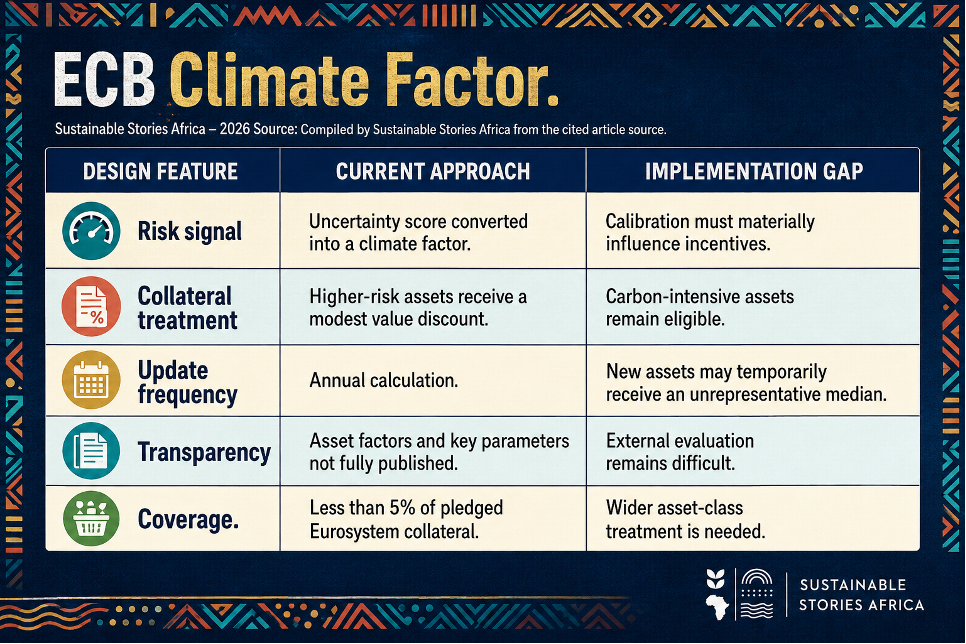
However, the mechanism applies to less than 5% of assets pledged in the Eurosystem and remains difficult for outsiders to evaluate.
Its credibility will depend on transparency, timely scoring and broader coverage.
Climate Risk Reaches Central-Bank Collateral
The European Central Bank’s climate factor is an important recognition that carbon-intensive assets can carry transition risks ignored by conventional financial models.
By slightly reducing the collateral value of exposed assets, the ECB is beginning to protect its own balance sheet and influence what banks choose to pledge.
However, the first design reaches less than 5% of collateral pledged in the Eurosystem.
That narrow scope risks turning a potentially powerful policy signal into a modest adjustment.
The Score Converts Uncertainty Into Haircuts
Each covered asset receives an uncertainty score based on sector and company exposure.
The score becomes a climate factor: greater uncertainty means a reduced factor and a slightly larger discount when the asset is pledged.
The mechanism can make high-transition-risk financing less attractive; however, three weaknesses stand out in Clarisse Murphy’s Green Central Banking analysis.
- The ECB does not plan to publish asset-level factors or key parameters.
- Scores are calculated annually, while newly eligible assets receive a median factor that may not reflect their risk
- All carbon-intensive assets remain eligible, even where exclusion could correct longstanding carbon bias more decisively.
Coverage is another constraint. Different collateral classes require different methods; however, credit claims, among the most common pledged assets, offer an obvious place to extend the principle using sector information.
Better Design Can Shift Financial Incentives
A transparent and responsive climate factor could help banks recognise stranded-asset risk before markets reprice it abruptly.
It could also correct the hidden advantage created when carbon-intensive collateral receives eligibility and relatively low haircuts despite transition exposure.
The lesson travels beyond Europe. African central banks considering green monetary tools must protect price and financial stability while accounting for local energy needs and data limitations.
Clear methodologies and phased implementation can build trust without copying a euro-area instrument wholesale.
Monetary Tools Need Local Calibration
The ECB debate matters to African central banks because collateral policy can influence bank incentives even where green asset markets are shallow.
- However, climate factors require reliable issuer, sector and exposure data.
- Applying blunt discounts in data-poor markets could reduce liquidity without accurately separating risk.
A sensible sequence would begin with disclosure, portfolio mapping and scenario analysis, followed by transparent pilots on asset classes where evidence is strongest.
- Authorities should evaluate financial-stability effects and access to credit before scaling.
Climate-sensitive collateral rules should complement, not replace, fiscal policy, regulation and development finance.
Their legitimacy depends on a clear mandate and proof that risk treatment is technically defensible rather than symbolic.
Publish Parameters And Expand Coverage Carefully
The ECB should disclose enough methodology and aggregate results for independent evaluation, calculate scores when assets become eligible and test whether haircuts materially change incentives.
It should examine exclusions for the highest-risk activities and adapt the approach to credit claims.
Regular impact reviews should assess collateral composition, bank behaviour and unintended consequences.
A tool designed to manage uncertainty must itself be measurable.
Path Forward – Strengthen The Signal Beyond Symbolism Now
The climate factor creates a valuable policy foothold, but reach, transparency and calibration will determine whether it changes risk-taking.
The ECB should treat implementation as iterative: publish evidence, close timing gaps and extend climate-sensitive treatment across suitable collateral classes.
The stronger the link between genuine risk and collateral value, the more credible the framework becomes.
Culled From: The ECB’s climate factor: a good idea that deserves better implementation - Green Central Banking