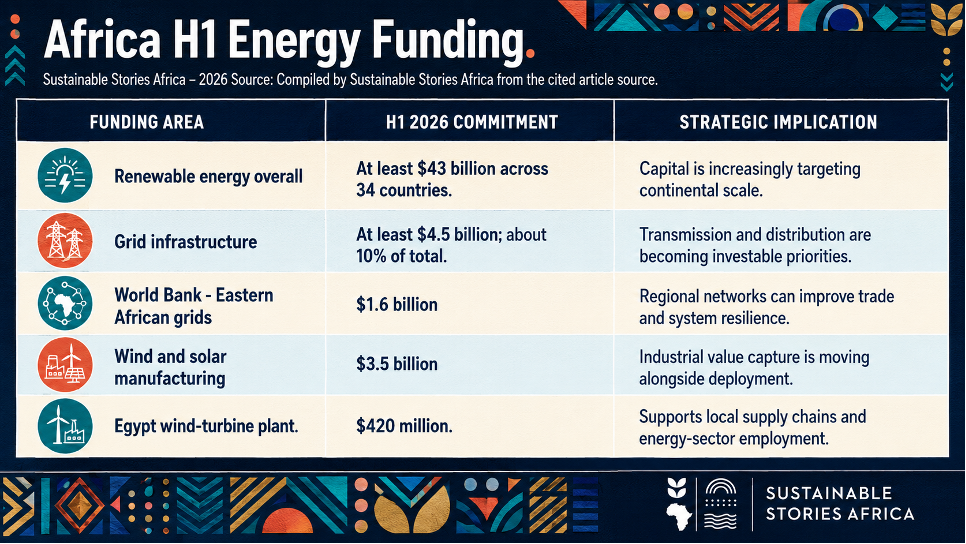
At least $4.5 billion, approximately 10% of Africa’s $43 billion in renewable-energy funding commitments during the first half of 2026, was directed to grid infrastructure.
The shift signals growing recognition that generation alone cannot deliver reliable electricity without transmission, distribution and regional interconnection.
For African households and businesses, the quality of the grid will determine whether the renewables boom becomes usable power.
The Transition Meets Its Hardest Constraint
African countries attracted at least $43 billion in renewable-energy funding and commitments in the first half of 2026; however, the most revealing number may be the $4.5 billion directed to grids.
That is approximately 10% of the total and a sign that financiers are finally addressing the wires, substations and control systems required to turn new generation into dependable electricity.
The commitments reached 34 countries, while multi-country and regional funds represented about 40% of the total.
This suggests investors are searching for scale and recognising that electricity systems do not stop at national borders.
Generation Growth Exposes Weak Networks
Solar and wind capacity can be built faster than high-voltage networks. Without corresponding grid investment, new plants face curtailment, connection delays and weak off-takers, while consumers continue to experience outages.
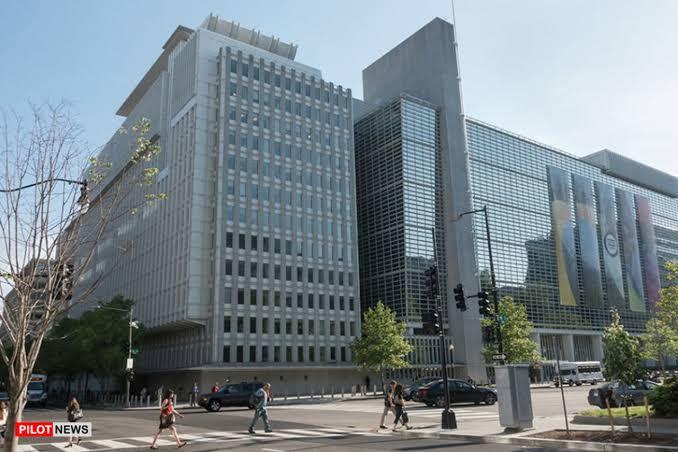
The World Bank’s $1.6 billion commitment for Eastern African grids was the largest named contribution in the first-half review.
The funding picture also reveals an emerging industrial strategy. Wind and solar equipment manufacturing attracted $3.5 billion in commitments, including $420 million for a wind-turbine manufacturing plant in Egypt.
However, factories that make clean-energy equipment also need reliable electricity and efficient logistics.
Grid investment therefore supports both decarbonisation and industrialisation.
For a market trader, hospital or small factory, the transition is not measured in installed megawatts.
It is measured in hours of reliable service, stable voltage and the declining need for backup diesel.
Better Grids Multiply Every Renewable Investment
- Modern networks allow utilities to integrate variable generation, connect storage, reduce losses and move power from surplus areas to demand centres.
- Regional interconnectors can also make smaller national systems more resilient by sharing reserves and balancing supply.
The wider benefit is financial.
- Stronger grids improve utility revenues and project bankability, which can lower the cost of capital for future power generation.
- They also create a platform for electric transport, digital services and productive-use demand that turn access into economic value.
Reliability Is The Real Metric
Africa’s grid deficit is not only a shortage of kilometres of transmission.
- Distribution losses, weak metering, poor maintenance and utility balance sheets can prevent newly financed lines from improving service.
- Investment plans must therefore connect physical expansion with operational reform and the ability to recover revenue fairly.
The social dimension is equally important.
- Grid upgrades can bypass low-income communities if connection costs remain unaffordable or service expansion favours large users alone.
- Regulators and financiers should track reliability, new connections, losses, outage duration and productive use.
Those indicators reveal whether capital is strengthening a system or merely adding assets to it. A modern grid succeeds when people can rely on the electricity it carries.
Harmonise Rules Before Capital Loses Patience
- Governments should align grid codes, connection procedures and cross-border trading rules, while publishing investable transmission plans tied to realistic demand forecasts.
- Procurement must reward resilience, maintainability and local skills, rather than the lowest upfront price.
- Development lenders should expand guarantees and blended-finance structures for transmission and distribution, areas where private participation remains limited.
- Regulators must also support cost-reflective, socially balanced tariffs so utilities can maintain the assets being financed.
Path Forward – Build Networks That Carry Africa’s Ambition
The first half commitments mark progress, but $4.5 billion is a beginning, not a solution. Projects must move from pledges to substations, lines and stronger utility operations.
Africa’s renewable pipeline will deliver its full social and economic value only when electricity can travel reliably from project sites to homes and businesses.
Grid reform, regional coordination and patient finance now belong at the centre of the transition.
Culled From: Grids take at least 10% of H1 funding commitments