The African Development Bank has approved an eight-year subordinated loan to Equity Bank Kenya to strengthen the lender’s capital and support more long-term finance for small businesses.
Women-led and youth-run enterprises are among the priorities, alongside businesses in agriculture, manufacturing, trade, logistics and green sectors.
The bank also envisaged up to $900,000 in business support.
AfDB backs Equity Bank Kenya
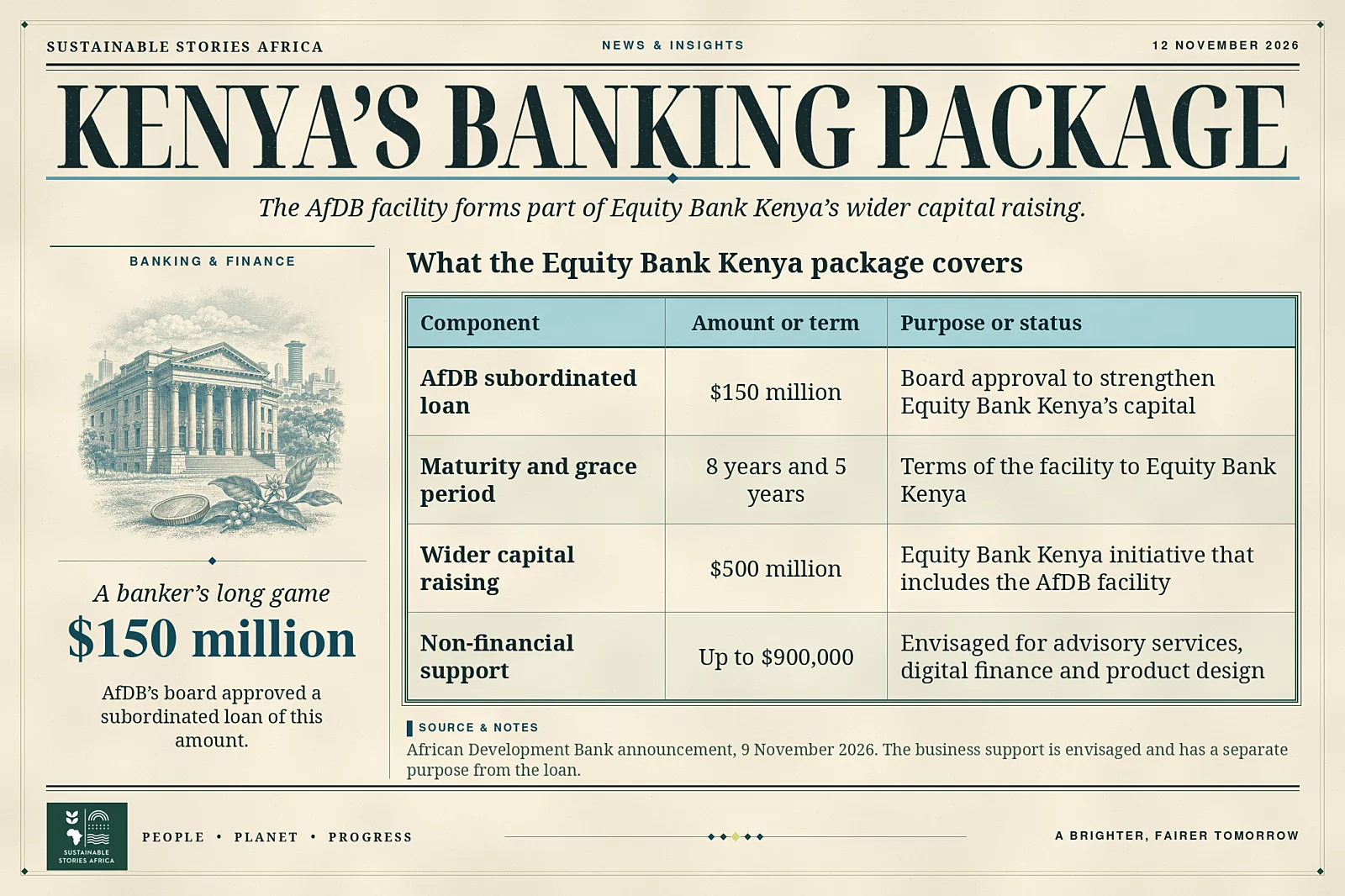
The African Development Bank Group has approved a $150 million subordinated loan to Equity Bank Kenya Limited to strengthen its capital base and expand financing for small and medium-sized enterprises.
- The board approved the facility on 30 October, and the AfDB announced it on 9 November.
- The loan has an eight-year term, including a five-year grace period, and forms part of Equity Bank Kenya’s wider $500 million capital-raising initiative.
The AfDB is lending to Equity Bank Kenya, which will make its own lending decisions for eligible businesses.
- Subordinated debt ranks behind senior debt for repayment if the borrower fails.
- The facility is intended to give the lender more room to extend long-term financing.
- Bank facilities have up to an eight-year maturity and grace period.
Entrepreneurs will need to assess the terms of the loans offered to their own businesses.
Priority sectors and proposed business support
The AfDB expects the financing to reach businesses in agriculture, manufacturing, trade, logistics and green sectors.
- It identifies women-led and youth-run enterprises as a priority.
Ahmed Attout, the AfDB’s director of financial sector development, said the operation aims to combine longer-term finance with practical support.
- The bank also envisages up to $900,000 through its SME Credit Catalyst Program for measures including advisory services, digital financing and products tailored to women and young entrepreneurs.
Longer repayment can support equipment investment
For a food processor, the time between buying equipment and collecting revenue may include installation, testing and negotiations with buyers.
- A longer repayment schedule can give the business space to put the machine into use and build a sales record.
- In agriculture, timing may also depend on harvests.
These terms matter to these businesses, including instalment dates, fees, collateral requirements, and the headline interest rate.
The proposed advisory support could help borrowers prepare financial records, estimate cash flow and judge whether a purchase is likely to generate enough income to service a loan.
Digital finance may also help businesses apply or track repayments.
- Its usefulness depends on whether smaller firms can meet the lender’s documentation requirements and whether entrepreneurs can obtain help when an online application cannot capture how their business operates.
The five-year grace period gives Equity Bank Kenya time before the facility moves beyond that stage.
- How it translates into loan products depends on the lender’s decisions about which businesses to reach and what repayment schedules to offer.
The AfDB describes the financing as part of the bank’s wider capital raising.
- The $500 million figure highlights the initiative’s size, while the $150 million is the specific commitment covered by the announcement.
The distinction also matters for measuring access.
- Growth in the bank’s overall SME portfolio would show that more credit is outstanding.
- Data on applications, approvals and loan sizes would help explain whether that growth comes from lending to more firms or from larger loans to businesses the bank already serves.
- The proposed advisory work gives the bank another way to observe where potential borrowers need help before they can qualify.
This feedback could inform how branches explain the application process or request evidence of business income.
Outcomes depend on who receives credit
The AfDB expects the operation to support jobs, productivity and investment in areas such as sustainable agriculture and renewable energy.
- These are expected results
Equity Bank Kenya’s reporting can show how the capital reaches firms by tracking disbursements, repayment terms and participation by women-led and youth-run enterprises.
- Information on first-time borrowers and businesses outside major commercial centres could show whether lending is expanding to firms with fewer financing options.
For firms that receive loans, the results can be tracked by what the credit pays for.
- A business that buys more efficient equipment may be able to report how much it saves in energy costs.
- Another may take on extra staff after increasing production.
Comparing these outcomes with repayment performance would help lenders assess whether the loans fit firms’ revenue cycles and whether the combination of financing and advice is working as intended.
Path Forward – Tracking Credit From Approval To Businesses
The next stage is for Equity Bank Kenya to turn the capital facility into financing that firms can use on workable terms.
Reporting on loans by sector and borrower group, together with updates on the proposed advisory support, would show how much of the programme reaches women-led and youth-run firms.