Gabon has signed agreements to sell about six million forest carbon credits to SEFE, a German state-owned energy company.
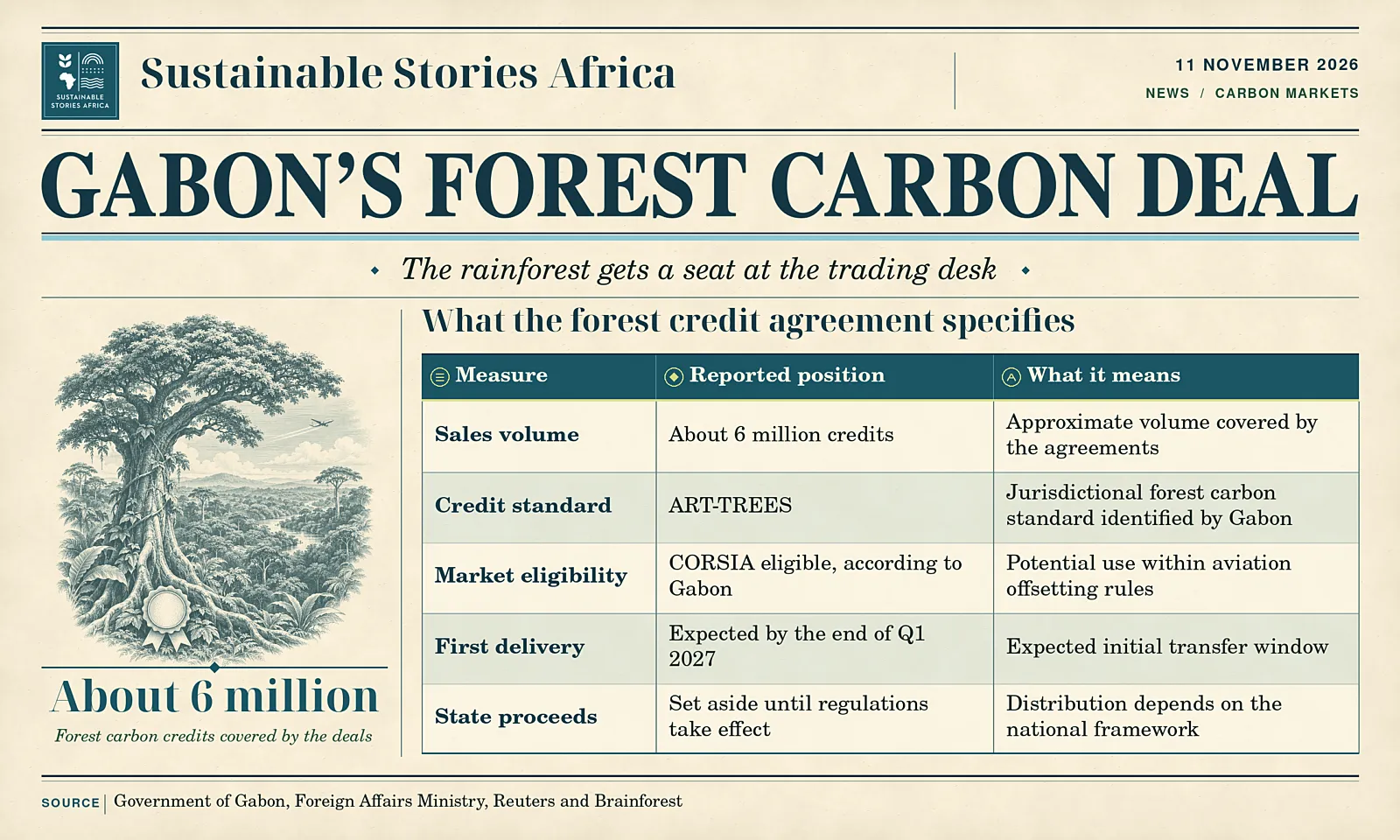
The first deliveries are expected by the end of the first quarter of 2027.
A national carbon market framework will determine how proceeds are managed and shared with affected communities.
A sovereign sale with benefits still to be defined
Gabon has agreed to sell about six million forest carbon credits to Securing Energy for Europe, (SEFE), the German state-owned energy company.
Gabon’s government announced the signing in London on 2 November and said the first deliveries were expected by the end of the first quarter of 2027.
- The government described the deal as an African first at this scale for sovereign credits linked to forest conservation.
The announced agreement concerns units representing emissions reductions.
- Gabon says the state retains authority over ownership and management of its forest estate.
- The government announcement did not disclose a price, and the sales volume cannot establish how much public revenue the deal will generate.
The national rules governing the use of state proceeds and the distribution of benefits remain under development.
What buyers and communities can verify
The government says the units meet ART’s Trees standard, a framework for crediting forest-related emissions results at jurisdictional scale, and are eligible under CORSIA, the international aviation offsetting scheme.
- Jurisdictional crediting assesses forest performance across a defined area rather than limiting the assessment to a single site.
- For a buyer, the practical questions include which units are delivered and what records support the right to use them.
Gabon’s green economy agency, AGADEV, represented the country in the transaction
- The government says proceeds due to the state will be set aside until the national regulatory framework enters into force.
- That framework is expected to specify how financial benefits are distributed, including the share intended for affected communities.
- The time between signing and delivery gives stakeholders a window to examine how those rules will work.
The Foreign Affairs Ministry reiterated the planned transaction in November, underlining the government’s focus on using forest conservation to generate revenue while retaining national control over the asset.
The timing of a delivery matters because credit sale agreements can be signed before a buyer receives any units.
- A public update could show how many units have been transferred, identify their vintage and explain which registry entries correspond to the deal.
This information would help observers distinguish agreed volume from delivered volume and assess the records supporting the credits’ claimed use.
A conservation incentive with a local test
Gabon points to its position with high forest cover and low deforestation.
- If the sale creates a dependable revenue source tied to credible forest performance, it could support activities that keep forests standing.
- The outcome will also depend on consistent future demand, how the credits are monitored and how proceeds reach the institutions and people involved in conservation.
Gabonese environmental organisation Brainforest welcomed the agreement while asking authorities to disclose prices and revenue arrangements, protect land and use rights, and make benefit sharing meaningful for Indigenous Peoples and local communities.
- Households that depend on forest access need to know how any programme affects that access and what participation entails.
The value of a payment also depends on when it arrives and whether the claims process is accessible.
From the signing to a traceable transfer
Publishing the regulatory framework would clarify which institutions manage revenues, how eligible communities are identified and how payment decisions can be challenged.
- Registry records can help verify issuance and transfers.
- Public reporting can also show how much money the state actually receives and which activities or communities it supports.
Other forest countries considering similar transactions will closely monitor Gabon’s experience.
- A useful record would follow the same deal from the underlying forest results through the delivery of credits to the distribution of proceeds.
- That would let communities, public authorities and market participants assess different parts of the transaction using the same disclosed evidence.
Benefit sharing will require choices about eligibility and representation.
- Forest communities may have different relationships to the same area, including customary access or livelihoods that cross administrative boundaries.
- Rules designed with these view differences can make the process easier to understand.
Brainforest’s call for recognised land and use rights gives the debate a specific focus as the national framework takes shape.
Path Forward – Forest Credit Revenues Await National Rules
The first delivery is expected by the end of March 2027.
Gabon still has to put its national carbon market framework into effect.
The terms, traceable transfers and clear rules for community benefit will determine how the agreement can be assessed over time.