Brazil’s COP30 Presidency says reforms could raise annual climate finance for developing countries to $1.27 – $1.41 trillion by 2035.
The assessment comes as COP31 gets underway in Antalya.
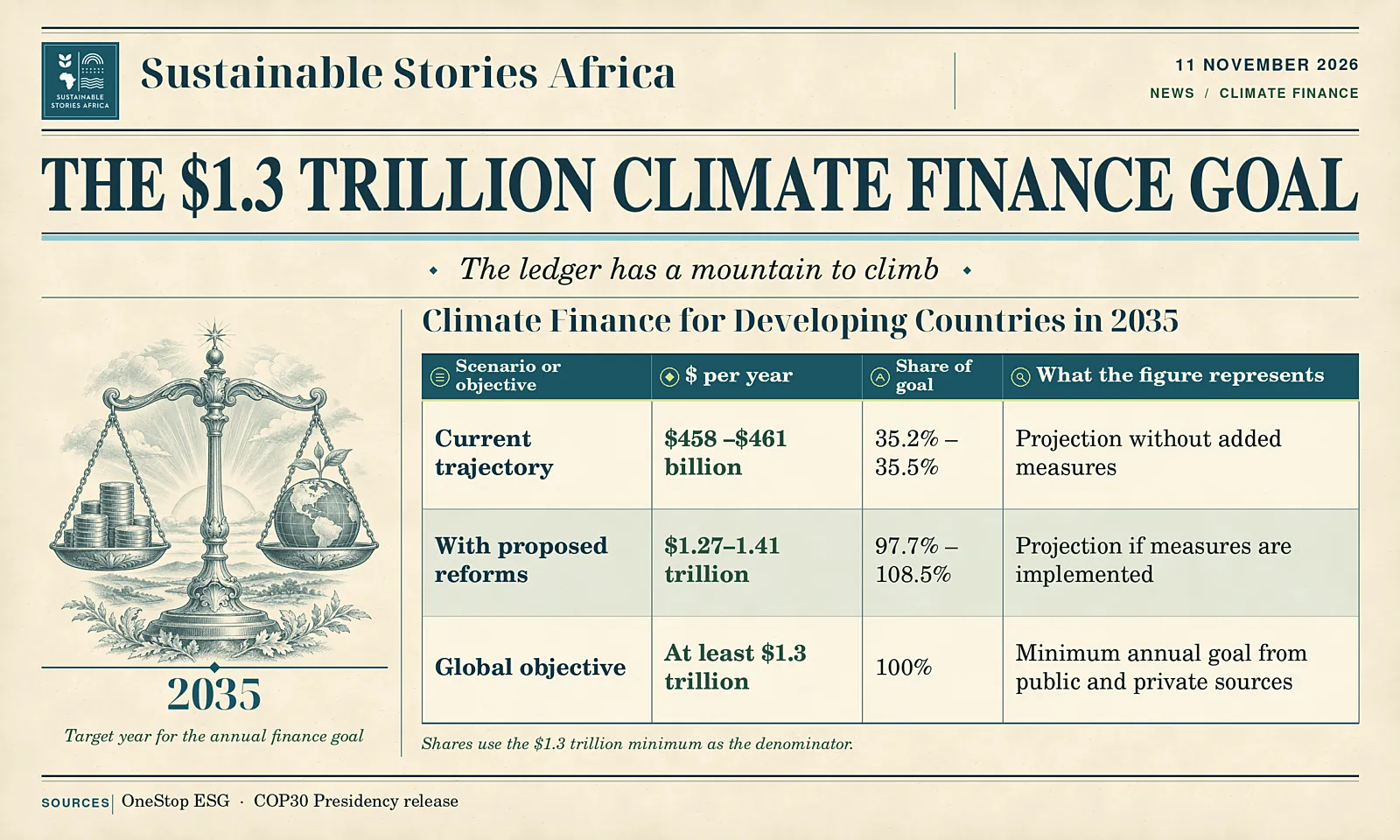
On current trends, the report projects only about $460 billion a year by 2035.
For African governments, the terms and timing of that funding could determine which flood- protection and clean energy projects go ahead.
A funding gap comes to Antalya
Brazil’s COP30 Presidency presented a plan in Antalya, Türkiye, on 8 November showing how annual international climate finance for developing countries could reach US$1.27 trillion to US$1.41 trillion by 2035.
- The report, covered by OneStop ESG on 10 November, estimates that without additional measures annual flows would reach just $458 billion to $461 billion.
- COP31 opened in Antalya on 9 November, a day after the presentation.
The report builds on the Baku to Belém Roadmap, presented by the COP29 and COP30 presidencies in November 2025.
- The $1.3 trillion annual objective draws on public and private sources.
- The COP29 decision also set a goal of at least $300 billion a year by 2035, with developed countries taking the lead and contributions drawn from a range of sources.
The new report offers a voluntary plan for reaching the broader objective.
Where the money could come from
The report identifies six channels for increasing flows.
- They include finance on more favourable terms than the market offers, private investment and cooperation among developing countries.
- The others propose redirecting Special Drawing Rights, an international reserve asset created by the International Monetary Fund, alongside innovative financing mechanisms and carbon markets.
Governments, development banks and investors would have to act for these channels to deliver the projected totals.
The original roadmap proposed more than 75 measures, including expanding access to grants and lower-cost finance, easing fiscal pressures and making it easier for private investors to fund climate projects.
The updated projections suggest what such changes could achieve.
- At the low end of the reform scenario, flows would still fall $30 billion short of the global objective.
- At the upper end, annual flows would exceed the minimum by $110 billion.
The current trajectory would leave an annual gap of $839 billion to $842 billion.
What affordable finance could change
Nigeria’s climate plan calls for national and subnational institutions to gain direct access to international climate funds and for the country to develop projects it can take to different sources of finance.
Nigeria’s adaptation communication also identifies drainage and flood control among state-level measures.
- A drainage upgrade can protect homes and keep roads to markets open during heavy rain, even when it produces little revenue to service a commercial loan.
- A grant could help pay for project design, and lower-cost finance could help cover construction where borrowing is affordable.
Revenue-generating clean energy projects can draw on a different mix.
- For example, a development-bank guarantee can help attract private lenders by covering specified risks.
The choice of instrument matters to governments with limited budget room.
- Expensive loans can leave less money for maintaining new infrastructure, while slow disbursements can push work past the season when protection is most needed.
- The national plan also calls for Nigeria to assess public and private financing options and implement a disaster risk finance strategy. For a state seeking funds, the implications are practical.
A project application can highlight who is exposed to flooding, what the upgrade will cost and how the state will pay for maintenance.
What funders can show at COP31?
The Presidency’s implementation framework links national investment plans with coalitions that can advance climate projects and with institutions that can finance them.
- COP30 President André Corrêa do Lago wrote in the report’s foreword that “the evidence exists, the instruments are known”.
- The Brazilian Presidency has scheduled climate finance discussions for 13 and 14 November, including on how to implement the roadmap.
Governments and development banks can use those sessions to identify projects ready for financing and outline who will fund them, on what terms and when money can be released.
- The proposed Climate Finance Action Compass would track how much finance flows, how quickly it moves, whom it reaches and what it achieves.
Publishing those measures alongside commitments would let communities and their representatives check whether approved funding is reaching projects and reducing climate risks.
Path Forward – From Funding Targets to Project Delivery
The roadmap calls for more grants and affordable finance, alongside reforms that bring private investment into projects suited to it.
Developing countries can use their climate plans to identify which projects need each kind of funding.
The Antalya discussions offer governments and lenders a chance to attach timelines and funding terms to those priorities.
In African markets, progress will show up in disbursements and in the protection that completed projects provide.