
The Leiden Declaration calls for transparent use of artificial intelligence in mathematics research.
Endorsed by the International Mathematical Union, it asks researchers to disclose tools, credit prior work and take responsibility for results.
Journals and funders must decide how to apply these principles without restricting access to research.
A declaration about who stands behind a proof
The Leiden Declaration on Artificial Intelligence and Mathematics asks researchers to disclose their use of automated tools and take responsibility for the accuracy of published work.
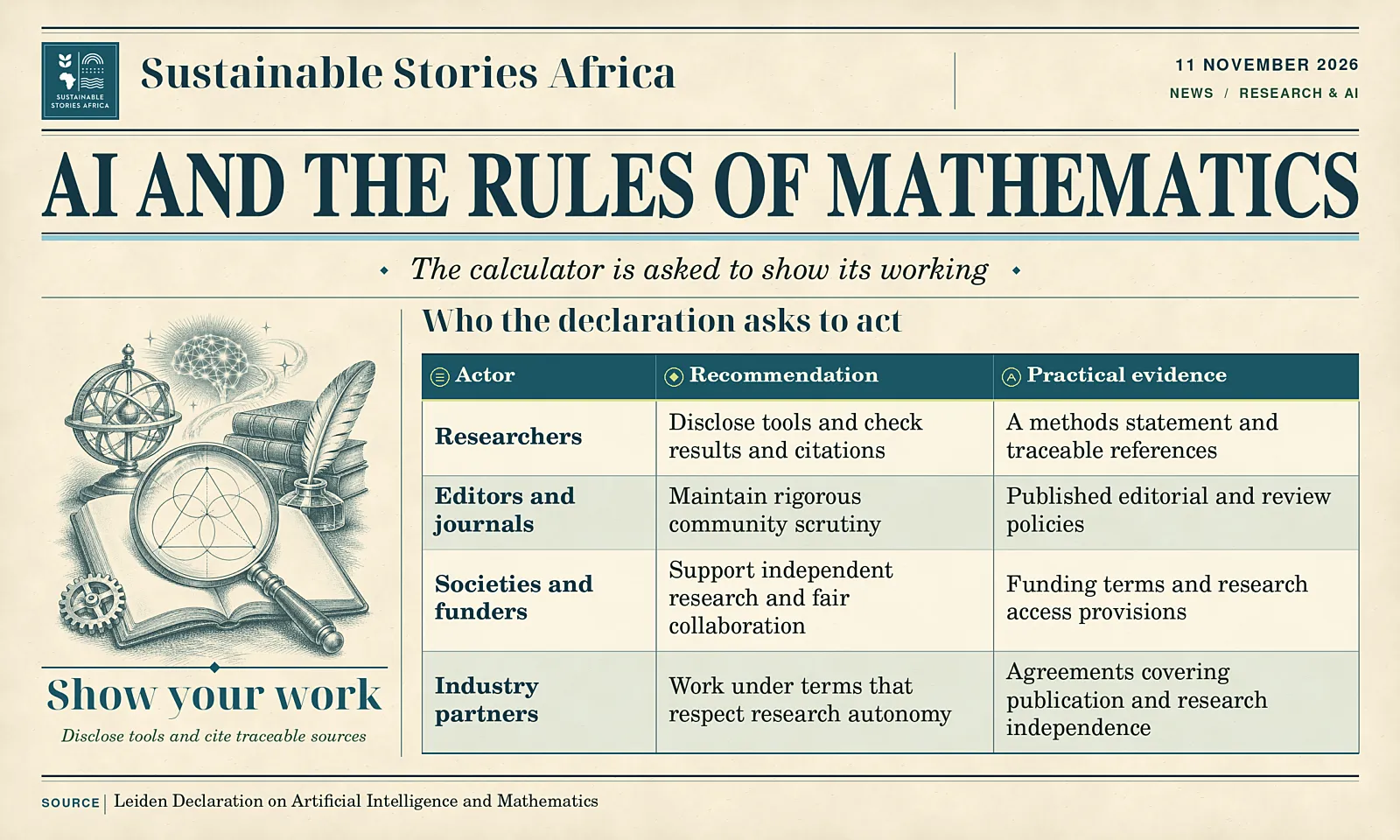
Dated 2 June 2026 and endorsed by the International Mathematical Union, it also sets out recommendations for journals, professional societies, research funders, governments and industry.
- This comes as systems can help generate or formalise mathematical arguments and researchers consider how to check and credit that work.
A proof tells readers why a result follows.
- When a tool helps produce an argument, reviewers still need to identify assumptions, trace the reasoning and see which prior results it relies on.
- The declaration supports disclosure that includes large language models and other automated or computational tools.
It also requires human authors to retain responsibility for correctness and reference accuracy.
Where AI puts pressure on review
A generated argument can read fluently while containing an error that takes time to detect.
- Formal verification can help when a proof is encoded in a way that a computer can check, but translating an argument into that form involves decisions about definitions and assumptions.
- The declaration asks authors to make reviewing easier through precise references, explanations of tool use and formal proofs where appropriate.
The authors also point to the risk of research announcements circulating before specialists have scrutinised them.
- A technical paper gives readers the material they need to evaluate a claim and trace earlier contributions.
- The International Mathematical Union’s September newsletter placed the Leiden initiative alongside other statements on AI and mathematics, including work by the Mathematical Union of Latin America and the Caribbean.
The debate is already taking different forms across research communities.
For a department writing its own guidance, the declaration offers a starting point.
- It leaves disciplines and institutions the room to decide how to apply the recommendations to their work.
The statement also links attribution to decisions about training material and licences.
- It encourages professional organisations to develop terms that protect authors’ rights and let authors opt out of particular uses.
- This places some responsibility with institutions that negotiate publication and access terms.
Individual researchers can improve their citations, while societies and publishers can address how the underlying literature is licensed.
Why access matters alongside verification
A department with limited access to proprietary tools may struggle to reproduce a result if the supporting materials depend on a subscription or infrastructure it cannot use.
- Open documentation and reusable verification materials can help researchers outside well-funded institutions evaluate and build on the work.
- The declaration encourages consideration of accessible or less resource-intensive tools and calls for independent research capacity.
Universities also have negotiating collaboration choices.
- A partnership can give researchers access to tools, data or computing time.
- Its terms can also affect what they may publish and whether others can inspect how a result was produced.
Universities and funders can protect autonomy by ensuring publication and verification rights are part of the discussion before research begins.
Making disclosure useful to reviewers
Editors can specify what information an AI disclosure should contain and how reviewers should handle material that may be confidential.
- Authors can document where a tool entered the workflow and what checks were performed on its output.
The clearer these requirements are explained, the easier it is for early-career researchers and small teams to meet them without guessing at journal expectations.
- Institutions can assess progress by looking at what researchers can reproduce independently and whether publication rules give reviewers enough information to identify errors.
- The declaration’s recommendations become practical when result assessments help people understand its origins, test its reasoning and credit the contributors whose work made it possible.
Research assessment creates another incentive.
- A hiring panel or funder can reward clear arguments, careful checking and useful supporting materials.
- If evaluations focus heavily on how many results someone produces, researchers may have less reason to spend time making those results independently verifiable.
The declaration asks institutions to preserve standards for evaluating depth and significance as the tools available to research groups change.
Path Forward – Keeping Mathematical Proof Open To Scrutiny
Journals and research organisations can put the declaration’s principles into practice through clear disclosure and review rules.
Universities and funders can verify and publish rights as part of collaboration agreements and support researchers who need access to the materials behind a result.