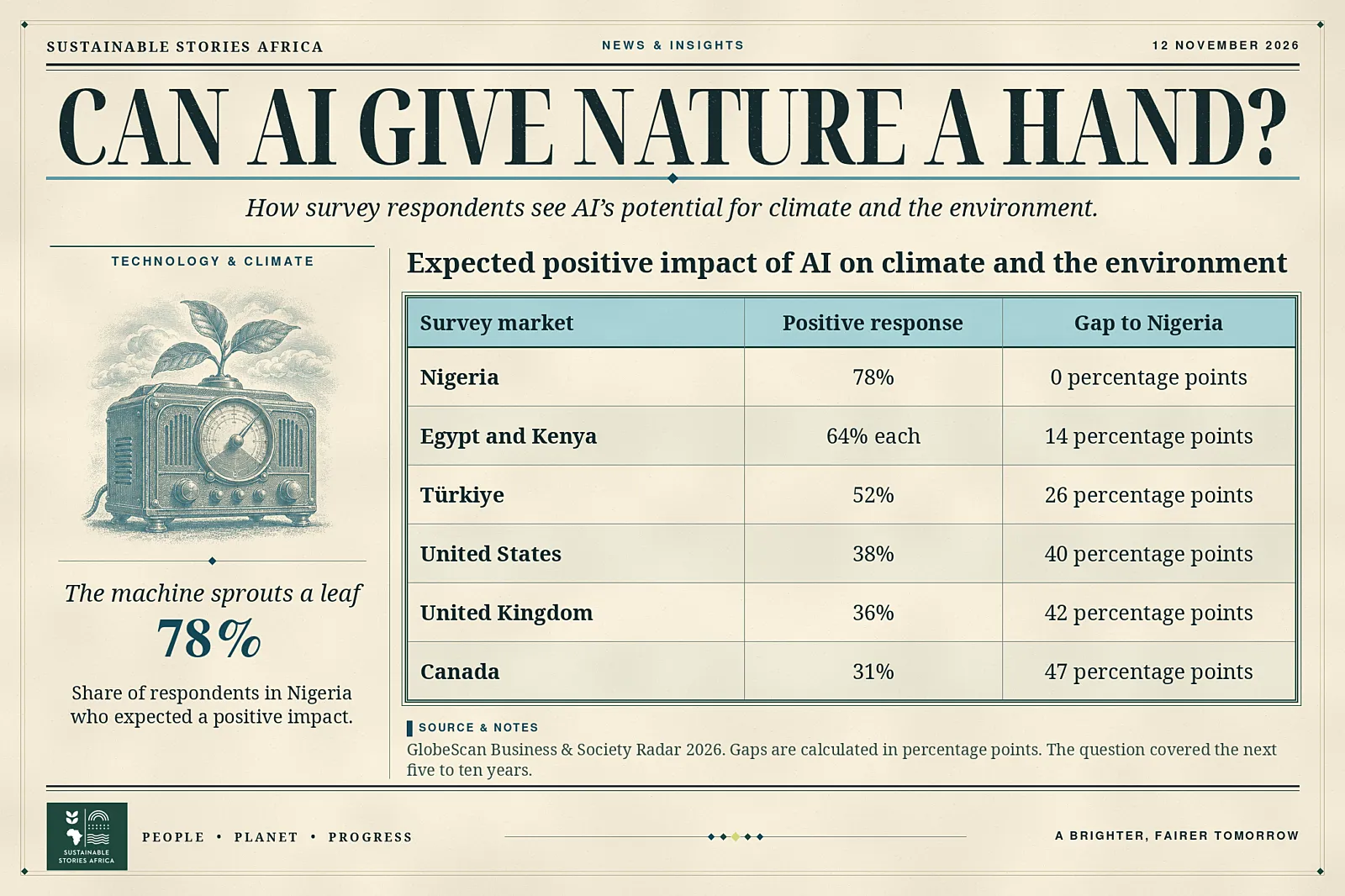
GlobeScan found that 78% of Nigerian respondents expect artificial intelligence to help address environmental problems and climate change over the next five to ten years.
In several European and North American markets, respondents were more sceptical. In the United States and Britain, views were nearly evenly split between positive and negative expectations.
The poll arrives as COP31 puts AI’s climate applications and resource demands on the same agenda.
A divided public weighs AI’s promise
Nigeria recorded the strongest positive expectations in GlobeScan’s 2026 survey of views on how artificial intelligence could affect the environment and climate.
- The research, published on 11 November as COP31 got underway in Türkiye, found that 78% of respondents in Nigeria expected a positive impact over the next five to ten years.
- Egypt and Kenya each recorded 64%, while 52% in the host country expected a positive impact.
GlobeScan found that across the markets used for its global average, roughly twice as many respondents expected AI to help as expected it to harm.
Views differed widely by country.
- In Canada, Italy, France and Sweden, the negative share exceeded the positive share.
- In the United States and United Kingdom, the two shares were separated by three percentage points.
The results capture expectations about what AI may do, a question distinct from how much climate benefit current systems have delivered.
What the survey captures
GlobeScan used representative online surveys across 34 countries and territories, generally reaching an average of 1,000 people in each market.
- Kenya and Nigeria had 500 respondents, while the United States and China each had 1,500. Global figures are averages of 33 markets.
- The infographic shows the share expecting a positive impact on the environment and climate.
The remaining respondents include people with neutral or other responses as well as those with negative expectations.
Climate uses face a resource test
The COP31 Presidency’s Antalya AI Pledge addresses how AI is designed, bought, powered and used to support climate and development goals.
- The Presidency has also proposed pilots in smart energy and green industry.
- An electricity utility might use a model to forecast demand and schedule equipment more efficiently.
Whether this cuts emissions depends on how much fuel or electricity the application saves and on the resources used to run it.
GlobeScan found greater concern when respondents were asked specifically about energy consumption.
- In North America and seven of nine European markets surveyed, more respondents expected an adverse effect than a positive one on energy use.
That concern has practical implications for communities hosting data centres.
Electricity demand can affect grid-connection planning, while cooling choices and local water availability can influence the burden a facility places on water supplies.
Measuring benefits at the project level
A pilot can make its climate claims testable by defining what it aims to improve and measuring performance against the previous approach.
- For an energy forecasting tool, that might mean recording whether the utility burns less fuel or needs fewer emergency purchases.
- Operators can report the electricity and water associated with the system alongside the benefit.
This gives regulators and communities a way to assess the full effect of an application where it is used.
The survey also gives policymakers a reason to consult locally.
- A national figure cannot show how residents of a proposed data centre site feel about competing demands on their grid or water supply.
- Asking communities about siting, resource use and oversight can surface concerns that a general question about AI and climate would miss.
Reporting these discussions and the conditions attached to permits can show how authorities respond.
Public opinion can matter at two different points in a project.
- The first is when a government or company seeks permission to build the infrastructure.
- The second is when an agency asks people to rely on an AI tool, for example, to act on an early warning.
Residents may see value in the application while asking for clearer rules on the infrastructure that supports it.
- An environmental assessment and a public consultation give these questions a place in the decision.
The poll also highlights why one average offers limited guidance for a summit with countries at different stages of adoption.
- Differences between Nigeria, Egypt and Kenya are visible even among three markets with majorities expecting benefits.
- A climate tool will be judged on whether it helps people to make decisions, and whether its cost and resource use fit the setting in which it operates.
Local pilots can supply this evidence.
Path Forward – Measuring Climate Benefits And Resource Costs
The Antalya pledge and planned pilots give governments and companies a chance to define how they will measure AI’s environmental performance.
For communities and regulators, comparable figures on electricity, water and verified climate outcomes would make it easier to assess whether deployments deliver the benefits their sponsors claim.