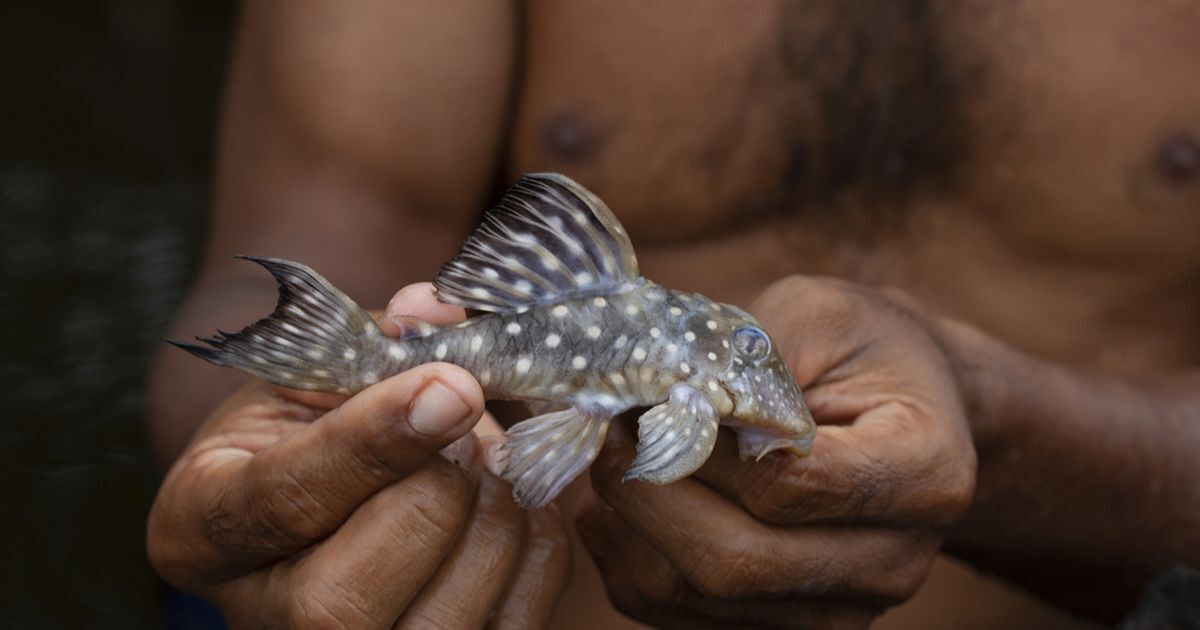
The attached Amazon Forgotten Fishes report warns that policy alone cannot protect freshwater biodiversity.
Dams, habitat loss, pollution, fishing pressure and climate change are interacting across a river system that supports food, income and culture.
Its wider lesson for African development is to assess connected ecosystems and cumulative impacts before infrastructure and land-use decisions become irreversible.
The forest depends on life below water
Protecting the Amazon requires safeguarding its connected rivers and floodplains, not only its standing forests, according to Amazon Forgotten Fishes.
- The report describes a freshwater system in which fish sustain food supplies, livelihoods, cultural identity and ecological processes, while facing pressures that reinforce one another across national boundaries.
The scale of biodiversity needs careful definition.
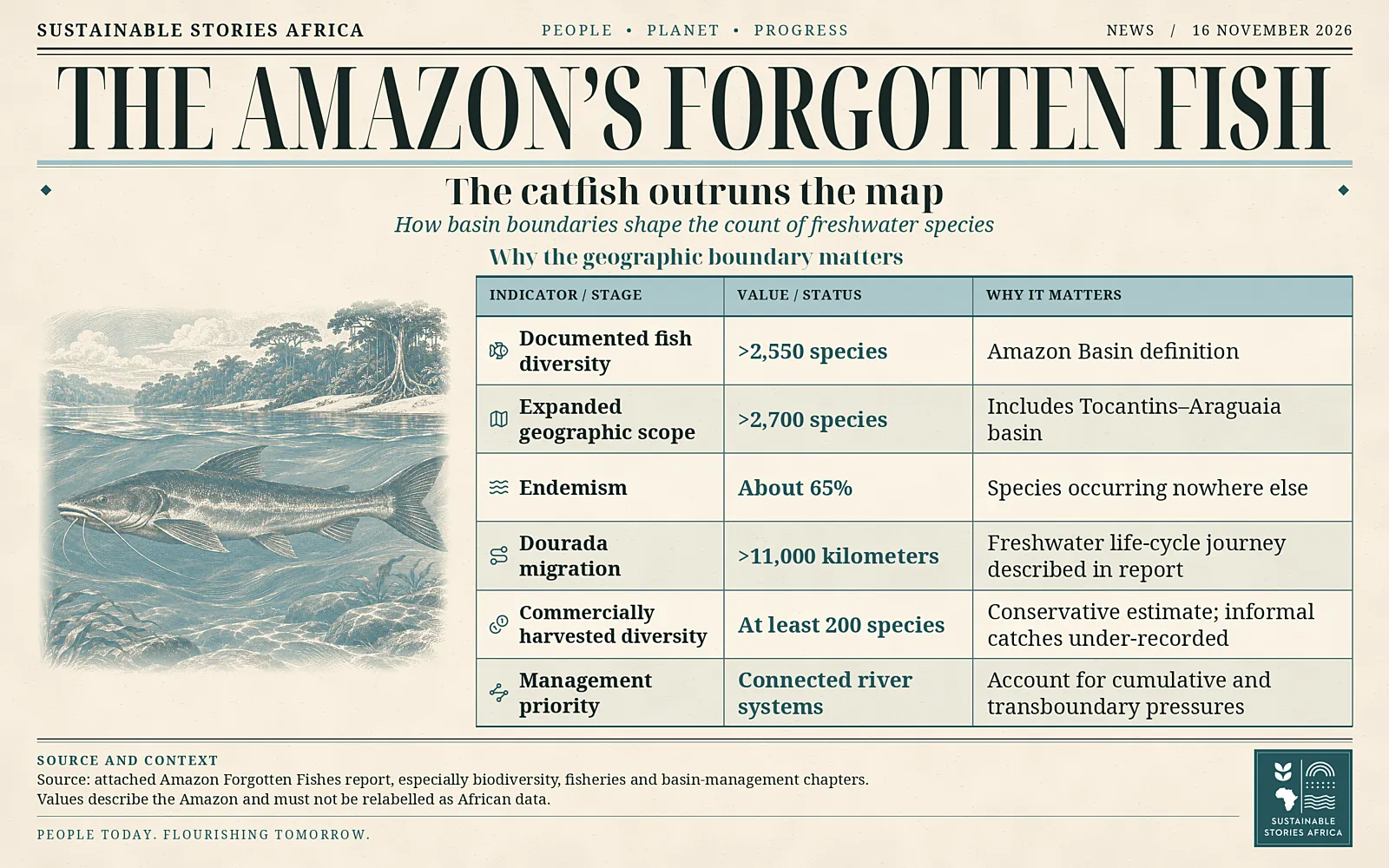
- More than 2,550 freshwater fish species have been documented in the Amazon Basin.
- The figure rises above 2,700 when the Tocantins–Araguaia basin is included.
- The report says roughly 65% of Amazonian fishes are endemic, meaning they occur nowhere else.
Presenting a single species total without its geographic boundary would obscure an important distinction.
Fish connect rivers, forests and communities
The report illustrates the system’s interdependence through fruit-eating fish such as tambaqui.
- During seasonal flooding, fish feed in inundated forests and disperse seeds, helping forests regenerate.
- Forests, in turn, provide food and habitat for fish.
Degradation can therefore weaken both sides of a relationship that links terrestrial and freshwater conservation.
Connectivity also operates over extraordinary distances.
- The dourada, a migratory catfish, can travel more than 11,000 kilometres over its freshwater life cycle.
- Such journeys depend on connections between distant spawning and nursery areas.
- A barrier in one part of the system can affect fisheries and habitats far beyond the infrastructure location
The report also exposes a monitoring problem.
- At least 200 species are commercially harvested, but informal and subsistence catches are incompletely captured.
- Older basin-wide landing datasets and more recent national figures have different geographic coverage and methods.
- They should not be combined into an apparently precise current production total.
- The information gap makes the fisheries’ economic and nutritional contribution easier to overlook.
Conservation must protect food and agency
The report’s account is not only about species.
- Fish provide nutrients and affordable food, while fisheries support fishers, processors, traders and vendors.
- Women have important roles across those activities.
Protecting freshwater habitats is therefore linked with food security and economic participation, rather than being a conservation objective separate from daily life.
Community management shows what can work.
- The report describes the recovery of pirarucu populations in some areas through measures including protected reserves, fishing controls and local management.
- It also stresses Indigenous knowledge and territorial rights, arguing that effective conservation must recognise the people who understand and govern these waters.
These examples should not be generalised into a claim that recovery has occurred everywhere.
For African readers, the useful connection is methodological, not a direct transfer of Amazon statistics.
- Assess river systems as connected ecological and livelihood networks, with attention to cumulative impacts and local knowledge.
- The report’s evidence is Amazon-specific; it does not quantify conditions in African fisheries.
The development question is whether infrastructure, land-use and conservation policies recognise the full service provided by a functioning river.
A project-level assessment may miss the larger system if it examines each intervention in isolation.
Plan across borders and pressures
The report calls for coordinated basin management that addresses dams, mining, deforestation, pollution, fishing pressure and climate change together.
- Its proposed response includes more natural flow regimes, protected and restored habitats, better monitoring, stronger community governance and integration of freshwater priorities into development and environmental commitments.
It also describes a regional action plan for dourada and piramutaba, endorsed under the Convention on Migratory Species in 2026.
- The plan focuses on habitat protection, shared knowledge, connectivity, sustainable value chains and policy coordination.
- Endorsement is an institutional milestone, not evidence that migratory populations have already recovered.
Development banks and public agencies should therefore examine cumulative and transboundary effects before financing infrastructure.
- Fisheries monitoring should include community knowledge and recognise the limits of official landings data.
- Conservation funding should explicitly account for freshwater ecosystems rather than assuming forest protection automatically secures the rivers within them.
For Africa’s sustainability debate, the report provides a clear caution: development decisions can affect ecological relationships beyond administrative boundaries.
Good governance must see these relationships before investment locks in damage.
Path Forward – Keep Rivers Connected And Communities Empowered
The Amazon report calls for basin-wide cooperation, stronger freshwater monitoring and conservation grounded in Indigenous and local stewardship.
Infrastructure planning must account for cumulative impacts and migration routes.
For African institutions, the transferable lesson is to integrate river connectivity, food security and community rights into development decisions, without treating Amazonian evidence as a substitute for local research.