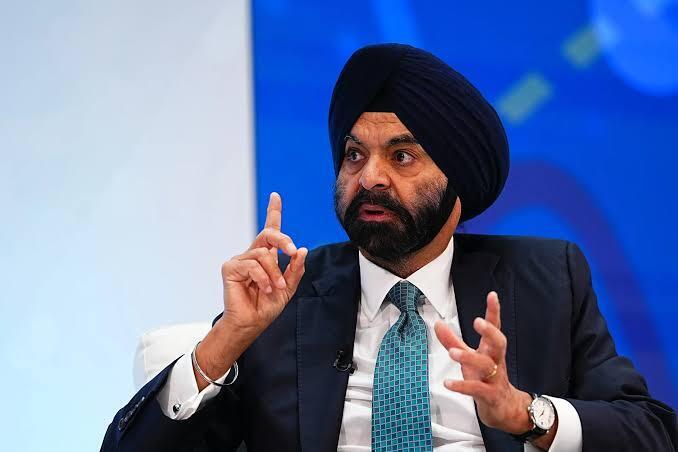
World Bank Group President Ajay Banga has set out a bigger role for private capital in financing development and climate priorities.
Speaking at COP31, he reported stronger mobilisation but acknowledged that investment growth was not reaching the poorest markets evenly.
For Africa, the challenge is converting global financial capacity into affordable infrastructure, resilient livelihoods and lasting jobs.
A larger pool, an uneven reach
The World Bank Group’s expansion of private-capital mobilisation is exposing a difficult divide: more investment is flowing through the institution, but the poorest countries are not sharing evenly in that growth.
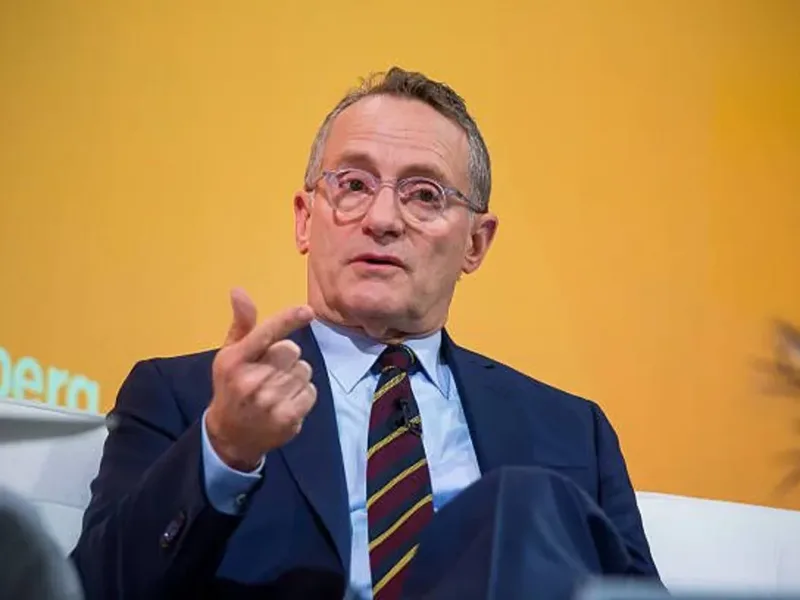
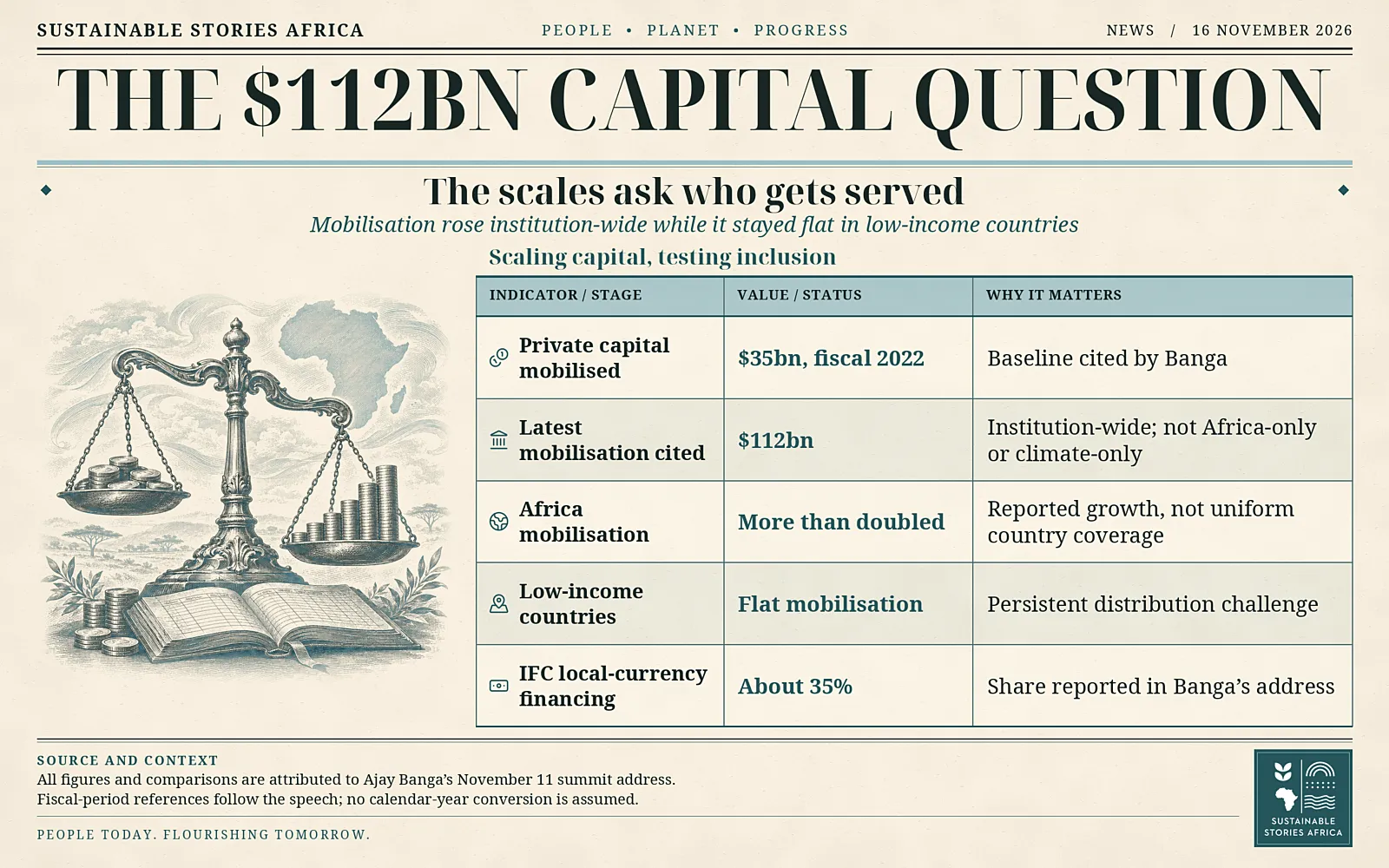
At the Global Finance Summit at COP31 on November 11, President Ajay Banga said mobilisation had reached US$112 billion, compared with US$35 billion in fiscal 2022.
Banga said mobilisation had more than doubled across Africa; however, it remained flat in low-income countries.
- These categories overlap but are not interchangeable.
His assessment points to a central challenge for African development: a continent-wide increase can coexist with persistent exclusion in the markets where financing constraints are most severe.
Public resources remain especially important in those settings, he said.
Rewriting how development finance reaches investors
The summit brought together government, development-bank, business and financial leaders around investment in clean industry, electrification, resilience and the energy transition.
- Banga framed the financing challenge around expanding employment needs and constrained government budgets, arguing for a country-led combination of public finance, private investment, philanthropy and technology.
His proposed response starts before a transaction reaches investors.
- Predictable rules, stronger institutions, physical infrastructure and human capital should make businesses more willing and able to invest.
- Guarantees can then address risks outside investors’ control, while local-currency finance can reduce exposure to exchange-rate movements.
- Banga said annual guarantee additions had increased to $25 billion and that around 35% of IFC financing was being provided in local currency.
The next proposed shift is to develop investments for eventual transfer to other investors, rather than holding every asset throughout its life.
- Banga said the World Bank Group and six other development banks were working on common approaches to assessment, documentation, packaging and transfer.
- The aim is to make development investments more accessible to long-term institutional capital and free development-bank capacity for further projects.
More investment must mean broader opportunity
For African economies, the attraction is not financial engineering for its own sake.
- Better access to long-term capital could support electricity, transport, agribusiness and other productive sectors.
- Banga identified infrastructure and energy, agribusiness, healthcare, tourism and value-added manufacturing as priority areas, placing smaller businesses and employment at the centre of the development case.
The summit also linked climate investment with industrial competitiveness.
Türkiye’s Treasury and Finance Minister Mehmet Şimşek described reducing reliance on imported energy as an economic objective alongside decarbonisation.
- The relevance for African policymakers lies in the relationship between energy supply, industrial costs and external vulnerability, rather than in copying another country’s investment plan without adapting it.
However, a larger mobilisation total does not itself show whether services have become affordable, projects have been completed or local firms have gained business.
- These outcomes require separate measurement.
Banga’s acknowledgement of flat mobilisation in low-income countries makes distribution an essential test of the model, not a secondary concern.
Pair investment scale with public accountability
Governments and development partners should make national investment priorities visible, prepare credible projects and identify the specific barriers preventing financing.
- Banga’s address supports a sequence in which policy and institutional capacity create the conditions for investment, rather than leaving guarantees to compensate for every underlying weakness.
Public support also needs a clear development rationale.
- Where guarantees or concessional resources help a project proceed, the relevant questions include whether support lowers financing costs, improves service quality or enables investment that would otherwise not occur.
- These are accountability questions arising from the summit’s proposed model, not benefits that should be assumed in advance.
A more mature financing system would report capital mobilisation alongside completion, affordability, employment and geographic reach.
- It would also retain grant and public-finance channels for essential services in markets unable to attract commercial investment.
- Banga’s own assessment recognises that private capital cannot replace public resources everywhere.
This is especially important when comparing markets at different stages of development.
- The relevant benchmark is not whether every country attracts the same financial structure, but whether the mix of public and private resources fits its needs.
Inclusion requires attention to markets that remain commercially difficult, not only expansion where transactions are already easier.
Path Forward – Make Capital Reach The Hardest Markets
The next test is whether a larger mobilisation platform can reach countries and communities still excluded from investment growth.
Country-led planning, local-currency solutions and well-targeted guarantees should support that effort.
For African governments, success should mean reliable services, stronger businesses and manageable public obligations.
Mobilisation is an important financing measure; inclusive development remains the outcome that matters.