International finance focused specifically on biodiversity reached US$18.9 billion in 2024, according to the 2026 Biodiversity Finance Trends Dashboard.
A broader category reached $34.2 billion, but the two measures overlap and must not be added together.
For African countries seeking nature investment, the findings show progress while reinforcing the need for clear definitions, accessible funding and implementation.
Nature finance rises, definitions matter
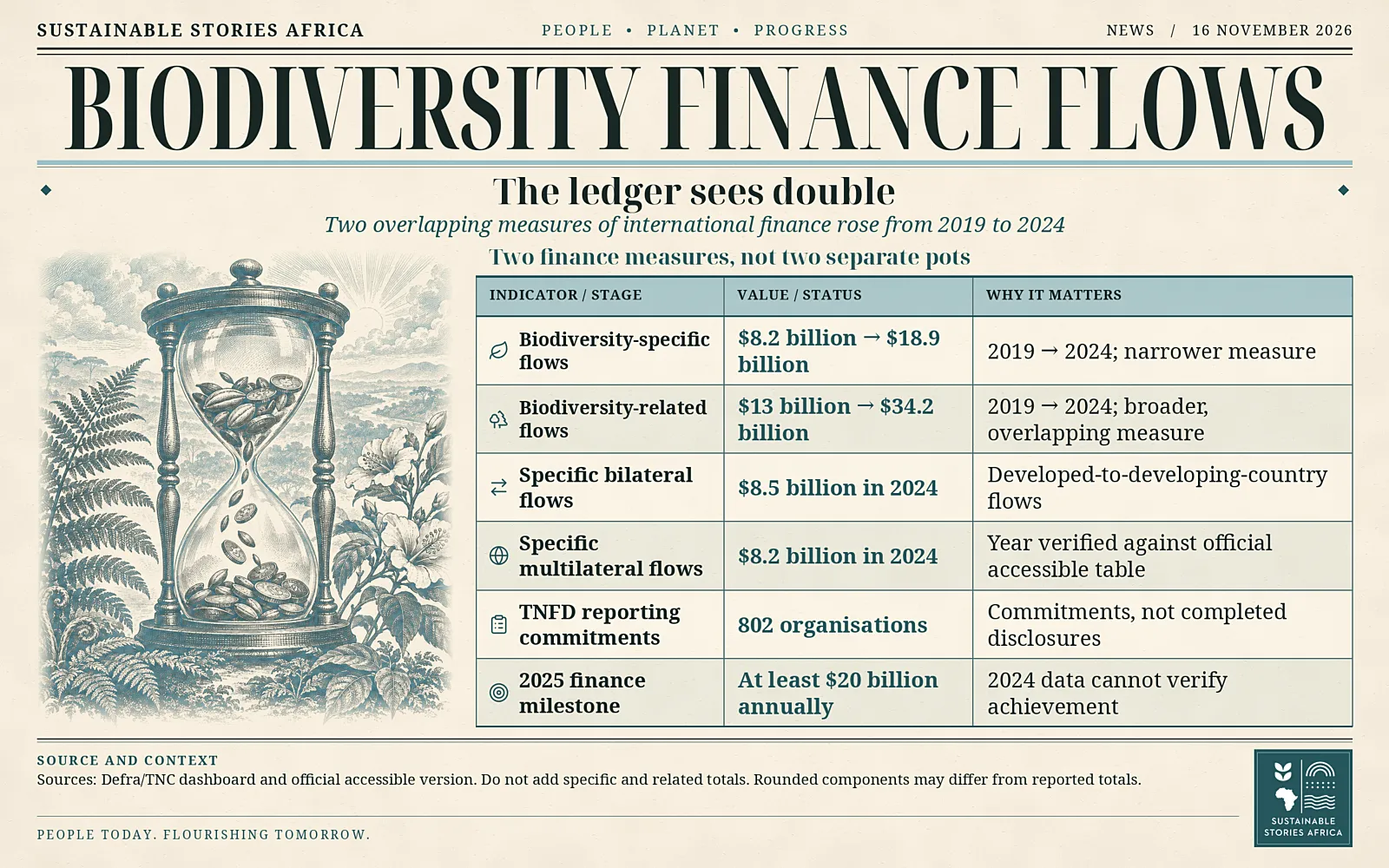
Finance flowing from developed to developing countries specifically for biodiversity reached $18.9 billion in 2024, up from $8.2 billion in 2019, according to the 2026 Biodiversity Finance Trends Dashboard.
- The broader biodiversity-related measure rose to $34.2 billion from $13 billion over the same period.
The difference is consequential.
- Biodiversity-specific finance is narrower than biodiversity-related finance, which includes activity where biodiversity is one of several objectives.
- The figures are not separate pots to be added together.
For African policymakers, financiers and civil society, the dashboard shows growing support; however, it reminds us that finance classification can change the apparent scale of progress.
Development flows strengthen, but data lag
The dashboard is a joint initiative of the UK Department for Environment, Food and Rural Affairs and The Nature Conservancy.
- Its 2026 edition compiles the latest available information against finance-related targets from the Kunming–Montreal Global Biodiversity Framework.
- Much of the international flow data relates to 2024, despite the dashboard’s 2026 publication date.
In the biodiversity-specific category, developed-country bilateral flows amounted to $8.5 billion in 2024 and multilateral flows to $8.2 billion
- Private finance mobilised through public finance reached $1.9 billion, while private philanthropy accounted for $0.3 billion.
- The reported total is $18.9 billion; individual rounded components need not sum precisely to that total.
The framework includes an international finance objective of at least $20 billion annually by 2025 and $30 billion by 2030.
- However, the dashboard’s 2024 observations cannot establish whether the 2025 milestone was achieved.
- Nor should the broader $34.2 billion measure be used without explanation to claim that the narrower finance challenge has been resolved.
The series should remain visible together, with their different definitions attached.
Connect financial progress with practical access
The dashboard records activity beyond international flows.
- The Global Biodiversity Framework Fund had programmed $362.1 million for 82 projects in 87 countries following five selection rounds since February 2024.
- It also reports that 41 countries had completed national biodiversity finance plans and 130 had formally begun developing one.
- These are distinct measures of programming and planning, not evidence of equivalent expenditure or ecological results.
Corporate attention is also increasing.
- About 802 organisations from more than 56 countries or regions had committed to report in line with the Taskforce on Nature-related Financial Disclosures recommendations, compared with 620 in 2025.
- A reporting commitment is a step towards transparency; it is not itself a completed disclosure or a verified reduction in nature-related harm.
For African institutions, the opportunity is to link these channels: national plans can identify priorities, public finance can support implementation, and corporate assessment can reveal dependencies and investment needs.
- However, the dashboard does not provide an Africa-specific allocation total, so its global figures should not be presented as money already reaching African projects.
The development value lies in whether finance becomes accessible for credible programmes and produces results that communities and public institutions can verify.
Count consistently and reform incentives
The dashboard also tracks the policy environment.
- It reports that 39 countries and territories had worked with BIOFIN to complete national assessments of harmful subsidies, while 16 countries and two regions were conducting assessments.
The global framework calls for reducing harmful incentives by at least$500 billion annually by 2030.
African finance and environment ministries should therefore connect biodiversity plans with budget decisions, investment pipelines and transparent funding classifications.
- Publishing both commitments and disbursements would make delivery easier to assess.
- Reporting should also identify whether finance is a grant, a loan or another instrument, rather than letting resources disappear into a single total.
The dashboard’s central value is accountability across several stages of progress.
- A plan, a reporting commitment, programmed funding and an ecological outcome each answer a different question.
- Keeping these categories separate makes the growth story more credible and gives decision-makers a clearer view of what remains to be done.
Such discipline would also prevent the dashboard’s different indicators from being mistaken for a single, comparable measure of success across every stage of delivery.
Path Forward – Count Finance Clearly Then Deliver Outcomes
Growing international flows provide a stronger base for nature investment, but transparent definitions and timely reporting remain essential.
African institutions should connect national priorities with accessible finance and measurable implementation.
The next test is not simply a larger headline total.
It is whether money reaches credible programmes while harmful incentives are reformed and nature-related commitments become verifiable action