
A new mid-decade assessment argues that nature finance must move beyond isolated successes towards implementation at scale.
The report links a substantial financing shortfall with harmful incentives, weak investment pipelines and incomplete recognition of ecosystem value.
For African markets, financial instruments work best when public policy rewards protection and communities share in the benefits.
More money cannot offset every harmful incentive
Governments need to change the economic incentives driving nature loss, not rely on financial innovation alone, according to Financing Nature: A Mid-Decade Update.
The report, produced by the Paulson Institute, The Nature Conservancy and World Wildlife Fund, argues that successful models now need to become standard practice across public policy and investment.
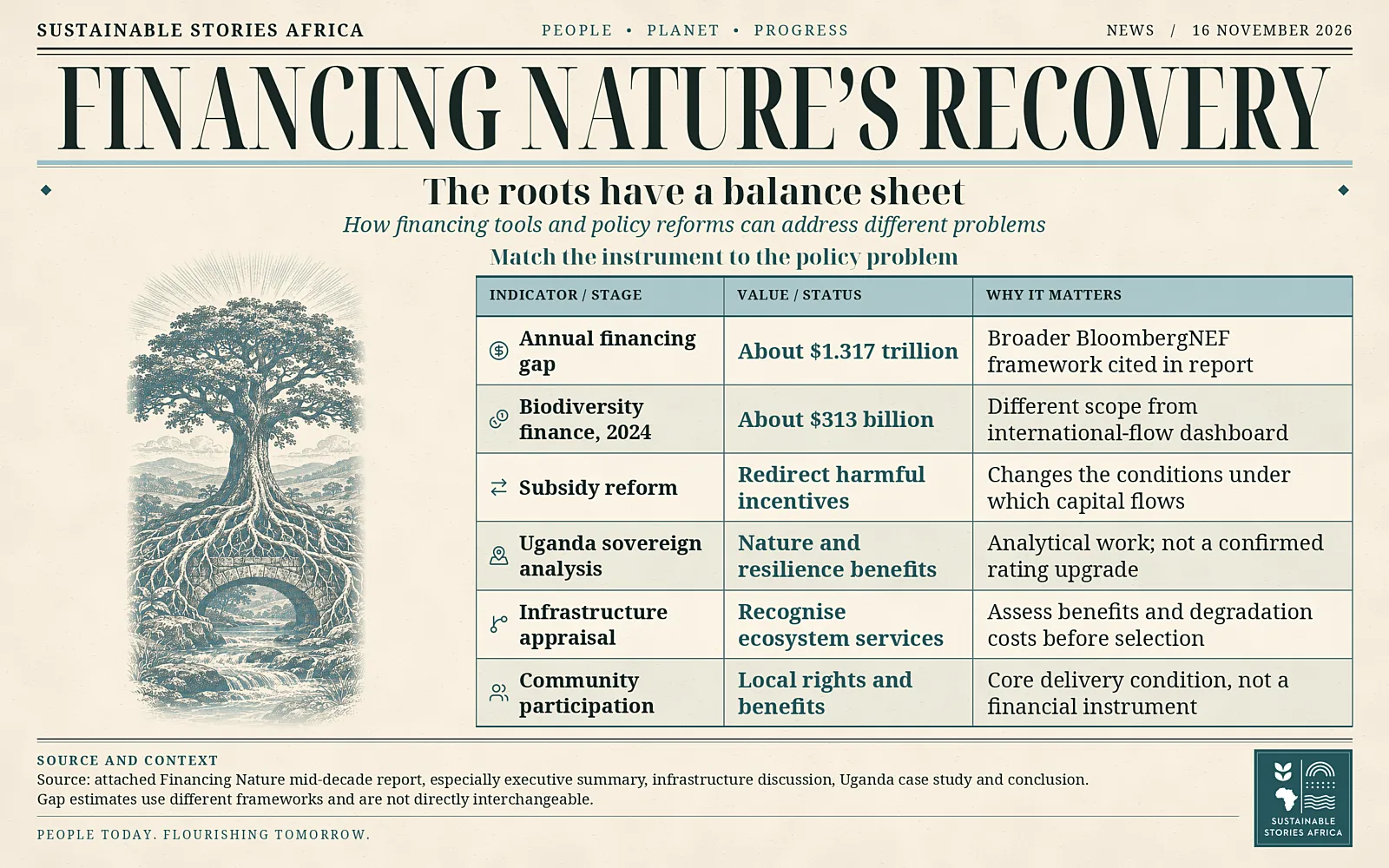
The assessment cites BloombergNEF’s broader estimate of a $1.317 trillion annual biodiversity financing gap, alongside approximately $313 billion in biodiversity finance in 2024.
- That gap should not be compared mechanically with the approximately $711 billion estimate in the original 2020 report: the newer framework is broader, and also affected by inflation.
A larger number does not establish a like-for-like doubling.
The financing toolkit has outgrown its scale
The report reviews public finance, capital markets, sovereign financing, supply chains, technology and community-led conservation.
- Its recurring argument is that tools exist, but the enabling conditions remain insufficient.
- Reliable revenues, credible regulation, preparation capacity and risk sharing are needed for ecological benefits to become investments that mainstream finance can support.
Its recommendations extend beyond raising new funds.
- Governments should review harmful subsidies, integrate nature into infrastructure planning and make ecosystem services visible in project appraisal.
- Development banks should strengthen safeguards, support preparation and adopt clearer nature-finance objectives.
The authors argue that finance cannot compensate indefinitely for policies that continue to reward degradation.
African examples make that relationship tangible.
- The report describes watershed restoration supporting Cape Town’s water security and a Ugandan effort to incorporate nature and resilience investment into sovereign risk analysis.
These examples address different problems, but both challenge treating functioning ecosystems as an environmental extra rather than part of an economy’s productive base.
Treat ecosystems as assets that support development
Uganda’s work is particularly relevant to finance ministries.
- Its Ministry of Finance, Planning and Economic Development is examining how agroforestry, forestry and sustainable land management can affect growth, fiscal performance and debt dynamics.
- The report describes an effort to make the benefits of resilience more visible within debt-sustainability and sovereign-credit discussions.
It does not establish that the exercise has already secured a sovereign rating upgrade.
The report also argues for treating ecosystems as infrastructure.
- A watershed, wetland or coastal ecosystem can provide services relevant to water security and resilience, while poorly planned conventional infrastructure can damage those same services.
- Making both sides visible in appraisal changes the decision before money is committed, instead of treating biodiversity only as a safeguard after a project has been selected.
This approach lets African institutions link conservation with development priorities without claiming that every ecosystem can produce a commercial return.
- Some benefits remain public goods requiring public or philanthropic support.
- The report’s emphasis on incentives and credible revenue models recognises that private capital needs more than a persuasive account of nature’s importance.
Community participation is equally central.
- The authors argue that conservation models are more durable when local people participate and benefit, rather than allow protection costs while financial value accrues elsewhere.
Make nature visible before investment decisions
Finance ministries should start by linking biodiversity priorities with budgets, debt strategies, public investment and incentive reform.
- The report recommends turning national plans into costed pipelines and choosing instruments appropriate to the underlying investment, rather than treating every conservation need as a candidate for the same financing product.
Its sovereign-finance examples also underline the importance of distinguishing transaction size from conservation proceeds.
- A debt conversion can refinance a large amount while directing a smaller, specifically governed funding stream towards nature.
- Reporting should identify expected savings, conservation allocations, time periods and verification arrangements separately.
For infrastructure and energy programmes, the immediate priority is to assess biodiversity impacts early enough to avoid unnecessary damage.
For investors, it is to test the credibility of revenues, baselines, safeguards and performance measures.
For governments, it is to stop allowing harmful incentives to work against the finance being mobilised for protection.
- The report’s strongest practical message is that scaling nature finance requires a change in normal decision-making.
More instruments help, but implementation depends on institutions consistently valuing the natural systems that economic activity already uses.
Path Forward – Make Nature Central To Economic Decisions
African governments can connect nature finance with fiscal strategy, infrastructure planning and investment preparation.
Development partners and investors should support credible pipelines, transparent risk sharing and community participation.
The priority is to scale proven approaches while reforming incentives that drive degradation.
Financial innovation should reinforce that policy shift, rather than a substitute.