World Bank Group officials and financial institutions have highlighted guarantees, stronger project preparation and investment partnerships as routes to mobilising private capital for climate and development.
At COP31, speakers said available capital often struggles to reach projects constrained by regulatory uncertainty, currency exposure and limited lending capacity.
For African markets, the discussion underlined the importance of linking financing structures with credible national priorities, viable projects and measurable development outcomes.
Moving capital beyond climate promises
The World Bank Group has highlighted guarantees, investment partnerships and changes to its financing model as central to expanding private investment in climate and development, as commercial lenders warned that worthwhile projects still struggle to secure funding.
Speaking at a COP31 session published on 12 November, Ariane Di Iorio, economics and sustainability director at the Multilateral Investment Guarantee Agency, said the Group had achieved $112 billion in mobilisation “this year”.
- She said its guarantee platform had reached $25 billion, exceeding a stated $20 billion target for 2030.
The central issue was practical: how to turn development priorities into investments that lenders can finance and communities can benefit from.
Why good projects remain unfunded
“There is capital available,” said BBVA executive Marisa Pardo Menéndez.
- “But the challenge we face is how we can mobilise it.”
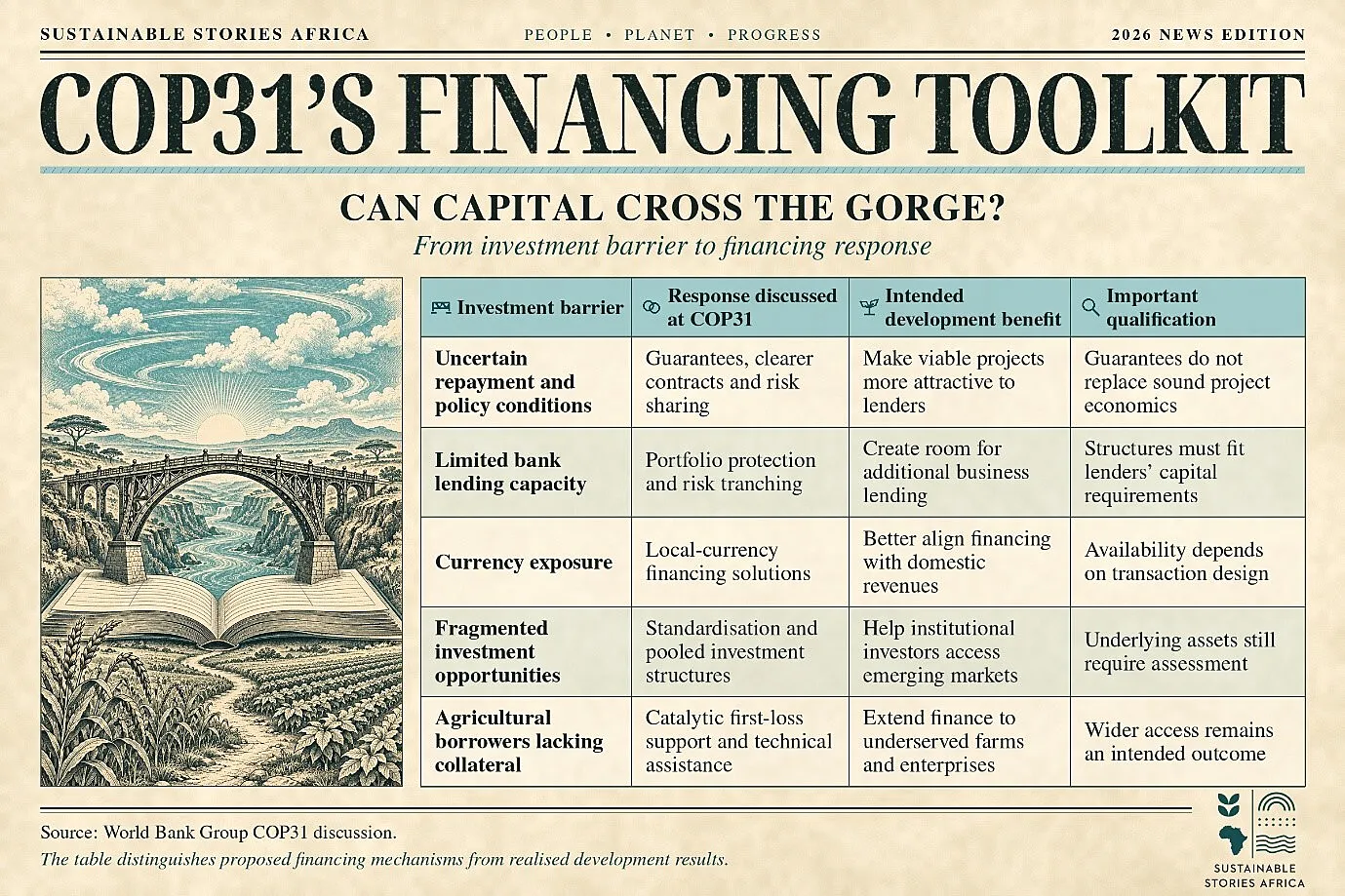
- She identified uncertain cash flows, legal and regulatory uncertainty, and currency risk as barriers commercial banks cannot always manage alone.
Her distinction between development value and financial viability framed the discussion.
- A project may address an urgent public need without offering sufficiently clear revenues, repayment arrangements or contracts to attract commercial financing.
“Unfortunately, a good development project is not always a bankable project,” she said, calling for earlier bank involvement, visible national investment pipelines and faster execution.
She also highlighted banks’ regulatory capital constraints.
- Sharing portfolio risks with development institutions can help lenders expand financing capacity, rather than relying solely on additional borrowing.
BBVA’s cited examples included an IFC-supported small-business portfolio transaction in Mexico and a MIGA-backed local-currency financing structure in Colombia.
Bringing finance closer to livelihoods
The discussion moved from global investment structures to the smaller businesses that often struggle to qualify for finance.
- Fatma Nur Çetinel of Türkiye’s Şekerbank said agriculture and small-business lending together accounted for around 70% of the bank’s portfolio.
- She described an IFC catalytic first-loss initiative intended to encourage lending to customers held back by limited collateral or financial knowledge.
Longer-term funding also matters.
- Agricultural equipment requires longer-term investment, while new production methods need technical support.
- Çetinel argued that dependable development-finance relationships help banks plan products and support customers beyond individual transactions.
For African readers, the relevance lies in the financing model rather than a newly announced African programme: combine risk protection with local banking knowledge, appropriate maturities and practical assistance.
Build markets, not isolated transactions
IFC managing director Makhtar Diop described a shift towards originating investments with their eventual distribution to other investors in mind.
- Standardisation and securitisation, packaging financial assets into investable securities, were part of the effort to reach capital markets at greater scale.
ALTÉRRA chief executive Majid Al Suwaidi offered a complementary approach.
- He said the investor had capped its returns in selected fund structures to encourage other investors to participate, challenging perceptions that Global South investments cannot generate attractive returns.
Neither approach removes the need for discipline.
- Al Suwaidi explicitly rejected the idea that private investors could avoid all risk. Pardo Menéndez, meanwhile, stressed that delays can undermine a project’s financial viability.
Taken together, the discussion points towards a practical priority: establish credible projects, allocate risks transparently and involve financiers early.
Announcing capital is only one stage; structuring investments that can proceed is the harder test.
Path Forward – Turn Investment Promises Into Bankable Projects
Governments and development institutions should connect national priorities with transparent project pipelines, clear contracts and earlier investor engagement.
Banks need financing structures that address specific risks rather than treating guarantees as substitutes for preparation.
For African markets, the opportunity is to adapt these approaches to local conditions while tracking whether mobilised capital reaches productive businesses, strengthens resilience and supports employment, the development objectives emphasised during the discussion.