A World Bank COP31 session has focused attention on turning sustainable agriculture ambitions into investments that can reach farmers.
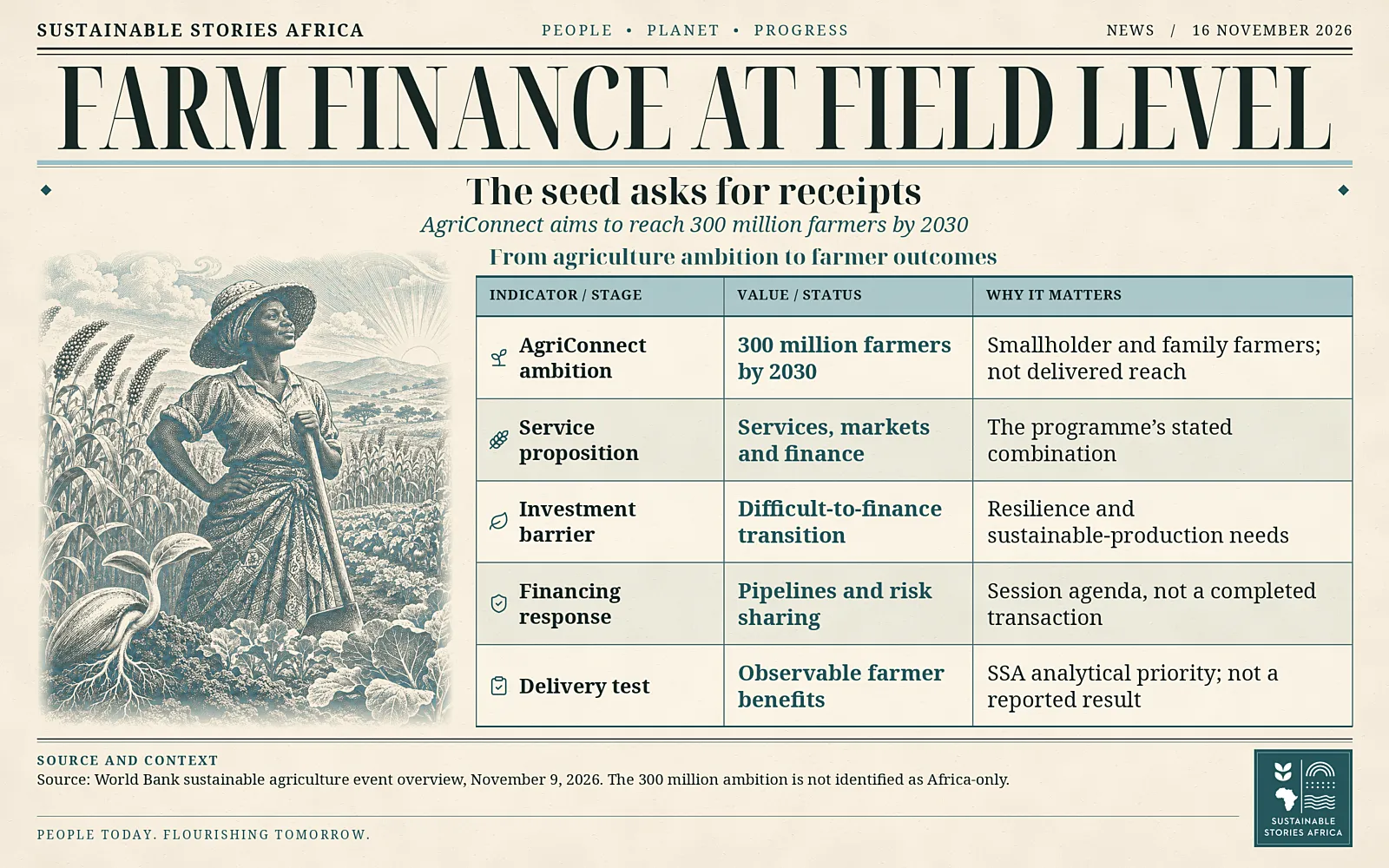
Its agenda links project preparation and risk sharing with AgriConnect’s ambition to help 300 million smallholder and family farmers by 2030.
For African agriculture, the test is whether finance reaches the services, markets and practical changes that farmers need.
Climate ambition needs a farmer-facing model
Financing sustainable agriculture requires more than recognising that smallholders face climate and nature risks.
The World Bank’s November 9 COP31 session framed the challenge as turning that ambition into credible investment pipelines, supported by cooperation among governments, development partners and commercial financiers.
- Its central question was how to mobilise finance for farmers at scale.
The session linked that agenda with AgriConnect’s ambition to help 300 million smallholder and family farmers access services, markets and finance by 2030 in a sustainable, climate-smart way.
- This is a programme ambition, not a count of farmers already reached, and the event overview does not identify it as an Africa-only target.
The distinction matters for reporting both geographic reach and delivery.
Bridging the gap between need and investment
Smallholder farmers are on the front line of climate change and nature loss, the World Bank says; however, investments needed for resilience and more sustainable production remain difficult to finance.
- The agenda therefore emphasises how different institutions work together, rather than suggesting that one financial product can solve the problem.
The speakers included Buddhi Marambe, Sri Lanka’s lead agriculture negotiator at the UNFCCC; Sintayehu Demissie Admasu, head of Ethiopia’s Food Security Coordination Office; and World Bank Group Director Wagner Albuquerque de Almeida. Veronica Nyhan Jones was the moderator.
The investment logic is nonetheless clear.
- A credible pipeline identifies what will be financed and how delivery will work.
- Risk sharing addresses barriers that individual institutions may be unable or unwilling to carry alone.
- Cooperation links the financing arrangements with the farmers who need services, buyers and market opportunities.
Design finance around the transition itself
The intended development outcome is a transition that strengthens resilience without leaving smallholders behind.
- This requires the financing proposition to link practical support and market access.
- AgriConnect’s stated combination of services, markets and finance matters because it frames farming as an operating system rather than a sequence of isolated loans.
For African policymakers and lenders, a useful implication is to examine what would enable a farmer to adopt and sustain a proposed practice.
- A financing package should explain its intended beneficiaries, delivery partners and expected results.
- Claims of climate-smart transformation need a credible route from institutional funding to observed changes at farm level.
The same scrutiny applies to nature outcomes.
- Sustainable production should not be treated as established merely because a transaction carries a green label.
- Project preparation should define what resilience and sustainability mean in the relevant location, how progress will be monitored, and who are the responsible participants.
A more credible market would let farmers, public agencies and investors understand the same project in compatible terms: what is changing, why the change is useful and how financing supports it.
Make farmer outcomes visible in financing
Governments and partners should connect sustainable agriculture priorities with a transparent pipeline of investable programmes.
- The event supports collaboration on preparation and risk sharing, and the next accountability step is to make those arrangements intelligible: who provides capital, who delivers services, who carries losses and who verifies results?
For financiers, the challenge is to avoid reporting the volume of money committed as though it were equivalent to the number of farmers benefiting.
- Different measures are needed for financing approved, services received, market participation and changes in resilience.
- The 2030 ambition provides travel direction, but it does not explain how success will be counted across different interventions.
Farmer organisations and local delivery institutions should have a meaningful place in implementation design.
- Their involvement can help test whether proposed conditions are workable and whether services respond to actual needs.
- This is a practical governance priority, rather than a claim about agreements reached at the session.
The immediate opportunity for African agriculture is to turn a broad investment narrative into programmes with identifiable beneficiaries, realistic delivery arrangements and evidence that can withstand scrutiny beyond a conference announcement.
Path Forward – Put Farmers Inside The Financing Model
Sustainable agriculture finance should link investable projects with services, markets and accountable delivery.
Risk-sharing mechanisms need a clear explanation of how they help farmers participate in the transition.
For African programmes, demonstrate success through farmer-level results as well as capital mobilised, while keeping programme ambitions separate from independently verified achievements.