
The EU's Empowering Consumers for the Green Transition Directive took effect on 27 September 2026.
It matters now because vague claims such as “eco-friendly” are no longer acceptable without proof.
Exporters selling into Europe face immediate packaging and marketing audits.
Burden of Proof Shifts
Brands selling in the European Union can no longer call a product “eco-friendly” and leave it there.
- The Empowering Consumers for the Green Transition (ECGT) Directive took effect on 27 September 2026, and the European Commission has published a Questions and Answers document explaining how it applies, according to OneStop ESG.
The Directive amends the Unfair Commercial Practices Directive and the Consumer Rights Directive.
- It creates no new environmental standards.
- Instead, it tightens what businesses may tell shoppers and places the burden on traders to prove their claims.
What Is Now Banned
Generic claims such as “eco-friendly,” “green” or “biodegradable” are prohibited unless the trader can show recognised excellent environmental performance, for example through the EU Ecolabel.
- Imagery such as green leaves can count as an implicit claim.
“Carbon neutral” claims that rely on offsetting outside a product's own value chain are banned outright.
- Sustainability labels must be set by an EU public authority or rest on a certification scheme with independent verification.
There is no grace period.
- Existing labels and stock already on shelves must comply, although authorities will weigh proportionality when they enforce the rules.
- Retailers must also show reparability scores, where EU requirements exist, and a harmonised legal-guarantee notice.
National authorities and courts across all 27 member states will enforce the rules so a single misleading claim can draw scrutiny in multiple markets.
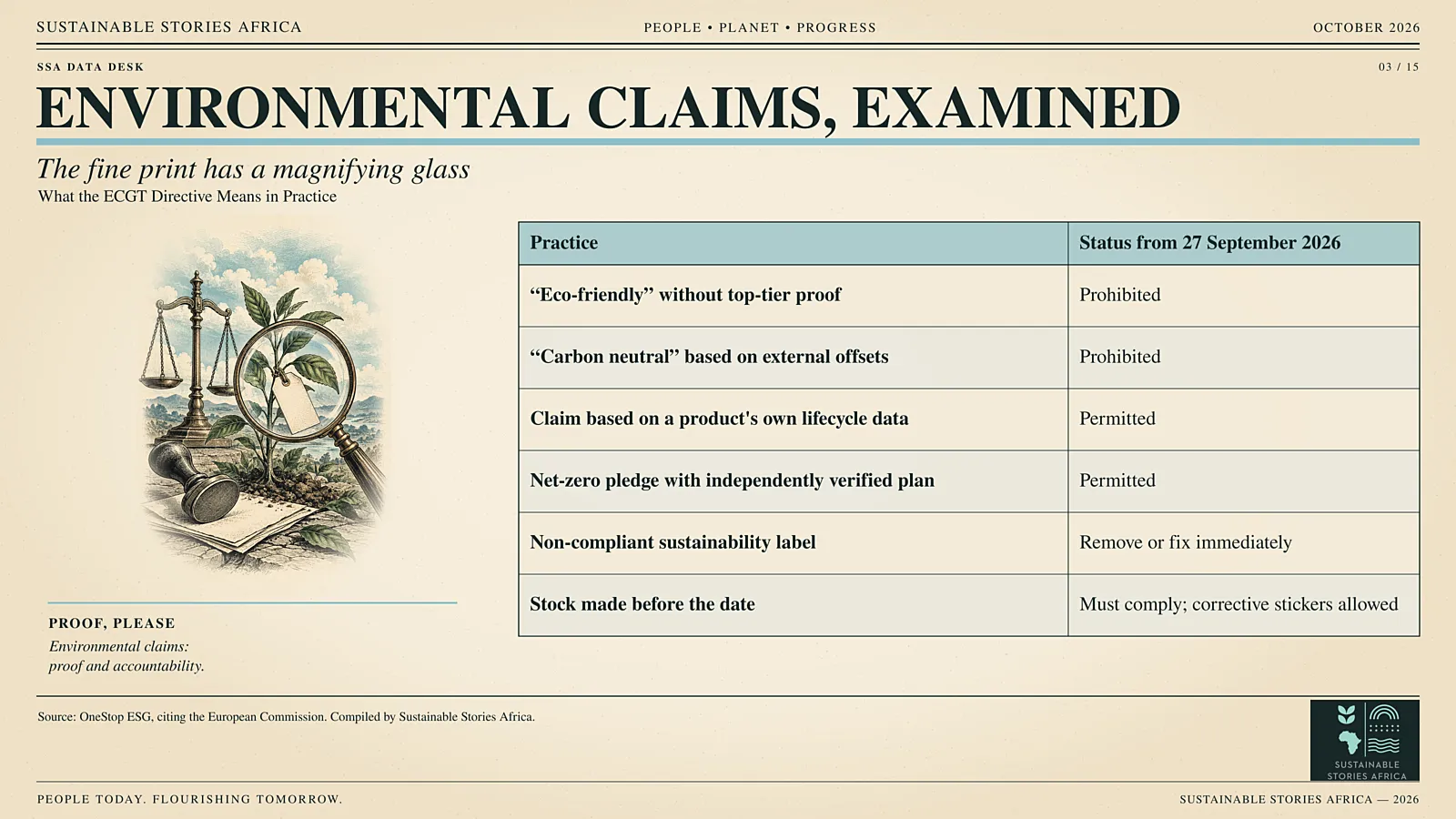
The table clarifies a clear line between slogans and substantiated claims.
- Companies with real lifecycle data can keep communicating, while those relying on offsets or general language must change course.
Credibility as a Commercial Asset
Verifiable claims remain permitted.
- A statement such as “100% of energy used to produce this packaging comes from renewable sources” can stand if the data support it.
- That creates an opening for companies with strong measurement systems to differentiate themselves.
For those without evidence, the exposure is immediate.
- Regulatory action, legal challenge and reputational damage can follow, and consumers who feel misled rarely return.
What Must Happen Next
Brands and exporters should audit packaging, labels and advertising now.
- They should replace broad slogans with specific, evidence-backed statements, and confirm that every label meets certification criteria.
- Offset-based neutrality language should be withdrawn.
The Directive applies to anyone marketing to EU consumers, so African and other non-EU exporters should treat the audit as a market-access issue.
Early compliance also signals credibility to ESG-conscious buyers and investors.
Path Forward – Audit, Verify, Substantiate: Claims Must Hold
Priorities include immediate audits of packaging and marketing, removal or correction of non-compliant labels, and substantiation through lifecycle data.
For exporters to the EU, early compliance protects market access and builds trust with ESG-conscious buyers.
Culled from: EU's New Anti-Greenwashing Rules Take Effect Under ECGT Directive | OneStop ESG