Developing countries are struggling to absorb the climate finance they urgently need, according to experts who warn that weak institutional systems, slow procurement, and limited technical capacity are undermining access to billions in global climate funds.
The Energy Mix reports that despite rising pledges, many countries cannot design, deliver, or track climate projects at the speed required. Experts say reform is now unavoidable.
Rising Finance, Slower Absorption Rates Expose System Gaps
Developing countries risk missing out on climate-finance opportunities due to inadequate domestic systems that cannot absorb funds quickly or efficiently, experts told The Energy Mix this week.
Despite a surge in global pledges from multilateral banks and climate-finance institutions, analysts say the absence of strong institutions, clear governance structures, and qualified technical teams is slowing access to urgently needed resilience and mitigation financing.
Inside the Capacity Gap Holding Back Climate Projects
Experts cited multiple system barriers:
- Fragmented institutions with overlapping mandates
- Lengthy procurement processes that impede project approvals
- Limited data systems, weakening monitoring and reporting
- Weak financial-risk controls, affecting funders' confidence
According to the Energy Mix, climate-finance flows rose globally in 2023, yet developing regions, especially Africa, Asia, and the Caribbean, struggled to translate available finance into implementable projects.
Many lacked strong national climate plans, pipeline-ready projects, or transparent reporting frameworks that international funders require.
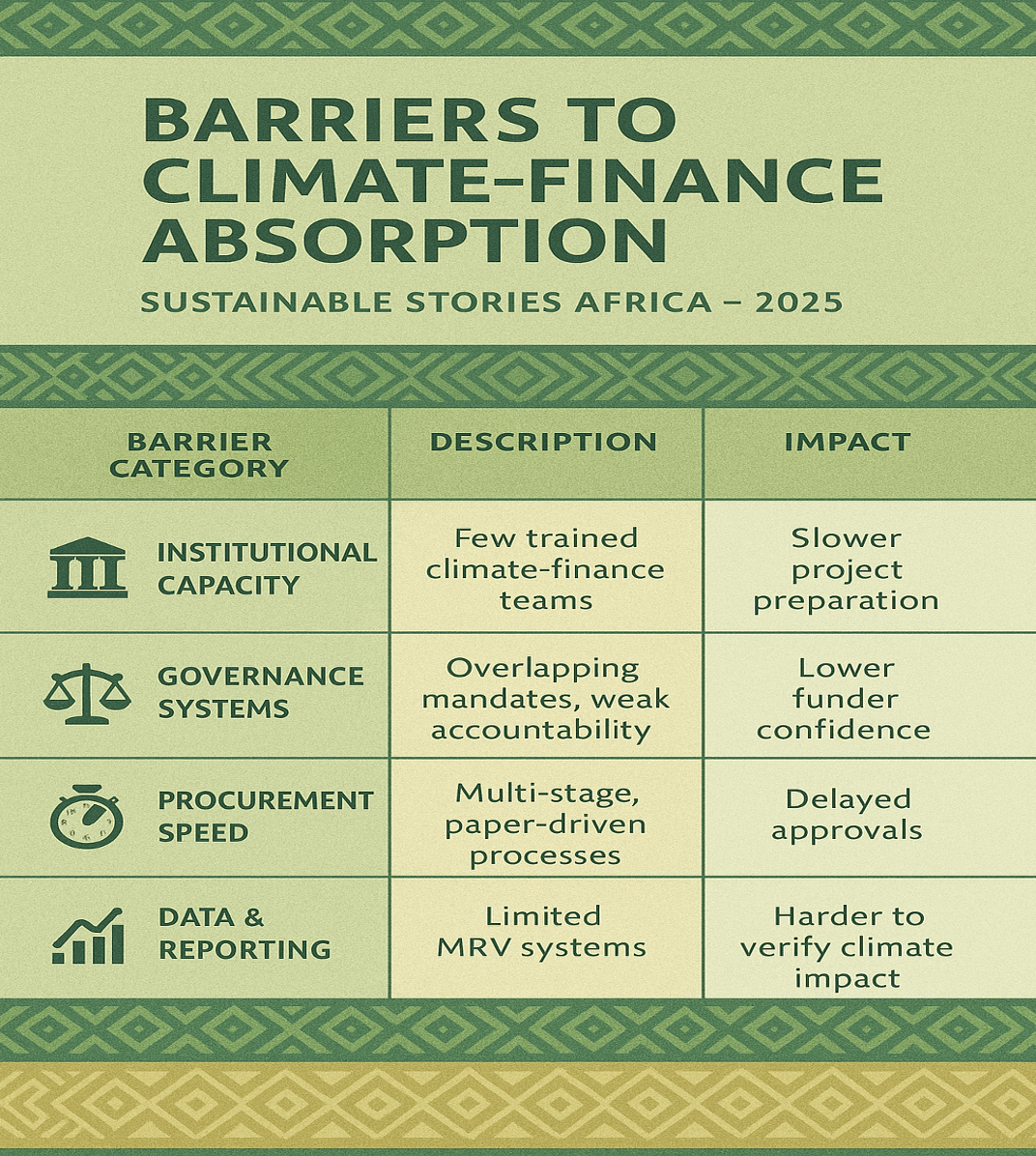
Barriers to Climate-Finance Absorption
| Barrier Category | Description | Impact |
|---|---|---|
| Institutional Capacity | Few trained climate-finance teams | Slower project preparation |
| Governance Systems | Overlapping mandates; weak accountability | Lower funder confidence |
| Procurement Speed | Multi-stage, paper-driven processes | Delayed approvals |
| Data & Reporting | Limited MRV systems | Harder to verify climate impact |
Experts argue that without reform, developing countries will continue to "underdraw" available funds, receiving commitments but failing to convert them into real projects on the ground.
Why Strengthening Systems Is Now Critical
According to development economists quoted in the report, donors increasingly prefer countries with strong execution systems, where climate finance can be deployed at scale with minimal loss or delay.
Countries such as Rwanda and Morocco, where national climate strategies, digital procurement systems, and technical units are more established, are attracting a larger share of climate-finance flows.
Comparative Snapshot: Climate-Finance Readiness
| Country Type | Characteristics | Fund Absorption Outlook |
|---|---|---|
| High-Readiness Countries | Clear climate plans, strong MRV, streamlined procurement | High uptake & faster deployment |
| Medium-Readiness Countries | Some institutional clarity, partial data systems | Moderate uptake, delays likely |
| Low-Readiness Countries | Weak institutions, fragmented systems | Low uptake; dependence on external managers |
Experts say the lesson is straightforward: funders follow capability.
How Countries Can Prepare for Higher Flows
Based on insights from The Energy Mix, analysts propose four immediate steps for developing countries:
- Create climate-finance delivery units within ministries to deepen technical expertise.
- Digitise procurement and reporting to reduce delays and improve funder transparency.
- Develop project pipelines, including feasibility studies and cost-benefit analyses.
- Strengthen climate-data systems, enabling reliable measurement, reporting, and verification (MRV).
Experts warn that global climate finance is expected to rise further as investors and multilateral funds expand green-investment portfolios. Countries that fail to upgrade their systems risk falling even further behind.
PATH FORWARD – Build Capacity, Absorb Finance, Accelerate Climate Action.
Developing nations must now prioritise institutional reform, procurement efficiency, and data transparency to capture the growing pool of global climate funds. Strengthened systems will enable faster project implementation and higher investor confidence.
With coordinated action, countries can shift from missed opportunities to accelerated climate-resilience outcomes, positioning themselves as credible destinations for long-term climate finance.
Culled From: https://www.theenergymix.com/developing-countries-need-better-systems-to-absorb-climate-funds-experts-say/