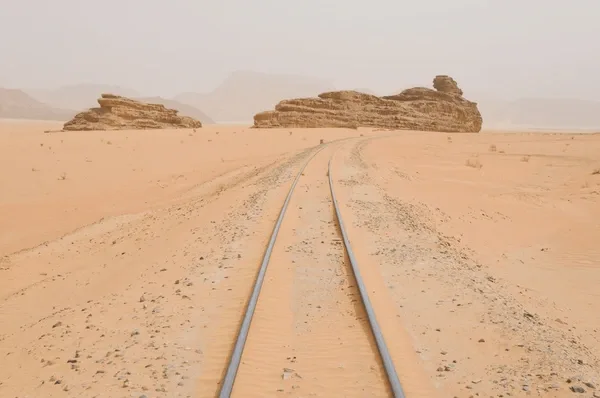
Mauritania's key mineral-export railway is set for a major overhaul as EIB Global and the African Development Bank announce a combined $275 million investment to modernise the country's 700-kilometre rail corridor. The upgrade will improve reliability, safety, and export competitiveness for iron ore and other bulk goods.
EIB, AfDB Commit $275 million to Transform Mauritania's Rail Corridor
EIB Global and the African Development Bank have approved a $275 million joint investment to modernise Mauritania's Nouadhibou–Zouérate railway, a strategic transport corridor central to the nation's mineral economy.
Officials said the rehabilitation will address deteriorating tracks, outdated signalling, and logistical bottlenecks that have constrained export volumes and increased operational costs.
What the Funding Covers and Why It Matters
The project financing covers full corridor modernisation, safety-system upgrades, and rolling-stock improvements. Mauritania relies heavily on iron-ore exports for fiscal revenue; disruptions along the rail line have long undermined production, competitiveness, and investor confidence.
The project is expected to reduce transport time, increase freight capacity, and align Mauritania with modern regional logistics standards.
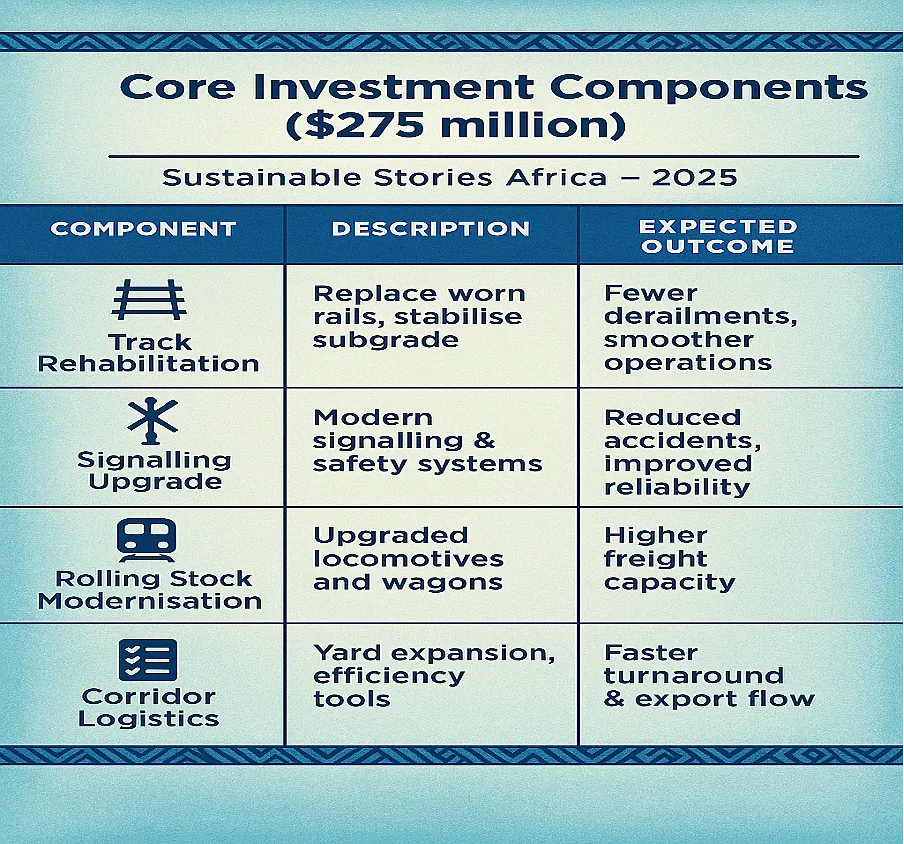
Core Investment Components ($275 million)
| Component | Description | Expected Outcome |
|---|---|---|
| Track Rehabilitation | Replace worn rails, stabilise subgrade | Fewer derailments, smoother operations |
| Signalling Upgrade | Modern signalling & safety systems | Reduced accidents, improved reliability |
| Rolling Stock Modernisation | Upgraded locomotives and wagons | Higher freight capacity |
| Corridor Logistics | Yard expansion, efficiency tools | Faster turnaround & export flow |
Evidence Supporting the Urgency of the Upgrade
Rail infrastructure on the 700-kilometre corridor has suffered from ageing assets, climate-related wear, and heavy freight loads. Operational disruptions have increased maintenance costs and slowed export cycles for the mining sector, which accounts for a significant share of Mauritania's GDP and foreign currency earnings.
The upgrade aligns with AfDB's and EIB Global's sustainable-infrastructure priorities, particularly for countries seeking to maximise mineral revenues while improving national resilience.
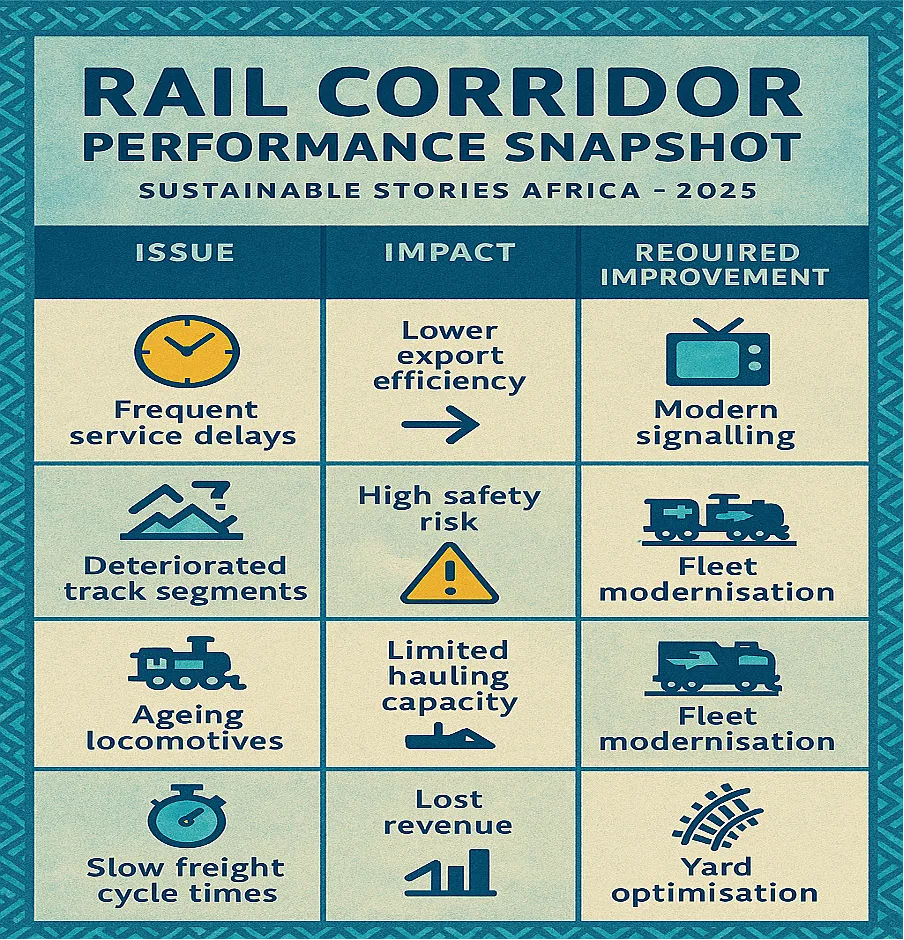
Rail Corridor Performance Snapshot
| Issue | Impact | Required Improvement |
|---|---|---|
| Frequent service delays | Lower export efficiency | Modern signalling |
| Deteriorated track segments | High safety risk | Rail replacement |
| Aging locomotives | Limited hauling capacity | Fleet modernisation |
| Slow freight cycle times | Lost revenue | Yard optimisation |
What Mauritania and Partners Must Implement Next
The project will be executed in partnership with national authorities and Société Nationale Industrielle et Minière (SNIM), the state-owned mining and rail operator. Implementation will include phased construction, safety training, and environmental compliance aligned with AfDB standards.
The financing package is expected to catalyse additional private-sector logistics investments and strengthen the broader Atlantic mineral-export ecosystem. Authorities are encouraged to ensure transparent procurement, strong supervision, and sustained maintenance to safeguard long-term value.
PATH FORWARD – Rail Modernisation Driving Economic Transformation
The $275 million investment marks a pivotal step in strengthening Mauritania's logistics backbone, improving export competitiveness, and boosting fiscal stability. Effective execution will determine how quickly the country realises productivity gains.
By modernising its most important rail corridor, Mauritania positions itself for expanded trade, new industrial opportunities, and long-term sustainable infrastructure growth.