
Global institutional investors managing trillions of dollars have tightened their climate playbook. The Net-Zero Asset Owner Alliance has expanded its framework with updated transition targets designed to accelerate real-economy decarbonisation.
The move signals growing pressure on investors to translate climate pledges into measurable portfolio actions.
For emerging markets, including Africa, the implications are significant: capital allocation, corporate governance, and climate accountability may increasingly converge.
Global Investors Tighten Net-Zero Climate Commitments
A coalition of the world’s largest pension funds and sovereign wealth funds has taken a decisive step to deepen climate accountability in global finance.
The Net‑Zero Asset Owner Alliance has unveiled an expanded framework that strengthens institutional investors' ability to set and implement portfolio transition targets aligned with the Paris Agreement.
The updated framework introduces clearer sector-specific pathways, enhanced portfolio emissions metrics, and more rigorous engagement expectations for companies.
The alliance, whose members collectively manage over $11 trillion in assets, said the expanded targets aim to bridge the widening gap between long-term net-zero pledges and short-term investment decisions.
“We are moving from ambition to implementation,” the alliance said in a statement accompanying the new framework.
For investors, the message is clear: climate commitments must now be reflected in capital allocation, corporate engagement, and portfolio design.
From Pledges To Measurable Transition Pathways
The Net-Zero Asset Owner Alliance was originally launched under the United Nations Environment Programme Finance Initiative to mobilise institutional investors to achieve net-zero greenhouse-gas emissions by 2050.
However, as global emissions continue to rise, critics have questioned whether investor climate pledges translate into real-world change.
The alliance’s new framework attempts to address that gap.
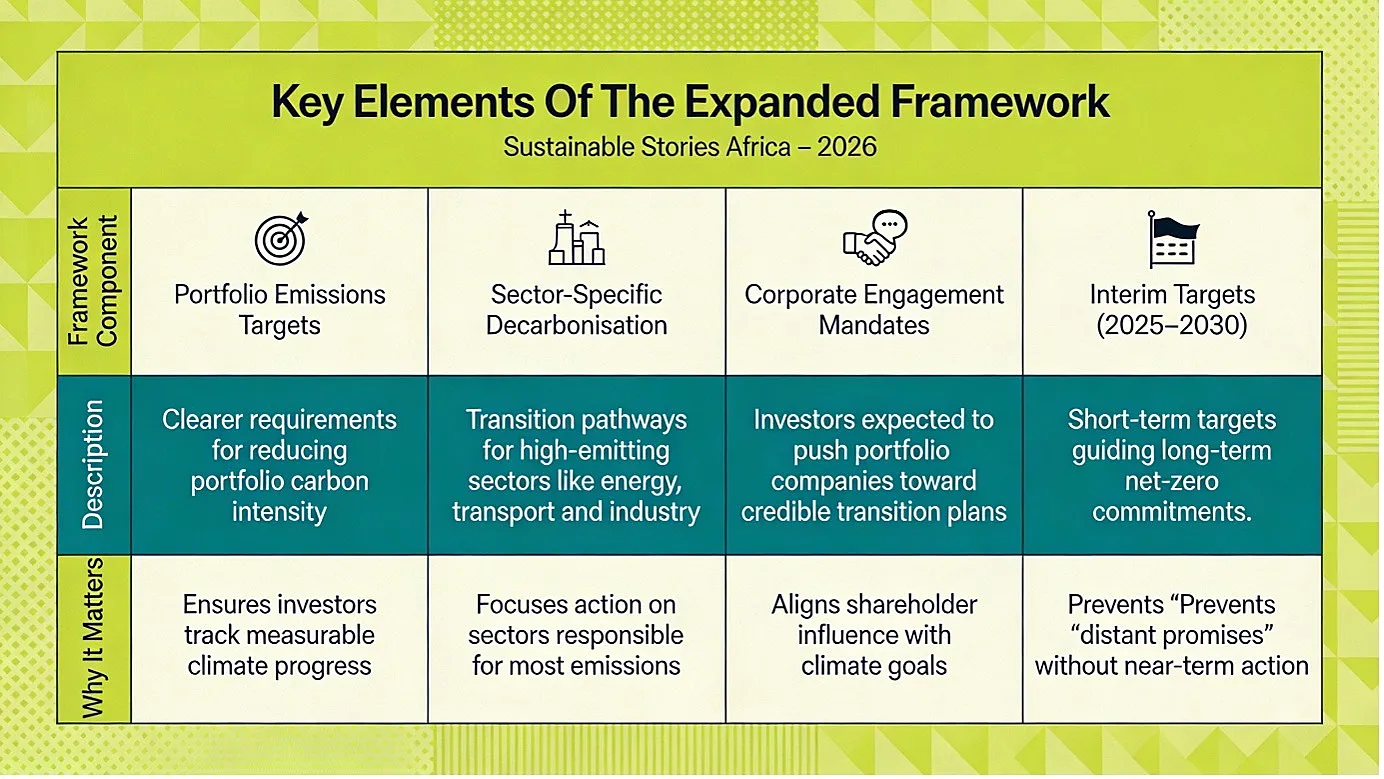
Key Elements Of The Expanded Framework
Framework Component | Description | Why It Matters |
|---|---|---|
Portfolio Emissions Targets | Clearer requirements for reducing portfolio carbon intensity | Ensures investors track measurable climate progress |
Sector-Specific Decarbonisation | Transition pathways for high-emitting sectors like energy, transport and industry | Focuses action on sectors responsible for most emissions |
Corporate Engagement Mandates | Investors expected to push portfolio companies toward credible transition plans | Aligns shareholder influence with climate goals |
Interim Targets (2025–2030) | Short-term targets guiding long-term net-zero commitments | Prevents “distant promises” without near-term action |
The alliance emphasised that achieving net zero requires not only portfolio decarbonisation but also real-economy emissions reductions.
This distinction matters particularly in emerging markets, where industries such as cement, power generation, and oil and gas remain central to economic development.
For African economies balancing industrial growth with climate commitments, investor expectations are evolving quickly.
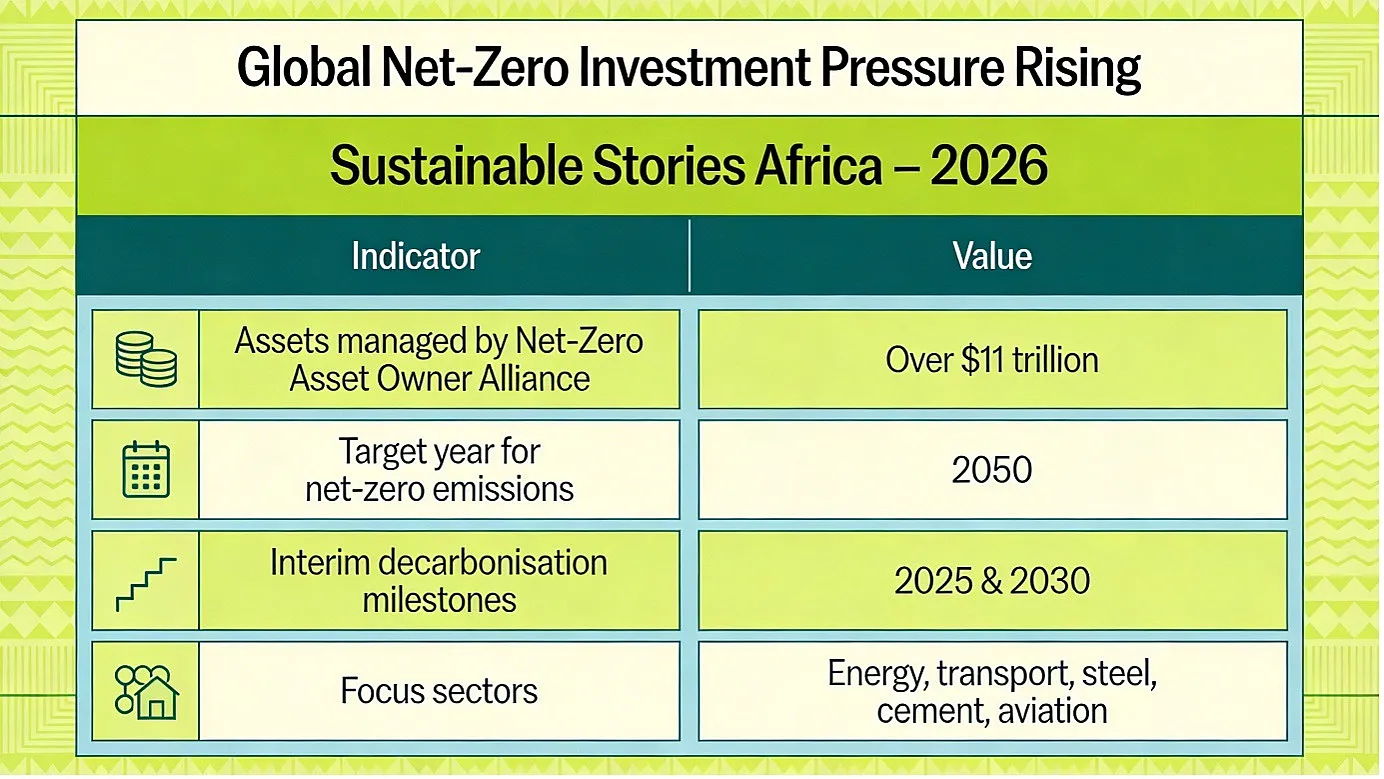
Global Net-Zero Investment Pressure Rising
Indicator | Value |
|---|---|
Assets managed by Net-Zero Asset Owner Alliance | Over $11 trillion |
Target year for net-zero emissions | 2050 |
Interim decarbonisation milestones | 2025 & 2030 |
Focus sectors | Energy, transport, steel, cement, aviation |
Financial markets are increasingly becoming the arena where climate transitions are enforced.
Investors are now expected to evaluate whether companies have credible transition strategies, including emissions targets, capital expenditure alignment, and governance oversight.
Aligning Capital Markets With Climate Reality
The updated framework could help reshape how global capital flows toward climate solutions.
For institutional investors, clearer transition targets provide a structured pathway to balance financial returns with climate commitments.
For companies, the implications are profound.
Firms seeking long-term capital from pension funds and sovereign wealth investors may increasingly need to demonstrate credible decarbonisation plans.
In Africa, this dynamic could unlock new opportunities.
Infrastructure projects aligned with energy transition, such as renewable power, green hydrogen, electric mobility, and climate-resilient agriculture, may attract growing investor interest.
At the same time, industries that fail to adapt risk higher capital costs or reduced access to international finance.
Climate alignment is quickly becoming a capital market requirement rather than a voluntary corporate initiative.
Investors Must Turn Targets Into Implementation
Yet the alliance acknowledges that targets alone will not drive transformation.
Investors must translate frameworks into active ownership strategies, including:
- Voting on climate-related shareholder resolutions
- Pressuring companies to adopt science-based targets
- Redirecting capital toward low-carbon sectors
- Supporting credible transition financing in emerging markets
Policymakers also play a crucial role.
Clear climate disclosure rules, carbon pricing mechanisms, and transition finance frameworks can help investors align portfolios with real-economy decarbonisation.
Without supportive policies, investor ambition may struggle to translate into measurable emissions reductions.
For Africa, the challenge is to balance climate ambition with development priorities, ensuring energy access and economic growth remain central to the transition.
Path Forward – Turning Climate Finance Into Real Transition
The alliance’s expanded framework reflects a broader shift in global finance: climate commitments must now translate into measurable investment actions.
For emerging markets, the opportunity lies in aligning development pathways with climate-aligned capital.
If African governments, corporations, and investors move quickly, the transition could unlock billions in sustainable investment while accelerating the continent’s low-carbon growth trajectory.
Culled From: Net Zero Asset Owner Alliance Expands Framework with New Transition Targets