Ghana has completed the exchange of its outstanding SADEREA notes, resolving the final component of its sovereign bond-debt restructuring.
All holders approved the transaction and received new government notes due in 2035 and 2037.
The exchange removes a lingering creditor issue, but durable recovery now depends on fiscal discipline, growth and transparent debt management.
Ghana Closes Its Final Bond Chapter
Ghana has completed the exchange of its outstanding SADEREA notes, closing what the Ministry of Finance describes as the final chapter of the sovereign bonded-debt restructuring launched in October 2024.
The exchange was settled on 13 July 2026 with a value date of 10 July, and all outstanding SADEREA notes were cancelled.
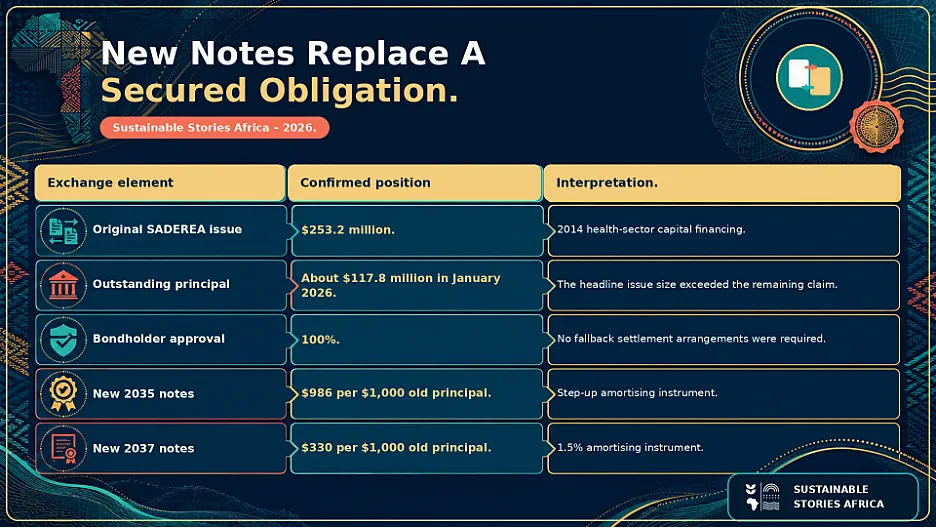
Holders representing 100% of the principal approved the written resolutions, eliminating the need for fallback arrangements.
The original notes had been issued at $253.2 million, while about $117.8 million of principal remained outstanding in January 2026.
The distinction between 'nearing completion' and 'completed' matters to investors. Settlement removes execution uncertainty around one of the last commercial claims left after Ghana's 2022 external-debt default.
New Notes Replace A Secured Obligation
For every $1,000 of outstanding SADEREA principal, holders received $986 of Ghana's step-up coupon amortising notes due 2035 and $330 of 1.5% amortising notes due 2037.
The government delivered about $116.1 million in 2035 notes and $38.9 million of the 2037 notes.
Those securities are fungible with notes issued in the 2024 Eurobond restructuring, bringing the SADEREA creditors into the same broader architecture.
The old 12.5% senior secured amortising bonds were issued in 2014 through an Irish special-purpose vehicle to finance health-sector capital expenditure.
The exchange follows Ghana's domestic debt operation in 2023 and the restructuring of roughly $13 billion in international bonds in 2024 under a wider programme to restore debt sustainability.
Businessfront reported that S&P had estimated completed or agreed treatments covered close to 97% of debt within the restructuring perimeter before this final settlement.
A Clean Exchange Does Not Erase Risk
Unanimous participation is a positive signal because it shows creditors accepted the negotiated comparability framework without a coercive holdout process.
It also simplifies the debt stock and removes a secured instrument whose treatment had remained unresolved.
However, restructuring changes payment terms; it does not by itself permanently create fiscal space.
Ghana still needs primary balances, stronger revenue mobilisation, disciplined borrowing and economic growth sufficient to service the new notes when amortisation rises.
Currency weakness, commodity volatility and election-cycle spending can quickly reopen debt pressures.
There is also a social dimension. The original financing supported health-sector investment, while the costs of debt distress have been felt through inflation, constrained budgets and reduced household purchasing power.
Recovery will be credible only if improved debt metrics translate to the protection of essential services and more stable livelihoods.
Debt Transparency Must Anchor The Recovery
The Ministry of Finance should publish a consolidated post-restructuring debt profile showing annual interest, amortisation, currency exposure and contingent liabilities.
- Investors need a clear map of the new obligations; citizens need to understand what fiscal commitments follow from the exchange.
The government should also strengthen parliamentary scrutiny of new borrowing, maintain a credible medium-term debt strategy and disclose how infrastructure-backed or special-purpose obligations are treated.
- Transparent procurement and project appraisal are essential so future debt finances productive assets rather than repeated refinancing.
For other African sovereigns, Ghana's experience reinforces an uncomfortable lesson:
- Restructuring can take years, involve several creditor classes and impose high economic costs
- Prevention through early disclosure, prudent maturity management and realistic revenue assumptions remains cheaper than crisis resolution.
Creditor confidence should also be rebuilt through consistent data releases rather than celebratory announcements alone.
Markets will watch reserves, arrears, fiscal balances and the treatment of state-owned enterprises long after the exchange date.
Path Forward – Ghana's Recovery Now Depends On Discipline
The SADEREA settlement closes an important legal and financial chapter.
Ghana can now focus less on negotiating old claims and more on rebuilding credibility through implementation.
The path forward requires consistent budgets, transparent debt reporting and investment that expands productive capacity and essential services.
If those disciplines hold, the exchange can mark a genuine transition from crisis management to sustainable recovery rather than a pause before the next debt cycle.
Culled From: Ghana nears completion of $253 million external debt restructuring after SADEREA notes exchange - Businessfront