South Africa's Competition Commission has recommended conditional approval of Coca-Cola HBC's $2.6 billion acquisition of a 75% stake in Coca-Cola Beverages Africa.
The regulator found no substantial competition threat but secured commitments on jobs, ownership, procurement, investment and headquarters.
The Competition Tribunal must still decide, making enforcement of those promises the deal's decisive sustainability test.
A Mega-Deal Clears Its Regulatory Hurdle
South Africa's Competition Commission has recommended that the Competition Tribunal approve Coca-Cola HBC's planned acquisition of Coca-Cola Beverages Africa, supported by conditions, clearing a major but not final hurdle for one of the continent's largest consumer goods transactions.
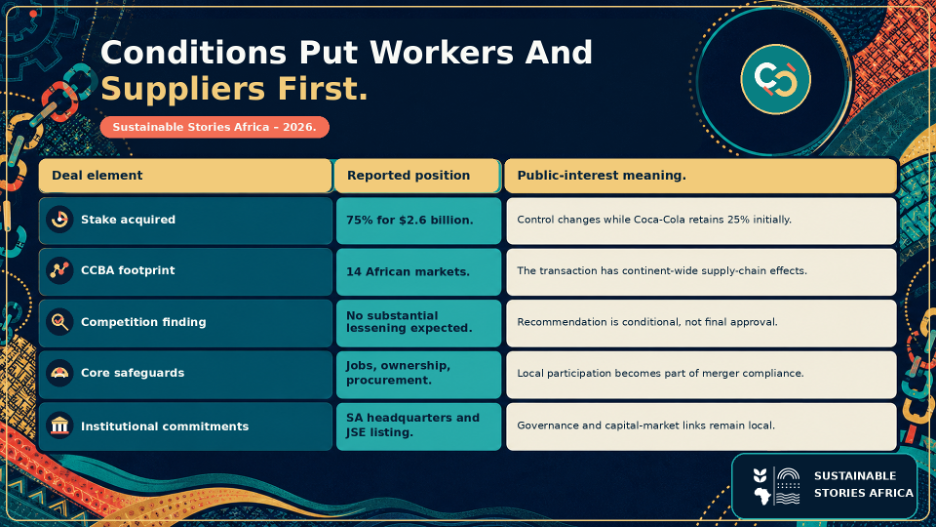
Coca-Cola HBC agreed in October 2025 to buy a 75% stake in CCBA from The Coca-Cola Company and Gutsche Family Investments for a combined $2.6 billion.
- The transaction implies a $3.4 billion equity value for the whole bottler.
- Coca-Cola HBC would gain an option over the remaining 25% held by The Coca-Cola Company, creating a path to full ownership.
The Commission concluded that the merger is unlikely to lessen or prevent competition significantly, in any market.
Its recommendation now goes to the Tribunal, which has authority to approve, amend or reject the transaction.
Conditions Put Workers And Suppliers First
The public-interest conditions are the centre of the South African decision.
The buyer agreed to a moratorium on merger-related retrenchments in South Africa, to maintain aggregate ownership levels held by historically disadvantaged persons and workers, and to restore those levels within a specified period if an existing shareholder or worker scheme exits.
The parties also committed to continued procurement from empowered suppliers, historically disadvantaged people and small, medium and micro enterprises.
Further undertakings cover investment in downstream distribution and retail, capital expenditure in South Africa, and the retention of CCBA incorporated and headquartered in the country.
Coca-Cola HBC is also committed to pursuing a secondary inward listing on the Johannesburg Stock Exchange, subject to regulatory approvals.
Together, the conditions treat local ownership, jobs and supplier participation as material elements of merger approval rather than optional corporate pledges.
The Combined Platform Will Reshape Bottling
CCBA operates in 14 African markets and represents about 40% of Coca-Cola system volumes sold on the continent.
Coca-Cola HBC says the combination would create the world's second-largest Coca-Cola bottling partner by volume, with positions across Africa and Europe and exposure to young, growing consumer markets.
The strategic logic is scale: common procurement, distribution expertise, capital and product portfolios can support expansion.
However, scale can also centralise bargaining power against smaller suppliers and distributors.
This is why the conditions matter beyond South Africa. Decisions on packaging, water, transport, retail equipment and route-to-market investment will ripple through local economies where bottling networks support thousands of indirect livelihoods.
Sustainability performance will also matter.
- A larger bottler inherits greater responsibility for water stewardship, packaging recovery, energy use and decent work across a wide operating footprint.
Approval Must Be Followed By Disclosure
If the Tribunal approves the transaction, regulators should translate each commitment into measurable obligations, deadlines and public reporting.
- A job moratorium is stronger when its duration and permitted exceptions are clear.
- Procurement promises need baselines, annual spend figures and supplier-development outcomes.
- Ownership commitments need transparent calculation and remedies.
Coca-Cola HBC should publish a South Africa implementation scorecard covering employment, capital expenditure, local procurement, worker ownership, water efficiency and packaging circularity.
The planned Johannesburg listing could strengthen accountability by placing African investors closer to the combined group's disclosures and governance.
For other African regulators, the case offers a useful model: competition analysis can sit alongside public-interest tests, provided conditions remain proportionate, enforceable and connected to the economic effects of the transaction.
Independent monitoring would ensure that the model is stronger.
Periodic compliance reports should identify missed targets, corrective action and any penalties, giving affected workers and suppliers a practical route to raise concerns.
Path Forward – Competition Approval Must Protect Shared Value
The Commission's recommendation recognises that a merger can be competitively acceptable while still requiring safeguards for workers, ownership and local value chains.
The Tribunal's final decision should preserve that balance.
Completion is targeted for the end of 2026.
Before then, the parties should turn broad commitments into verifiable plans so growth for the combined bottler also creates durable value for African employees, suppliers, investors and communities.
Culled From:South Africa watchdog backs $2.6 billion deal for Coca-Cola HBC bottling buy - Businessfront