Climate change and the net-zero transition are increasingly shaping inflation, output and the trade-offs confronting monetary policymakers, two NGFS reports have warned.
Repeated disasters, commodity disruption and transition costs may make familiar assumptions about temporary price shocks less reliable.
African central banks will need stronger climate data, scenario tools and clearer coordination without stepping beyond their mandates.
Climate Enters the Inflation Decision Room
Climate change and the transition to net zero are no longer peripheral considerations for monetary policy.
Two reports from the Network for Greening the Financial System say physical hazards and transition measures are increasingly affecting inflation and output, the variables at the heart of central-bank mandates.
NGFS chair Sabine Mauderer said an early, orderly and credible transition could limit macroeconomic and financial risk, while delay would make adjustment costlier and more disruptive.
The warning does not ask central banks to set climate policy. It asks them to recognise that floods, droughts, energy-system changes and supply shocks can alter the economy to which interest-rate decisions must respond.
Old Models Face New Persistent Shocks
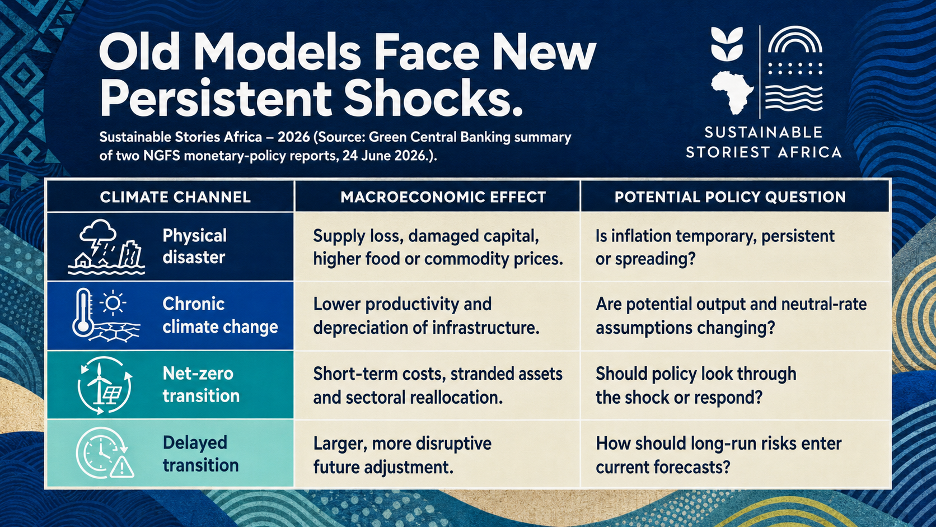
Physical climate impacts can lift commodity prices, interrupt supply chains, damage infrastructure and depress productivity.
Transition policies can temporarily raise costs or reduce output, particularly where workers and affected industries receive little public support. However, the NGFS argues that doing nothing will create larger long-term losses.
The difficult question is persistence. Central banks often “look through” a temporary supply shock when raising rates would add pain without restoring lost supply.
However, recurring storms, chronic heat or rising seas can compound damage.
If households expect repeated increases in food and energy prices, a sector-specific price shock can spread into wages and broader inflation.
Traditional models also struggle to capture nonlinear risks such as climate tipping points.
Recent Disasters Reveal Different Policy Choices
The reports contrast the policy pressures created by Pakistan’s 2022 floods and a cyclone in Mauritius in 2024.
- Mauritius used fiscal support while its central bank focused on medium-term price stability.
- Pakistan’s flooding was followed by a sharp increase in inflation and forceful monetary tightening.
The examples show why the same category of shock can demand different responses depending on magnitude, duration, location, expectations and fiscal capacity.
For African economies, the transmission can be especially fast. Food and fuel often carry significant weight in consumer-price baskets, agriculture depends heavily on rainfall, and currencies can weaken when import bills rise.
A climate shock can therefore hit household welfare, fiscal balances, foreign reserves and inflation simultaneously.
Central Banks Need Evidence Before Action
The NGFS recommends assessing how climate effects move through supply and demand over time.
A temporary transition-related increase may justify no immediate rate change; a persistent, broad-based inflation process may warrant a more coordinated approach.
- This requires better meteorological, agricultural, energy and financial data, as well as models that incorporate repeated shocks and sectoral exposure.
Communication also matters.
- Central banks should explain that governments retain responsibility for climate policy, while monetary authorities must respond to climate-driven effects on inflation and output.
In Africa, structured coordination with finance ministries, statistics agencies, utilities, and disaster-management institutions can improve the findings without compromising operational independence.
Path Forward – Build Climate-Smart Monetary Frameworks
African central banks should integrate climate variables into forecasting, stress testing and inflation communication, while developing contingency analysis for food, energy, currency and infrastructure shocks.
Scenario ranges may be more honest than single-point forecasts where uncertainty is extreme.
The goal is not a green interest rate. It is a more realistic policy framework, one capable of distinguishing temporary disruption from persistent inflation and protecting price stability as climate shocks become harder to ignore.
Culled From: Climate change and the energy transition could change monetary policy as we know it - Green Central Banking