A new round of US tariffs has imposed duties of 10% or 12.5% on 60 trading partners, including major African economies.
The measures can apply even where AGOA preferences remain, weakening the certainty exporters once relied upon.
Manufacturers, farmers and workers now face a sharper choice: negotiate, diversify markets and accelerate intra-African trade.
Preference Programme Meets A Tariff Wall
A fresh round of United States tariffs has exposed a basic contradiction in Washington's trade relationship with Africa: countries may retain preferential access under the African Growth and Opportunity Act; however, they still face additional duties imposed under a different law.
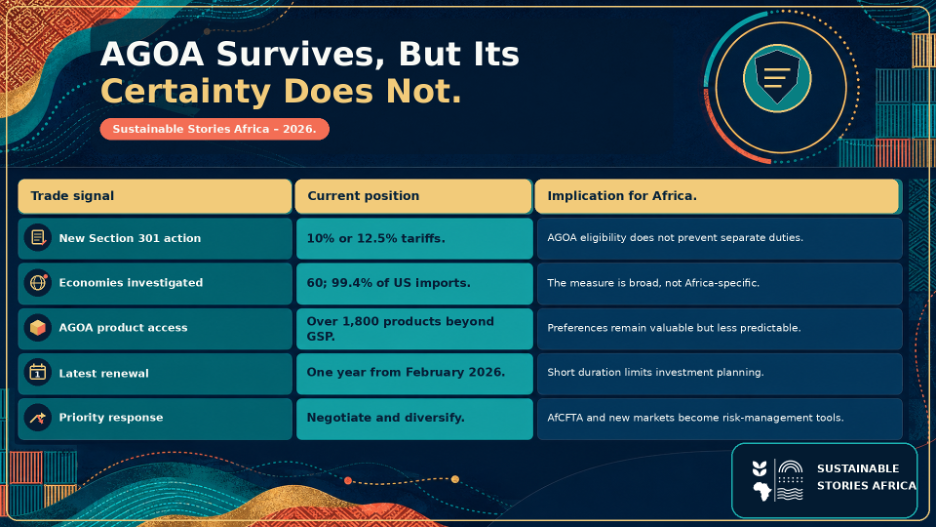
On 24 July, the Office of the US Trade Representative announced Section 301 tariffs of 10% or 12.5% on 60 trading partners, citing failures to prohibit or effectively enforce bans on imports produced with forced labour.
Businessfront reported that Nigeria, South Africa, Egypt, Morocco, Algeria and Angola were placed at the 12.5% rate.
The action took effect as African exporters were still adjusting to earlier country-specific tariffs.
For firms pricing garments, vehicles, citrus, metals or processed goods into the American market, legal distinctions offer little comfort.
A new duty can erase the margin that made an export competitive, delay investment and put labour-intensive jobs at risk.
AGOA Survives, But Its Certainty Does Not
AGOA has been central to US economic engagement with sub-Saharan Africa since 2000. USTR says it provides eligible countries duty-free access for more than 1,800 products, in addition to thousands covered by the Generalised System of Preferences. After a four-month lapse, the programme was reauthorised in February 2026 for only one year.
That short extension keeps the legal channel open but weakens its investment signal. Long-term factory decisions require predictable access, not annual suspense.
Businessfront reported that AGOA-linked exports fell by roughly one-third in the year to November 2025, with the decline concentrated in apparel and automotive sectors that the programme was designed to nurture.
South Africa illustrates the strain. A 30% tariff introduced in August 2025 substantially reduced its AGOA advantage, while vehicle exports to the US reportedly fell by nearly three-quarters.
Citrus growers, metals producers and suppliers across the automotive chain remain exposed.
Forced Labour Goals Meet Development Risks
Preventing forced labour is a legitimate human rights objective and belongs within responsible supply-chain governance.
The policy question is whether broad country tariffs are sufficiently targeted to change enforcement or whether they mainly penalise compliant exporters and workers with little influence over national legislation.
USTR says the investigations cover economies responsible for 99.4% of US imports and allow exemptions for raw materials, essential products and goods unavailable in sufficient supply in the United States.
It has also proposed a mechanism for reduced-duty textile volumes in some circumstances.
Even so, the additional tariffs weaken the simple promise that qualifying African products can enter duty-free.
The result is a more transactional system. Preferences are increasingly tied to reciprocity, market opening and bilateral bargaining rather than a stable development compact.
Africa Must Build Options Before Deadlines
African governments should continue collective engagement with Washington, pressing for clear exemptions, proportionate labour-enforcement benchmarks and a multi-year AGOA renewal that supports investment.
Exporters also need product-level tariff mapping, origin documentation and stronger traceability to demonstrate clean supply chains.
However, negotiation cannot be the only strategy.
- The African Continental Free Trade Area offers a larger long-term opportunity to build regional value chains, while Europe, the Gulf and Asia can absorb selected products.
- Diversification will require trade finance, logistics reform, common standards and faster border processes.
- It will also require moving beyond raw commodities into processed goods that can compete across several markets.
Workers and smaller firms need support to adjust during this transition.
Export-credit agencies, banks and governments can provide working capital, market intelligence and reskilling so sudden tariff changes do not destroy productive capacity before alternative buyers are secured.
Africa Must Trade Beyond Temporary Preferences
AGOA still matters, especially for apparel and manufactured exports, but a one-year extension cannot anchor industrial policy.
African states need a coordinated position that protects workers while resisting rules that make preference access commercially hollow.
The durable response is two-track: negotiate fairer US access now, while building regional production and diversified demand that no single capital can withdraw.
Culled From:Trump's second wave of tariffs hits Africa. Can AGOA survive the new American trade order? - Businessfront