South Africa has signed a $1.5 billion World Bank policy loan supporting reforms in electricity, freight, water and sanitation.
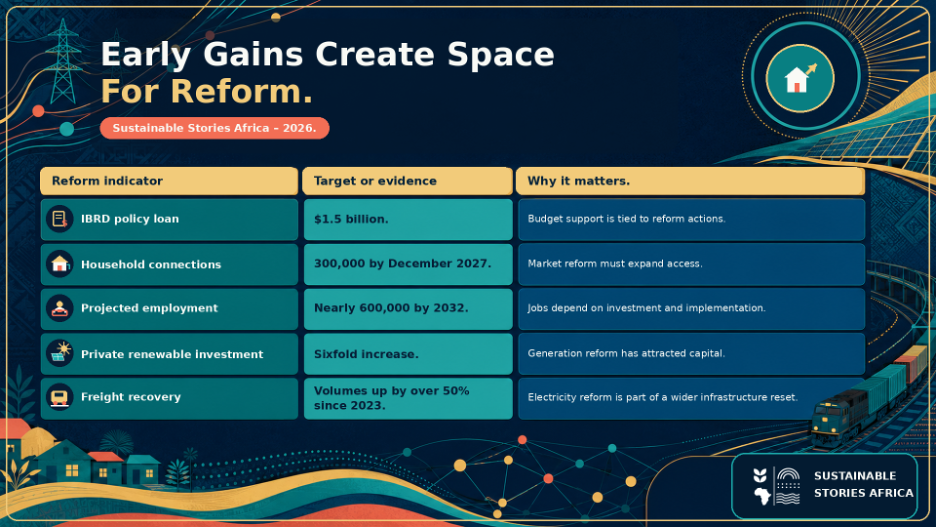
The programme targets a competitive wholesale power market, private transmission investment and 300,000 new household connections by December 2027.
Its success will be judged not by disbursement alone, but by reliable access, transparent competition and nearly 600,000 projected jobs.
A Policy Loan Targets Structural Bottlenecks
South Africa and the World Bank signed a $1.5 billion Development Policy Loan on 21 July, formalising support for reforms intended to modernise electricity, freight transport, water and sanitation, and remove infrastructure constraints on inclusive growth.
The International Bank for Reconstruction and Development financing is the fourth stand-alone policy loan to South Africa since 2022.
Unlike a project loan tied to a power station or transmission line, it provides budget support against agreed policy and institutional actions.
That gives government flexibility; however, it places a premium on the delivery of reform and public accountability.
Electricity sits at the centre of the programme.
The operation supports the launch of a competitive wholesale market, the continued restructuring of Eskom and greater private investment in transmission, a structural shift from the utility's historic dominance across the power system.
Early Gains Create Space For Reform
The World Bank says the reforms are built on measurable improvements.
Load shedding has been virtually eliminated for about 18 months, private renewable-energy investment has increased sixfold, and rail and port freight volumes have risen by more than 50% since 2023.
The new phase seeks to convert that recovery into a more durable market.
- A target of 300,000 new household electricity connections by December 2027 links institutional reform to access.
In freight;
- The programme supports competition among private rail operators and South Africa's first port terminal concession in Durban.
In water;
- It strengthens regulation, private participation and the National Water Resources Infrastructure Agency.
Taken together, the pillars recognise that unreliable electricity, congested logistics and weak water services reinforce one another, raising costs for manufacturers, miners, farmers, municipalities and households.
Jobs Depend On Execution Not Announcements
The World Bank expects the supported reforms to help create nearly 600,000 direct and indirect jobs by 2032.
That potential comes from lower infrastructure costs, new investment and activity in electricity networks, logistics and service delivery.
However, policy loans do not automatically build infrastructure or create employment.
- Transmission procurement must be competitive and bankable.
- The wholesale power market needs credible rules, independent operation, transparent pricing and protection against market concentration.
- New connections must be reliable and affordable, not simply counted at installation.
- Water reforms must strengthen public oversight even where private capital or operators participate.
South Africa must also manage Eskom's financial health and workforce transition.
- Unbundling without debt discipline
- Municipal payment reform
- Grid investment could move problems between institutions rather than solve them.
South Africa Can Set A Regional Example
Across Africa, power pools and national systems face similar tensions: state utilities carry public-service obligations but often lack capital.
- Private generators need predictable offtake, cost-reflective tariffs and access to transmission.
South Africa's reform offers a high-profile test of whether competition can improve investment without weakening universal-service goals.
The government should publish a reform dashboard;
- Showing market milestones, procurement results, grid investment, household connections, service quality and job outcomes.
Parliament, regulators and civil society need enough information to distinguish policy compliance from real-world improvement.
Development partners can support preparation and risk-sharing, but domestic institutions must retain ownership.
The most valuable outcome would be a credible model in which public regulation, private investment and social access reinforce rather than displace one another.
Municipalities also need technical and financial capacity to connect households and collect revenue fairly.
National market reform will not reach communities if local networks remain overloaded, poorly maintained or unable to fund service expansion.
Path Forward – Electricity Reform Must Deliver Reliable Access
The $1.5 billion loan gives South Africa fiscal room and international backing.
However, its legitimacy will come from services: more dependable power, faster freight, safer water and jobs that citizens can see.
The next phase should pair market opening with transparent regulation, transmission delivery and protection for vulnerable users.
If those pieces hold, the reform can strengthen South Africa's economy and offer lessons for infrastructure transitions across the continent.
Culled From: World Bank backs South Africa's $1.5 billion electricity market overhaul - Businessfront