Climate damage and the net-zero transition are beginning to alter inflation, growth and the choices facing central banks, according to two NGFS reports.
The warning matters as repeated food, energy and supply shocks become harder for policymakers to treat as temporary.
From flooded Pakistani farms to cyclone-hit Mauritius, interest-rate decisions increasingly determine whether households receive relief or bear a second economic shock.
Climate Risk Enters The Rate Room
Climate change is moving from the margins of central banking into the interest-rate room. Two reports published on June 24 by the Network for Greening the Financial System warn that physical disasters and the transition to net zero can simultaneously lift prices and weaken growth, forcing monetary authorities to choose between restraining inflation and protecting output.
The finding matters especially for African and other emerging economies, where food carries heavy weight in household budgets, currencies are vulnerable and fiscal buffers are often thin.
The NGFS, a coalition of 152 central banks and supervisors with 24 observers, says climate shocks should be assessed like other macroeconomic disturbances; however, their growing frequency, severity and persistence may make them much harder to ignore.
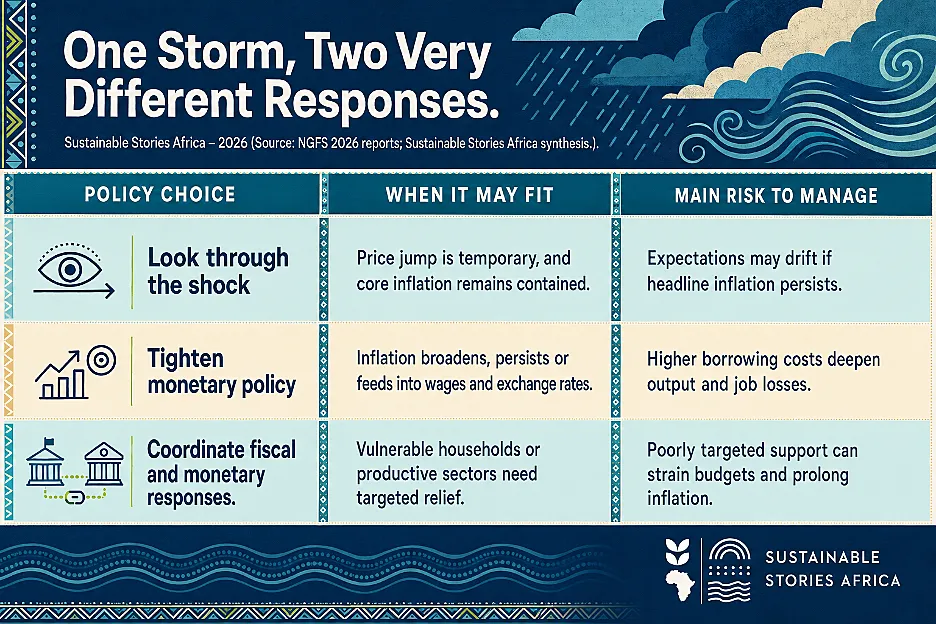
One Storm, Two Very Different Responses
The dilemma is already visible. When Tropical Cyclone Belal hit Mauritius in early 2024, flooding Port Louis and disrupting electricity and movement, curfew-related losses were estimated at Rs3 billion, approximately $70 million, or 0.5% of GDP.
Annual inflation rose from 3.9% in December 2023 to 6.2% in February 2024, while food inflation surged from 3.6% to 15.8%.
The Bank of Mauritius held its stance, judging the shock temporary, while government support targeted households, farmers and fishers. Inflation later returned to its pre-shock level.
Pakistan’s 2022 floods produced a harsher equation: more than 33 million people were affected; crop and transport damage helped push headline inflation from 12.2% to 29.2%; and the policy rate rose 825 basis points to 22% amid currency and financing stress.
For African policymakers, the lesson is not that one response fits every storm. A modelled Rwanda case found adverse weather raising food prices and headline inflation while reducing agricultural output.
In the NGFS transition modelling, oil exporters suffered the largest output losses as investment and exports declined; Nigeria served as the African proxy within that country group, making the result indicative rather than a country forecast.
Orderly Transition Can Reduce Future Pain
The transition itself can create near-term “greenflation”. Carbon prices raise energy and production costs, while demand for minerals, grids and clean technologies can outpace supply.
However, the NGFS modelling finds those trade-offs are smaller when policies are gradual, credible and supported by targeted subsidies, regulation and revenue recycling.
That is the more hopeful route. Cleaner power can reduce exposure to volatile fossil-fuel prices, while green investment, adaptation and better insurance can protect productivity and livelihoods.
The model estimates avoided climate damage could lift global output by about 0.3% in 2035, with negligible inflation effects; by 2055, cumulative avoided damage could equal around 3% of global output.
As NGFS chair Sabine Mauderer put it, “an early, orderly, and credible transition can help limit macroeconomic and financial risks.”
Build Climate Intelligence Into Every Decision
- Central banks now need climate-aware inflation models, granular food and energy data, short-term physical-risk scenarios and clearer tests for deciding whether a shock is temporary or persistent.
- Policy committees should publish the factors guiding their response, including effects on inflation expectations, currencies, credit, employment and vulnerable households.
- Governments must do the work monetary policy cannot: invest in resilient infrastructure and clean energy, protect displaced workers, strengthen insurance and social protection, and announce transition policies early enough for businesses and households to plan.
Tightening rates after every climate-driven food spike risks treating damaged supply as excessive demand; ignoring persistent pressures risks losing credibility.
PATH FORWARD – Making Monetary Policy Climate-Ready Across Africa
African central banks should embed climate scenarios in forecasting, stress-test transmission channels and explain policy trade-offs in plain language.
Finance ministries should pair credible transition plans with targeted relief, adaptation investment and stronger data systems.
The goal is not to turn central banks into climate ministries. It is to protect price and financial stability in economies where the next drought, flood or energy reform can quickly become a household cost-of-living crisis.
Culled From: Climate change and the energy transition could change monetary policy as we know it - Green Central Banking