Independent laboratory testing of 43 everyday food products purchased from South African supermarkets has found that 86% contain at least one detectable pesticide residue, including 13 substances classified as highly hazardous by the United Nations and World Health Organisation.
The findings, published by the African Centre for Biodiversity (ACB) in June 2026, expose critical gaps in South Africa's pesticide regulatory framework and raise urgent questions about public health protection, particularly for infants, toddlers, and young children.
Pesticides Found Across SA Supermarkets
South Africa's food safety net has a significant gap. A landmark independent study released in June 2026 by the African Centre for Biodiversity (ACB) found that pesticide residues, including some of the world's most hazardous chemicals, are present in the overwhelming majority of everyday foods sold in South African supermarket shelves.
Testing covered a cross-section of 43 products: staple maize meals and wheat flour, fresh fruit and vegetables, processed foods such as tomato sauce, tea and peanut butter, as well as nine baby and toddler foods.
The results paint a disturbing picture of routine chemical exposure through the ordinary diet.
At the centre of the story are not just the residues themselves, but the regulatory architecture, or absence of one, that permits them.
South Africa's pesticide law has not been substantially updated since 1947; unlike the EU, US, or Canada, the country does not require mandatory public testing or disclosure of food residue data.
86% Positive – The Number That Changes Everything
37 of 43 products tested positive for at least one pesticide residue. That is 86% of the foods that millions of South Africans, including babies, eat every single day.
However, the number that stops you cold is this: 13 of the 37 unique active ingredients detected meet the UN/WHO classification criteria for Highly Hazardous Pesticides (HHPs), substances associated with cancer, reproductive toxicity, neurodevelopmental harm, and persistent environmental damage.
These were detected 26 times across the sampled products.
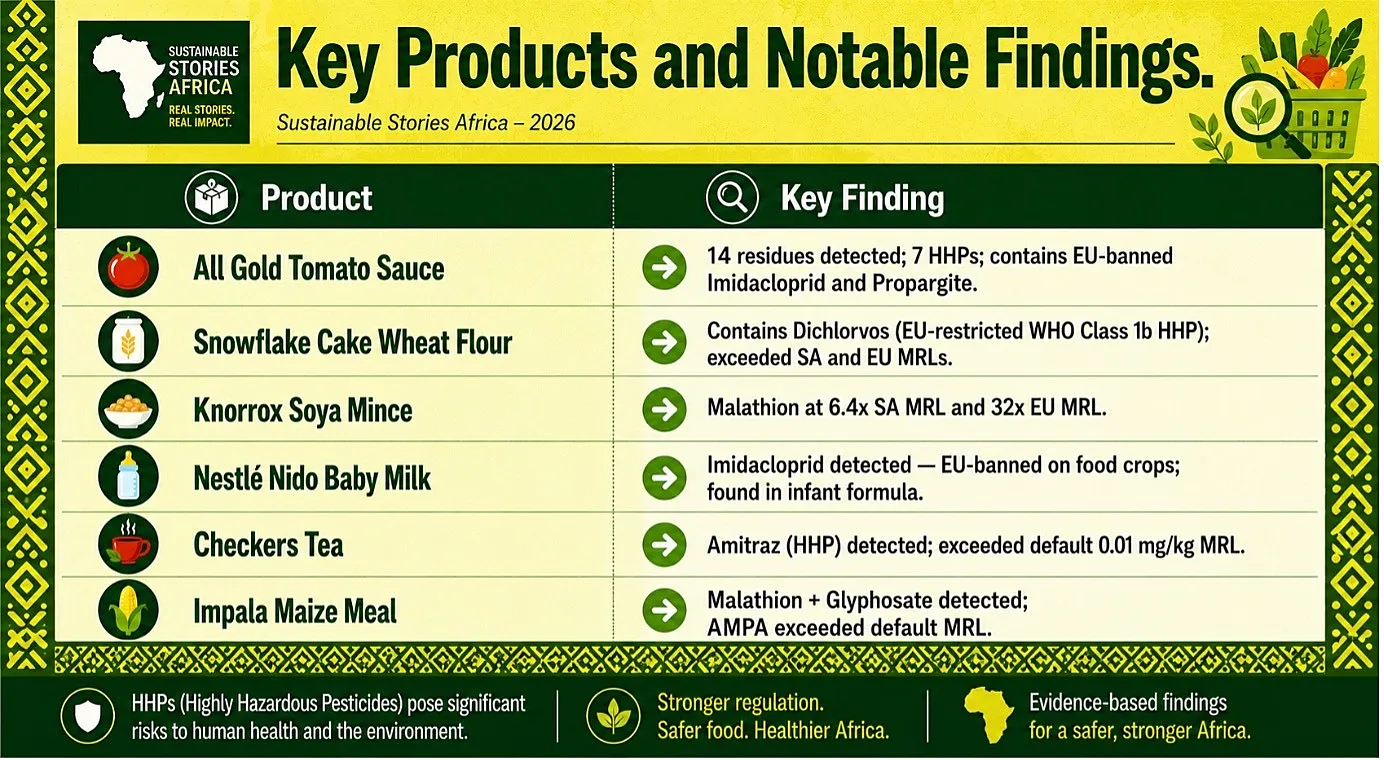
The most contaminated single product was All Gold Tomato Sauce, which contained 14 pesticide residues in one jar, including seven HHPs, two EU-restricted pesticides, and one substance the EU classifies as carcinogenic.
A condiment found in millions of South African kitchens.
What Was Found, and Where
The ACB commissioned a SANAS-accredited laboratory to screen 43 products using liquid chromatography-tandem mass spectrometry (LC-MS/MS), a method capable of detecting hundreds of active ingredients at parts-per-billion concentrations.
Products were purchased between November 2025 and January 2026.
Five of the pesticides detected, Dichlorvos, Imidacloprid, Propargite, Novaluron, and Dimethomorph, are not approved for use on food crops in the European Union.
Two others, Carbendazim and Epoxiconazole, are classified by the EU as carcinogenic, mutagenic, or toxic for reproduction (CMR substances). Both were found in widely consumed South African products.
The study also found 13 product-pesticide combinations that exceeded at least one applicable regulatory benchmark, South African, Codex, EU, or the default 0.01 mg/kg MRL. Knorrox Soya Mince, a popular household staple, contained Malathion at a level 32 times the EU's maximum residue limit.
A Food System That Protects, Not Harms
The same South African producers who supply European export markets must meet strict EU residue standards, and they do.
This means clean production is already technically and economically feasible within the South African agricultural system.
What is absent is not capability. It is regulatory will and institutional architecture. Countries with strong food safety frameworks, mandatory routine testing, public residue databases, child-specific safety factors, and cumulative risk assessment give their citizens a level of protection that South Africans are currently denied.
Reform Cannot Wait
South Africa's Constitution guarantees the right to an environment that is not harmful to health and well-being. The ACB's findings demonstrate that this right is not being upheld in the country's food system.
Policymakers must act urgently: mandate routine food residue testing and public disclosure, use a default MRL of 0.01 mg/kg as a precautionary baseline for all infant foods, initiate phased bans on HHPs, and modernise the 1947 pesticide legislation that still governs the country's regulatory response.
Path Forward – Protecting Every South African Plate
The ACB's six-point recommendations provide a clear roadmap: strengthen child-protective standards, phase out HHPs, align domestic MRLs with international benchmarks, incorporate cumulative risk assessment, improve transparency, and build institutional capacity.
These are not idealistic demands; they are evidence-based reforms already implemented by South Africa's trading partners.
The question is no longer whether the evidence demands action. It does. The question is how fast South Africa's regulators, legislators, and food industry will respond.