Kenya is redirecting more tea towards China and South Africa as instability in Sudan and economic difficulties in Iran disrupt traditional export routes.
The government says duty waivers with key partners are intended to improve competitiveness and reduce concentration risk.
For a sector supporting millions of livelihoods, diversification is not just a trade strategy. It is a resilience strategy that aligns foreign-exchange earnings, rural incomes and the ability to withstand geopolitical shocks.
Tea trade searches for stability
Kenya is widening the market base for its largest agricultural export after China and South Africa gained importance as destinations for Kenyan tea, reducing exposure to disruptions affecting traditional buyers such as Sudan and Iran.
Trade Cabinet Secretary Lee Kinyanjui said the government had concluded import-duty waivers with key partners to improve the competitiveness of Kenyan tea.
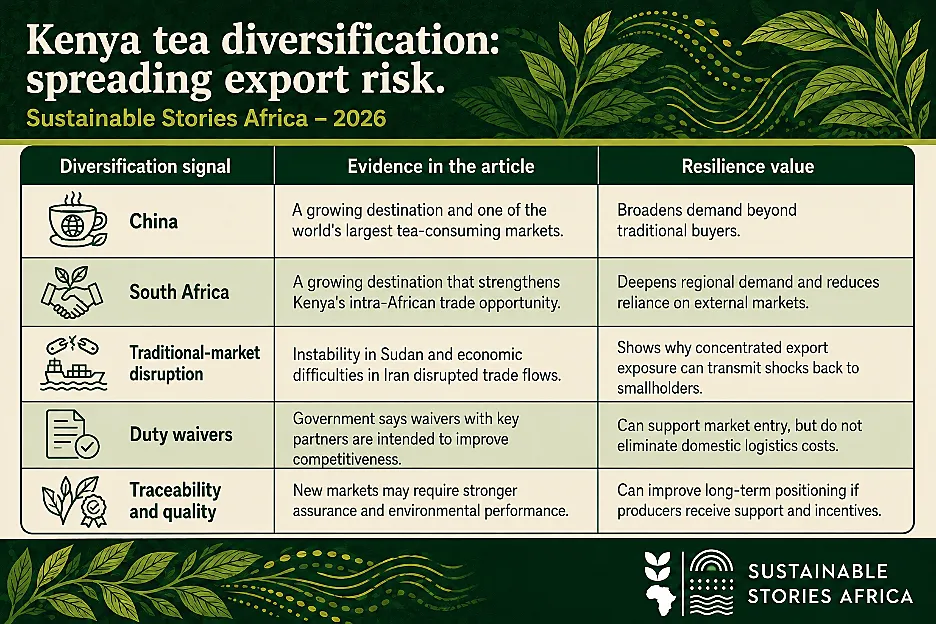
The shift follows instability in Sudan and prolonged economic difficulties in Iran, which disrupted trade flows and exposed the risk of relying heavily on a small group of overseas markets.
For Kenya, tea-market concentration is not an abstract trade statistic.
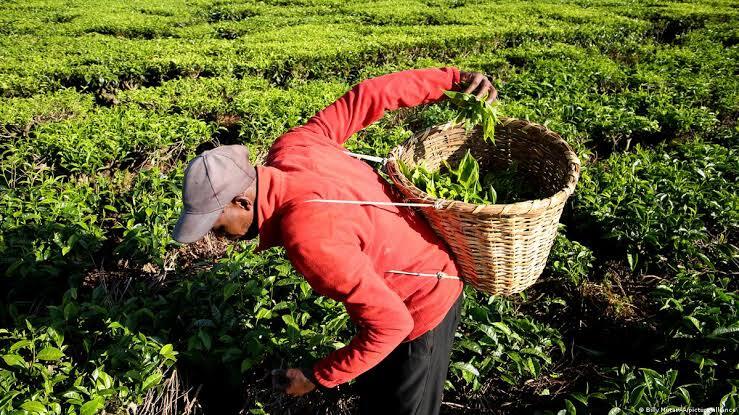
- The sector supports millions of livelihoods across smallholder production, processing, transport and export services, while generating vital foreign exchange.
- When a major destination falters, the shock can travel back through the value chain to factories, cooperatives and farm households.
New buyers change the risk map
China offers access to one of the world's largest tea-consuming markets, while South Africa strengthens the intra-African dimension of Kenya's export strategy.
That regional opportunity is consistent with AfCFTA's objective to expand trade within Africa, thereby reducing excessive dependence on external markets.
- Market diversification can reduce volatility by spreading demand across economies with different political and consumer cycles.
- It can also encourage exporters to adapt products, packaging and marketing to different customer segments rather than competing only through bulk volumes.
Duty waivers can improve price competitiveness; however, they do not remove Kenya's domestic cost problem.
- Exporters continue to face logistics expenses, port charges and inland transport inefficiencies.
- Those costs can determine whether new market access becomes profitable trade or simply a theoretical opportunity.
Improving transport corridors, port performance and digital customs could therefore benefit tea and other export sectors simultaneously.
The competitiveness agenda begins at the farm and factory but continues through every step to the port and final customer.
Diversification can protect rural incomes
A broader market portfolio can stabilise demand and reduce the probability that one geopolitical shock sharply cuts export earnings.
- For smallholders, greater stability can support household income, farm investment and the ability to absorb weather or price shocks.
There is also a sustainability opportunity.
- New markets may demand stronger traceability, quality assurance and environmental performance.
- If producers receive the support and commercial incentives to meet those requirements, diversification can strengthen the long-term positioning of Kenyan tea rather than merely redirect existing volumes.
South Africa's growing role is particularly important because stronger African demand can shorten some trade relationships and deepen regional value chains.
- It also demonstrates that intra-African trade can provide commercially meaningful demand for established export industries, not only future manufacturing ambitions.
That regional demand can become even more valuable when exporters develop products and brands for specific African consumers rather than treating the continent as a secondary market.
Turn market access into resilience
Kenya should treat diversification as a portfolio strategy rather than a one-off response to disruptions.
- Trade promotion requires continuous market intelligence, buyer development and product adaptation, while infrastructure policy reduces the domestic costs that erode competitiveness.
The benefits must also reach producers.
- Export growth that does not improve farmgate returns, productivity or resilience will be difficult to sustain.
Government, processors and farmer organisations should therefore track how new markets affect prices, volumes, payment reliability and smallholder income.
Path Forward – Diversify Markets, Strengthen Farmers
Kenya should deepen buyer relationships in China, South Africa and other markets while lowering logistics costs through improved corridors, ports and digital customs.
Export diversification needs continuous market development, not only tariff concessions.
Government and industry should also track whether new demand improves farmer returns, traceability and resilience.
A stronger tea strategy spreads geopolitical risk while ensuring the value of market access reaches the smallholders whose production sustains the export sector.