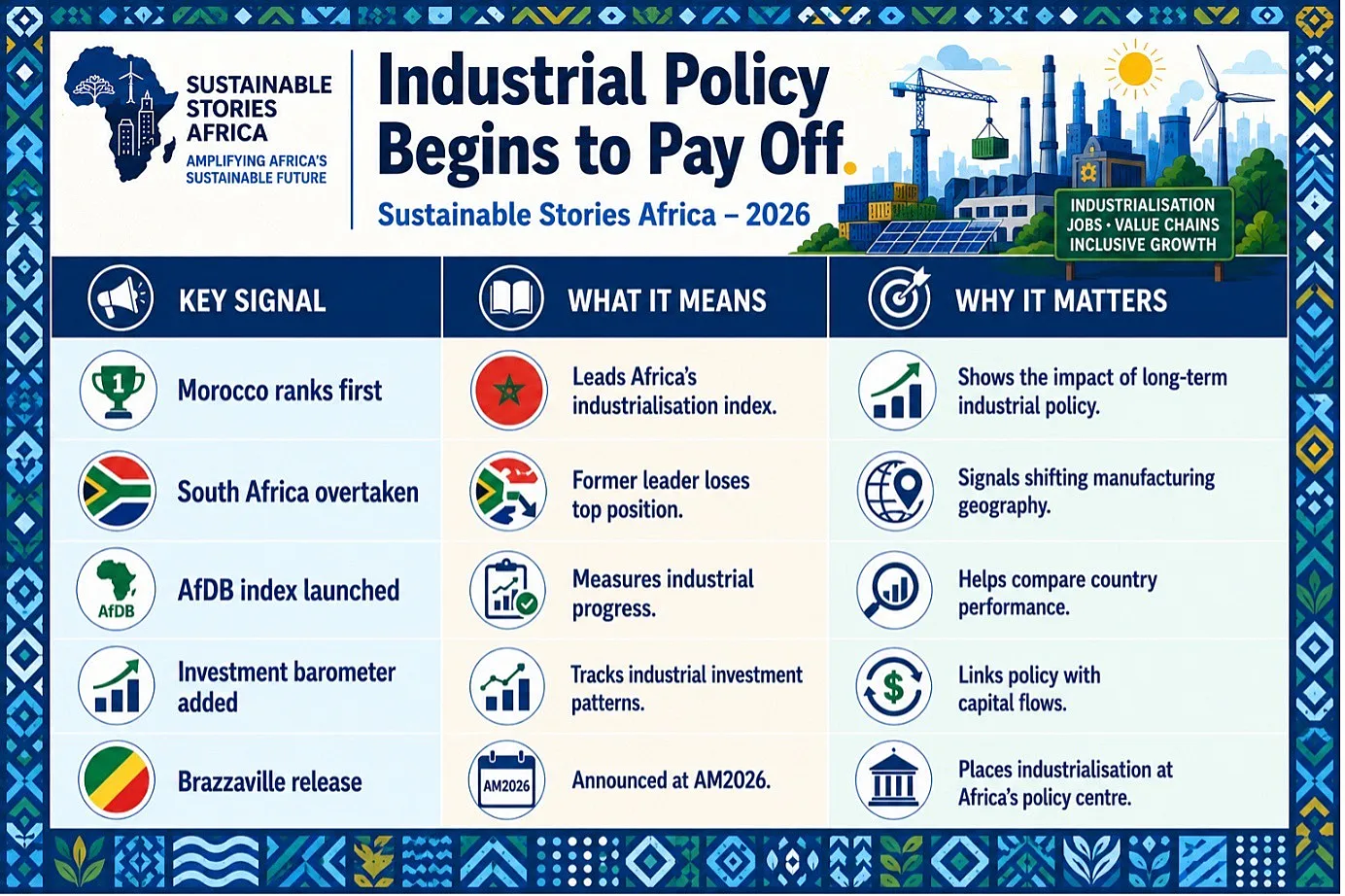
Morocco has been named Africa’s leading industrial economy in a new AfDB index.
The ranking was released during the Bank’s 2026 Annual Meetings in Brazzaville.
Its rise signals a wider contest over manufacturing, export diversification, jobs and investment-led transformation across Africa.
Morocco Takes Africa’s Industrial Crown
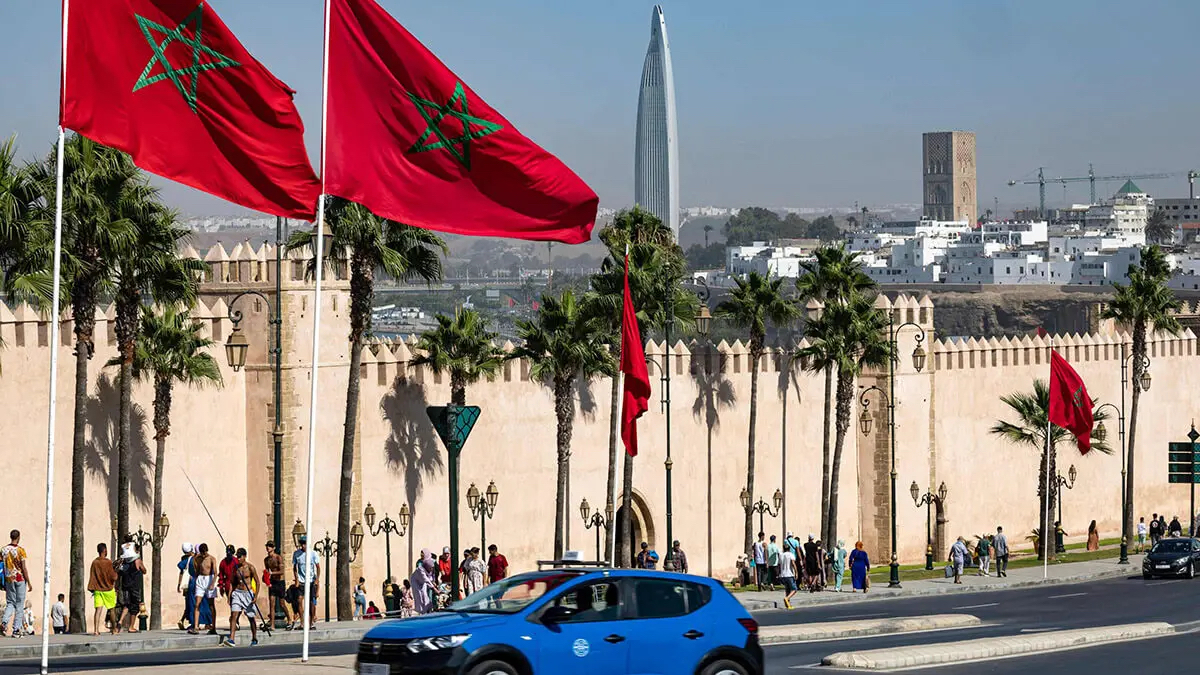
Morocco has overtaken South Africa to become Africa’s leading industrial economy, according to the 2025 Africa Industrialisation Index released by the African Development Bank during its 2026 Annual Meetings in Brazzaville, Republic of the Congo.
The finding marks one of the most striking shifts in the continent’s industrial landscape.
For decades, South Africa was widely seen as Africa’s manufacturing anchor. Morocco’s rise reflects sustained industrial upgrading, export diversification, targeted policy and deeper integration into global value chains.
For African economies seeking jobs, resilience and stronger local production, the message is direct: industrialisation is no longer just about natural resources or market size. It is about strategy, infrastructure, skills, logistics, finance and execution.
Industrial Policy Begins to Pay Off
The AfDB’s new index assesses industrial performance across African economies, while the inaugural Africa Industrial Investment Barometer examines how investment flows are shaping industrial competitiveness across the continent.
Morocco’s leadership reflects years of investment in automotive production, aeronautics, renewable energy, textiles, ports and export-oriented manufacturing.
The country has positioned itself as a production bridge between Africa, Europe and global markets, supported by industrial zones, logistics platforms and policy consistency.
The wider lesson is important for Africa. Industrialisation remains central to moving beyond commodity exports.
Countries that process raw materials, manufacture components, build supplier ecosystems and connect to regional markets are more likely to create productive jobs and reduce exposure to external shocks.
Manufacturing Can Change Livelihoods
For ordinary citizens, industrialisation is not an abstract ranking. It is the difference between exporting raw produce and selling processed goods; between informal work and skilled factory jobs; between importing essential products and building domestic production capacity.
Morocco’s performance shows what can happen when infrastructure, skills, trade policy and investment promotion move in the same direction.
Industrial clusters can attract suppliers. Export industries can train workers. Renewable energy can lower production risk. Ports and logistics corridors can connect firms to buyers faster.
For the rest of Africa, the opportunity is not to copy Morocco exactly; however, it is to learn from the discipline behind its rise.
Nigeria, Egypt, Kenya, Ethiopia, Ghana, Côte d’Ivoire and South Africa all have industrial ambitions; however, competitiveness will depend on consistent execution.
Turn Rankings Into Reform Pressure
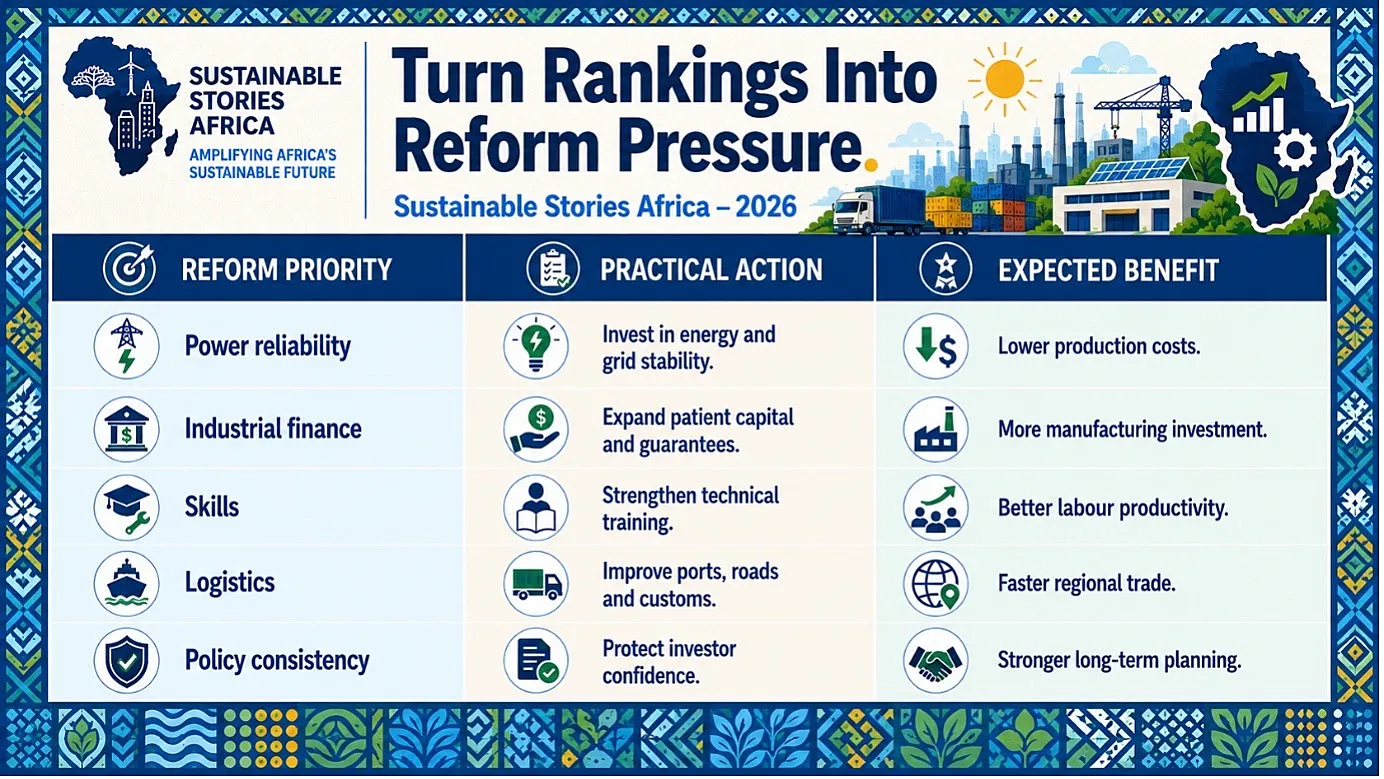
The new index should push African governments to treat industrialisation as a delivery agenda, rather than a slogan. That means building reliable power, reducing logistics costs, improving technical education, expanding industrial finance, and creating stable rules that investors can trust.
Regional integration also matters. The AfCFTA can help African firms scale, but only if countries invest in productive capacity and remove practical trade barriers.
A tariff-free market means little if manufacturers cannot access inputs, meet standards or move goods efficiently.
Investors, development banks and policymakers should use the index as a diagnostic tool.
The question is not only who ranks first, but what each country must fix to become more competitive.
Path Forward – Build Industry With Discipline
Morocco’s rise gives Africa a clear signal: industrial leadership follows strategy, infrastructure and execution.
The ranking should encourage countries to benchmark honestly and reform deliberately.
The path forward is practical: strengthen industrial ecosystems, scale regional value chains, finance local production and align manufacturing with climate-smart growth.
Africa’s next industrial leaders will be those who convert policy ambition into competitive firms and decent jobs.
Culled From: AM2026: Morocco named Africa’s industrialization leader in new African Development Bank Index