
Nigeria earned N998.5 billion from petrol exports in the first half of 2026.
The shift matters because petrol was absent from the country's leading exports in early 2025.
It signals a changing trade profile, though regulatory disputes still cloud the transition.
A Reversal in Fuel Trade
Nigeria earned N998.5 billion ($752.7 million) from petrol exports in the first half of 2026, as rising output at the Dangote Refinery reduced reliance on imports and created exportable surpluses, according to SBM Intelligence.
The figure is more than six times the previous year's, and African buyers took over 60% of it, worth N621.72 billion.
Second-quarter exports alone reached N546.02 billion, making petrol Nigeria's seventh-largest export commodity.
In the first quarter of 2025, petrol did not feature among the country's leading exports. In the same quarter, Nigeria spent N1.76 trillion importing it.
For a country long defined by queues at filling stations and heavy foreign-exchange spending on refined fuel, the reversal is striking.
It also raises a harder question: is the gain sustainable and shared?
A Transition That Is Not Smooth
The downstream sector has entered a phase of structural change, and the change is contested.
- The Dangote Refinery sits at its centre, and its ramp-up has altered the country's trade profile.
- Policy and legal friction has followed.
The Federal High Court ordered the Nigerian Midstream and Downstream Petroleum Regulatory Authority (NMDPRA) to keep issuing and renewing import licences for Matrix Energy, AA Rano and AYM Shafa.
- The ruling shows that import interests are still defending their place in the market.
Crude supply to domestic refiners shows a second tension.
- The Nigerian Upstream Petroleum Regulatory Commission (NUPRC) said producers offered 182 million barrels to domestic refiners between January and August, above the 154.6 million-barrel requirement.
- Only 112 million barrels were transacted.
The NMDPRA also plans to end regulated domestic gas pricing by September 2028, subject to better market conditions and infrastructure.
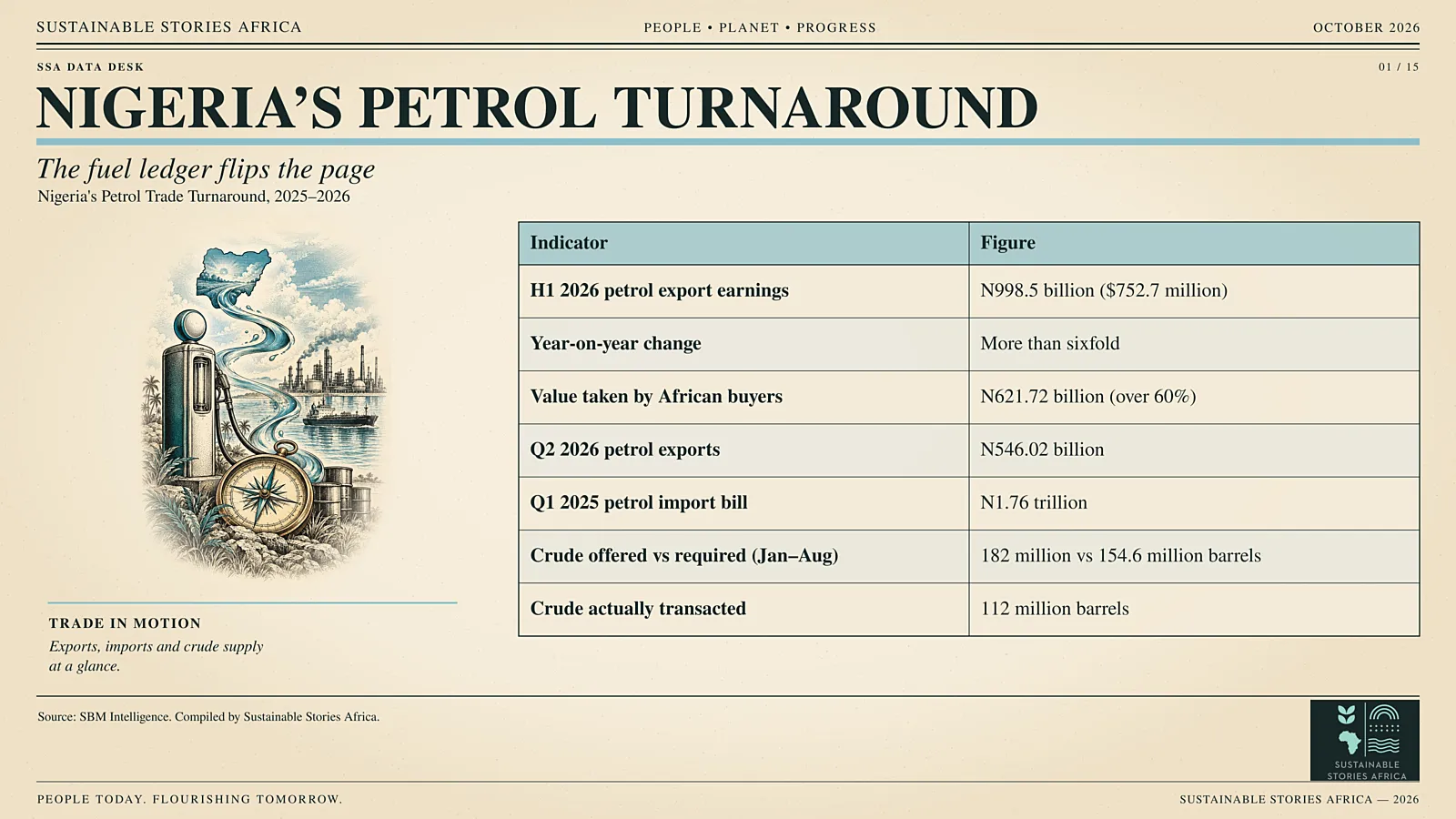
The table shows that crude availability is not the only constraint.
- Producers offered about 27 million barrels more than the required volume.
- However, only 112 million barrels changed hands.
That gap points to pricing, contracting or logistics frictions that merit scrutiny.
What Is at Stake
If export growth holds, Nigeria keeps more foreign exchange at home and builds trade ties with regional buyers across Africa.
- A country that once drained reserves on fuel imports could instead earn from supplying its neighbours.
The risk lies in concentration.
- If licensing disputes and weak crude-to-refinery transactions persist, the gains stay tied to a single corporate entity and remain fragile.
- Energy security, jobs and revenue then depend on one operator's performance rather than a diversified downstream sector.
What Must Happen Next
Regulators should publish clear licensing rules and resolve court-linked disputes quickly, so investors and importers understand the market terms.
Producers and refiners should close the gap between crude offered and transacted.
Policymakers should also treat gas pricing reform as an infrastructure and market question.
Reform timelines work only if pipelines, processing capacity and buyers are in place.
Path Forward – Turning Fuel Exports Into Lasting Resilience
Priorities include transparent import licensing, smoother domestic crude supply and regulating gas pricing by September 2028.
Success depends on better infrastructure and market conditions, so export gains build broader energy security rather than reliance on one refinery.
Culled from: Nigeria earns billions selling what it imported