
Ugandan companies are steadily integrating environmental, social, and governance (ESG) principles into their operations.
What began as a compliance exercise is evolving into a strategic business tool.
From climate reporting to community engagement, ESG is reshaping how firms manage risk, attract capital, and build trust.
Uganda's ESG Turning Point
Ugandan businesses are gradually embedding ESG into their corporate strategies, driven by regulatory expectations, investor pressure, and growing awareness of sustainability risks.
According to a KPMG Uganda survey reported by Consultancy Africa, ESG adoption is no longer limited to multinational corporations. Local firms across finance, manufacturing, and energy are integrating sustainability into governance, reporting, and operational decision-making.
The shift signals a broader transformation in how Ugandan businesses view long-term value creation.
ESG Becomes a Business Priority
ESG is no longer optional for companies in Uganda.
Climate risks, social expectations, and governance standards are reshaping how businesses operate, report, and compete. Investors increasingly demand transparency on environmental impact, labour practices, and board oversight.
For many organisations in Uganda, ESG is moving from a regulatory obligation to a strategic advantage, one that strengthens resilience and market credibility.
What the KPMG Survey Reveals
KPMG's findings highlight a gradual but clear shift toward structured ESG practices:
| ESG Area | Current Trend | Business Impact |
|---|---|---|
| Environmental | Climate risk awareness rising | Improved risk management |
| Social | Employee welfare prioritised | Stronger workforce trust |
| Governance | Board oversight strengthening | Better accountability |
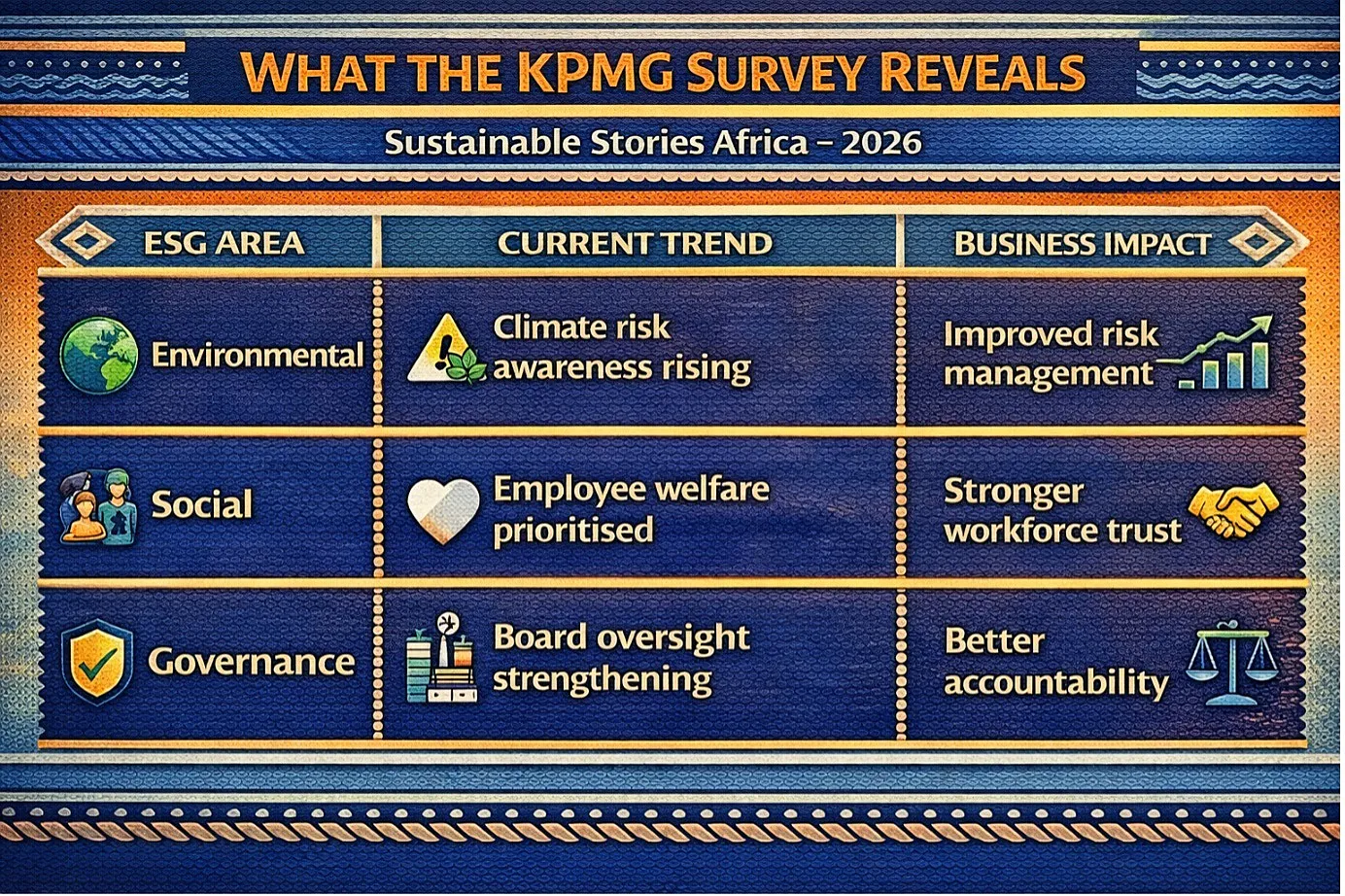
Most companies now recognise climate change as a material risk. Social factors such as health, safety, and inclusion are becoming prominent, while governance reforms focus more on transparency and ethical leadership.
However, ESG maturity varies widely. Larger organisations are leading adoption, while small and medium-scale enterprises often lack resources and technical capacity.
Why ESG Matters for Growth
Strong ESG practices can deliver measurable benefits:
- Improved access to international finance
- Stronger brand reputation
- Reduced regulatory and climate risks
- Better employee retention
- Long-term business resilience
For Uganda's growing private sector, ESG offers a pathway to sustainable competitiveness. Firms that align with global standards are better positioned to attract foreign investment and expand into regional markets.
Failure to adapt, however, could isolate businesses from capital and partnerships.
Closing Uganda's ESG Gaps
To accelerate ESG adoption, stakeholders must:
- Strengthen regulatory clarity
- Expand ESG training for SMEs
- Improve sustainability reporting frameworks
- Encourage private-sector transparency
- Support climate-risk integration
Partnerships between regulators, financial institutions, and professional bodies will be essential in building a consistent ESG ecosystem.
Path Forward – Building Uganda's Sustainable Business Future
Uganda's ESG journey is gaining momentum, but progress remains uneven. Stronger guidance, capacity building, and consistent reporting can help businesses turn sustainability into a competitive advantage.
By embedding ESG into corporate culture, Ugandan firms can improve resilience, attract investment, and support inclusive economic growth.
Culled From: https://www.consultancy.africa/news/2230/businesses-in-uganda-are-gradually-embracing-esg-says-kpmg