Global leaders are being tested like never before, as uncertainty reshapes economic, political, and social landscapes.
From inflation shocks to climate risks and digital disruption, decision-making now demands adaptability rather than prediction.
Experts say leadership success in 2026 will depend less on control and more on resilience, scenario thinking, and the ability to act decisively amid ambiguity.
Uncertainty Becomes the New Normal
From geopolitical tensions and climate shocks to inflation, AI disruption, and supply-chain instability, uncertainty is no longer an occasional challenge; it is the operating environment.
Leadership models built around predictability and long-term forecasting are being replaced by agile decision-making, rapid learning, and scenario-based planning.
"Today's leaders must act without perfect information," governance experts say. "Waiting for certainty is no longer an option."
Why Traditional Leadership Models Are Failing
For decades, leaders relied on linear strategies, stable assumptions, and detailed forecasts. But the global operating environment has become more volatile, complex, and interconnected.
Economic policies shift quickly. Climate risks disrupt operations. Digital platforms reshape markets overnight.
In this context, leaders who demand full clarity before acting risk falling behind.
Sources of Modern Leadership Uncertainty
| Risk Driver | Impact on Leadership |
|---|---|
| Geopolitics | Trade and policy instability |
| Climate change | Operational disruptions |
| Technology | Rapid business model shifts |
| Inflation | Cost and pricing volatility |
| Regulation | Compliance complexity |
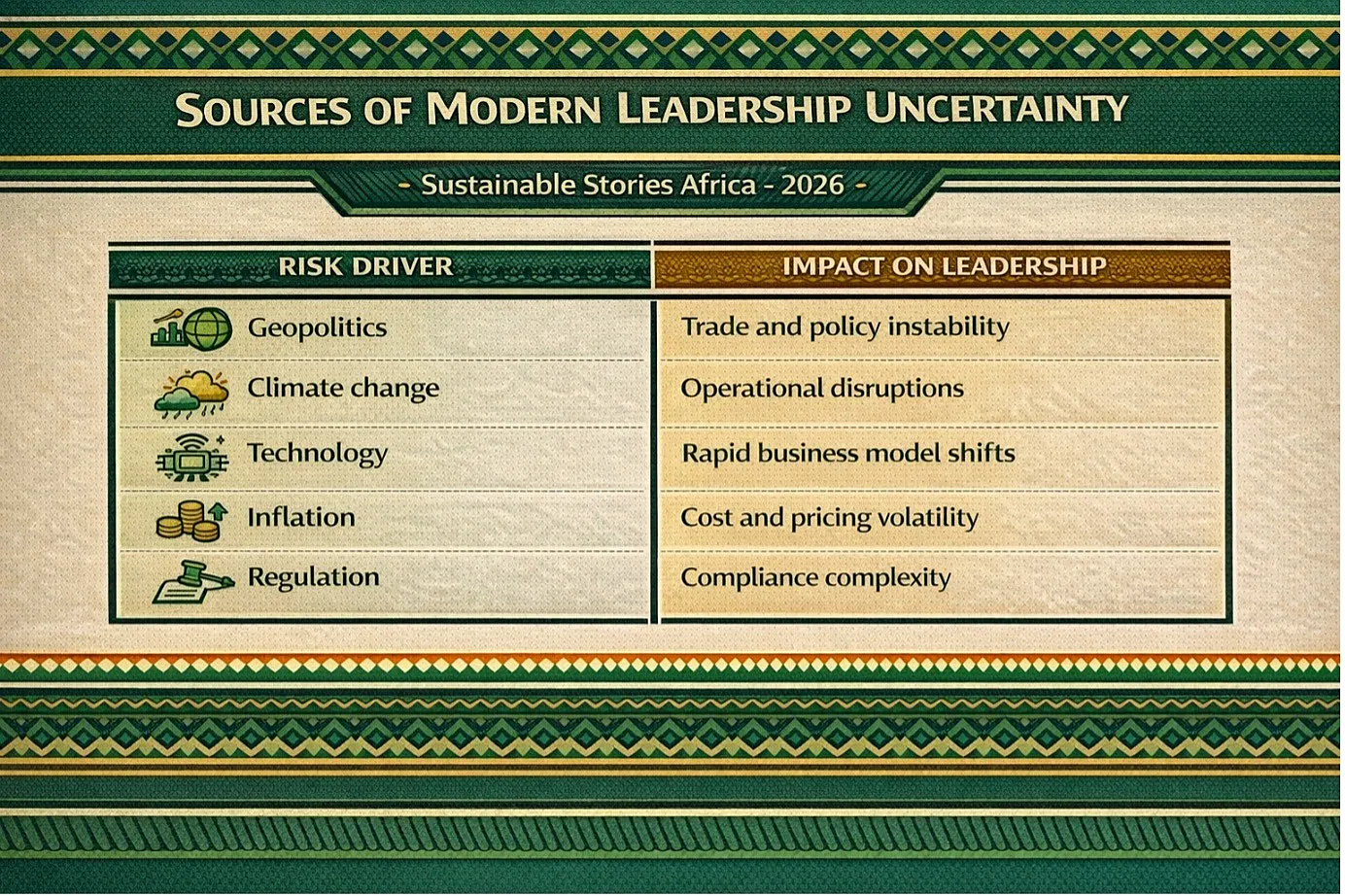
Experts argue that uncertainty is no longer something to be "solved" but something to be managed.
From Control to Adaptability
The most effective leaders are shifting from control-based management to adaptability-driven leadership.
Rather than chasing certainty, they focus on:
- Scenario planning
- Real-time data
- Diverse perspectives
- Decentralised decision-making
They also invest in psychological resilience, both personally and across their teams.
Leadership Skills for Uncertain Times
| Capability | Purpose |
|---|---|
| Scenario thinking | Prepare for multiple futures |
| Emotional resilience | Manage stress and ambiguity |
| Rapid learning | Adjust strategies quickly |
| Trust-building | Empower teams to act |
| Clear communication | Reduce uncertainty anxiety |
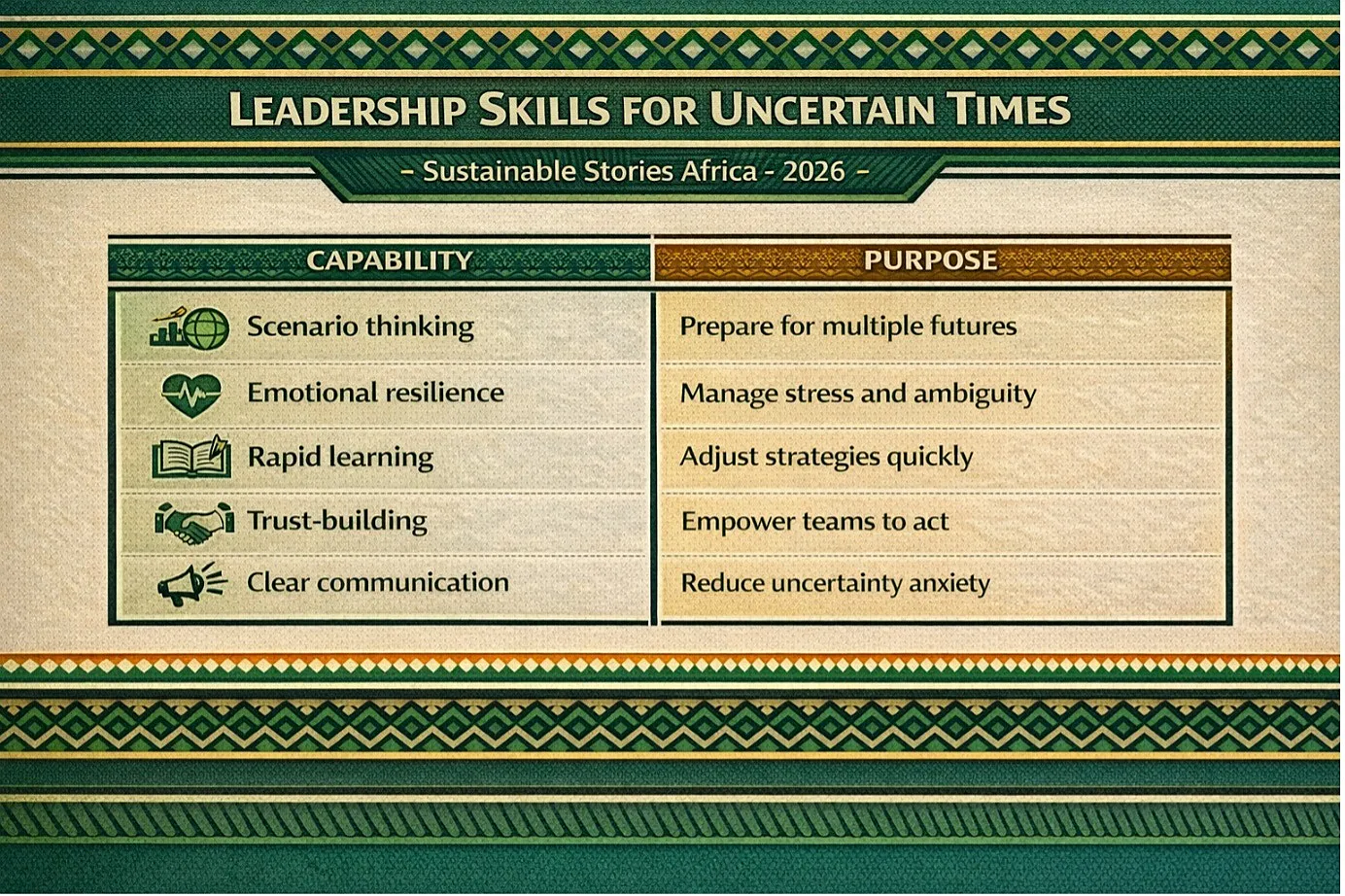
Leadership, experts say, is no longer about having all the answers, but about asking better questions.
How Leaders Can Build Uncertainty Tolerance
Organisations that perform well under uncertainty adopt practical strategies:
- Normalise ambiguity – Treat uncertainty as a constant, not a crisis.
- Strengthen decision speed – Make informed choices with partial data.
- Encourage experimentation – Pilot solutions before scaling.
- Build resilient teams – Invest in leadership development and mental well-being.
- Communicate transparently – Share risks honestly with stakeholders.
Employees who feel informed and trusted are more likely to perform confidently in unpredictable environments.
PATH FORWARD – Leading Without Perfect Answers
Uncertainty is not a leadership weakness; it is a leadership reality. The most effective leaders embrace ambiguity, build resilient systems, and empower teams to act with confidence.
By shifting from prediction to preparation, leaders can navigate disruption while sustaining trust, performance, and long-term value.
Culled From: Leaders, It's Time to Build Your Tolerance for Uncertainty