African CEOs are navigating a volatile global economy with renewed confidence, driven by strategic investments in artificial intelligence, workforce development, and ESG integration.
Confidence Amid Global Uncertainty – Africa's Corporate Resilience Playbook
Across Africa, a quiet but determined confidence is taking hold in corporate boardrooms. While global CEOs report declining optimism about the world economy, African business leaders remain focused on strengthening their own organisations through technology, talent, and sustainability.
According to the KPMG 2025 Africa CEO Outlook, 79% of African CEOs are confident in their organisations' growth prospects, supported by strong investments in AI (61%) and the retention and retraining of high-potential talent (62%).
This optimism is not passive. Almost 69% of African CEOs have already realigned their growth strategies to respond to intertwined pressures of tighter regulation, rising cybersecurity threats and accelerating demands for digital transformation.
Looking ahead, most anticipate rising revenues and expanded workforces over the next three years.
In a business climate defined by volatility, Africa's CEOs are not retreating. They are recalibrating.
Leaders Reframe Growth in Uncertain Times
Global economic confidence has dropped to a five-year low, with only 53% of African CEOs confident in the global economy's growth prospects. However, confidence rises sharply when leaders assess their own organisations. Almost 78% express optimism about company growth, nearly matching the global average of 79%.
Confidence is also reflected in expansion plans. Almost 86% of African CEOs expect to pursue acquisitions within the next three years, up from 77% in 2024, signalling an appetite for partnerships and scale.
However, optimism is tempered by realism. African CEOs identify three dominant pressures shaping short-term decisions:
- AI integration into operations (32%)
- Regulatory pressures (25%)
- Cybersecurity risks (24%)
These challenges are redefining leadership expectations across the continent.
Where CEOs Are Investing to Stay Competitive
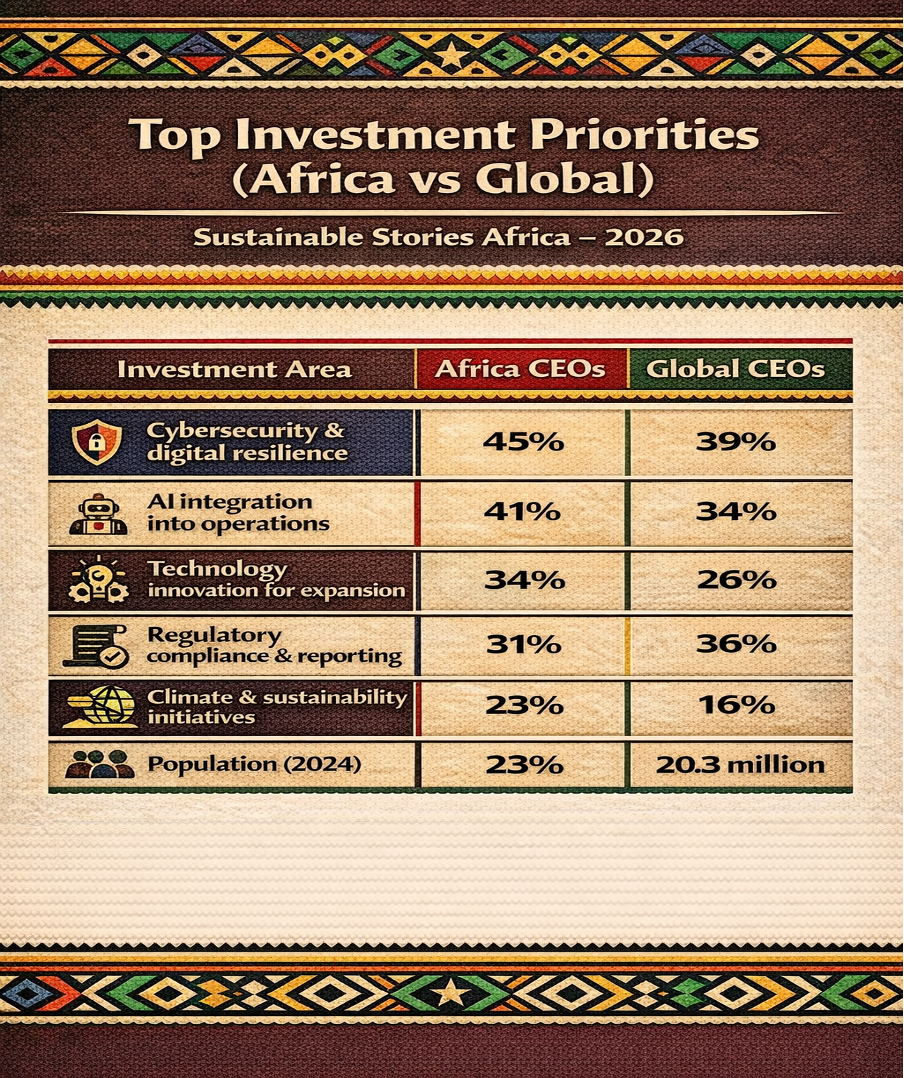
To navigate this complex environment, African CEOs are becoming more deliberate in allocating capital.
Top Investment Priorities (Africa vs Global)
| Investment Area | Africa CEOs | Global CEOs |
|---|---|---|
| Cybersecurity & digital resilience | 45% | 39% |
| AI integration into operations | 41% | 34% |
| Technology innovation for expansion | 34% | 26% |
| Regulatory compliance & reporting | 31% | 36% |
| Climate & sustainability initiatives | 23% | 16% |
Leadership capabilities are evolving in step with these shifting priorities. African CEOs now rank digital and AI literacy as the most critical leadership skills, followed closely by the ability to remain agile under pressure and to understand the strategic implications of AI.
Tola Adeyemi, CEO of KPMG West Africa, notes that today's leaders must go beyond strategy: "Modern leadership requires CEOs to be communicators, innovators, and champions of change."
Why AI and Talent Are Africa's Growth Engines – AI: From Experiment to Strategic Lever
Despite economic caution, AI remains a top strategic priority. Almost 14% of African CEOs plan to allocate more than 20% of their annual budgets to AI, compared to 26% globally.
Infrastructure constraints, including unreliable power, limited broadband, and high computing costs, continue to slow adoption. However, 34% of African CEOs are investing in technology and solution innovation, exceeding global peers at 26%.
A major barrier remains data readiness. Almost 96% of African CEOs say data limitations challenge AI implementation, largely because global AI models are trained on Western datasets that reflect African contexts poorly.
Talent: Africa's Strategic Advantage
African CEOs are betting on people as much as technology:
- 81% say AI upskilling will directly impact organisational success
- Only 64% worry about AI talent competition, versus 70% globally
- 67% are redeploying staff into AI-enabled roles
Africa's younger workforce offers a demographic advantage. Just 15% report generational skills gaps, compared with 30% of global CEOs. This gives African firms more time to build future-ready talent pipelines.
Segun Sowande, Partner at KPMG Africa, observes: "Africa CEOs are communicating openly with employees about the impact of AI on their roles, reinforcing trust and transparency."
ESG Moves from Compliance to Strategy
ESG alignment is increasingly central to corporate strategy.
- 46% of African CEOs align sustainability goals with core business strategies.
- 51% prioritise compliance and reporting.
- 79% are confident in their ability to navigate ESG regulatory differences.
However, regulatory fragmentation remains a major hurdle. Almost 22% cite decarbonising supply chains as the top barrier to achieving climate goals, alongside skills shortages and policy complexity.
Only 12% of African CEOs demonstrate a fully embedded commitment to ESG, compared with 30% globally, underscoring the urgent need to turn sustainability intentions into concrete execution.
Benson Ndung'u, CEO of KPMG East Africa, reflects: "While African CEOs face unique challenges, the drive for innovation and diverse approaches to sustainability demonstrate their resolve to adapt and lead."
AI is also emerging as an enabler for sustainability. Around 78–79% of African CEOs believe AI can improve emissions reduction, climate risk modelling, and sustainability data quality.
What Must Happen Next
To remain competitive in 2026 and beyond, African CEOs must:
- Embed trusted AI frameworks – Integrate cybersecurity, ethics, and governance into AI systems.
- Build African data ecosystems – Invest in local datasets to reduce AI bias and improve relevance.
- Accelerate workforce transformation – Expand AI training, redeployment, and leadership capability building.
- Strengthen ESG execution – Move from compliance to measurable sustainability value in capital decisions.
With 88% of African CEOs planning to increase headcount, AI is viewed as a tool to complement human capability.
Path Forward – A Resilient Corporate Future
African CEOs are reshaping growth strategies around AI adoption, talent development, and ESG alignment to strengthen resilience amid global uncertainty.
The next phase will demand deeper data readiness, stronger regulatory engagement, and workforce transformation to ensure Africa's growth remains competitive, inclusive, and sustainable.