Humanitarian funding cuts are pushing millions across West and Central Africa closer to hunger and malnutrition, the UN World Food Programme warns.
More than three million people now face emergency food insecurity, while 13 million children are at risk of malnutrition this year.
With Nigeria, Chad, Cameroon and Niger hardest hit, aid agencies say communities are reaching a breaking point.
Hunger Risks Reach Breaking Point
Aid cuts are driving millions across West and Central Africa deeper into hunger, with over three million now projected to face emergency food insecurity, according to WFP's latest analysis using the Cadre Harmonisé scale (1–5, where 5 signals catastrophe/famine).
The agency also projects 13 million children will suffer malnutrition this year.
Nigeria, Chad, Cameroon and Niger account for 77% of the region's food insecurity burden, including 15,000 people in Nigeria's Borno State at risk of catastrophic hunger for the first time in nearly a decade.
Funding Cuts, Rising Hunger
Conflict, displacement and economic turmoil have been driving hunger, but WFP says humanitarian funding slashes are now pushing communities beyond coping limits.
"The reduced funding we saw in 2025 has deepened hunger and malnutrition across the region," said Sarah Longford, WFP Deputy Regional Director.
"As needs outpace funding, so too does the risk of young people falling into desperation."
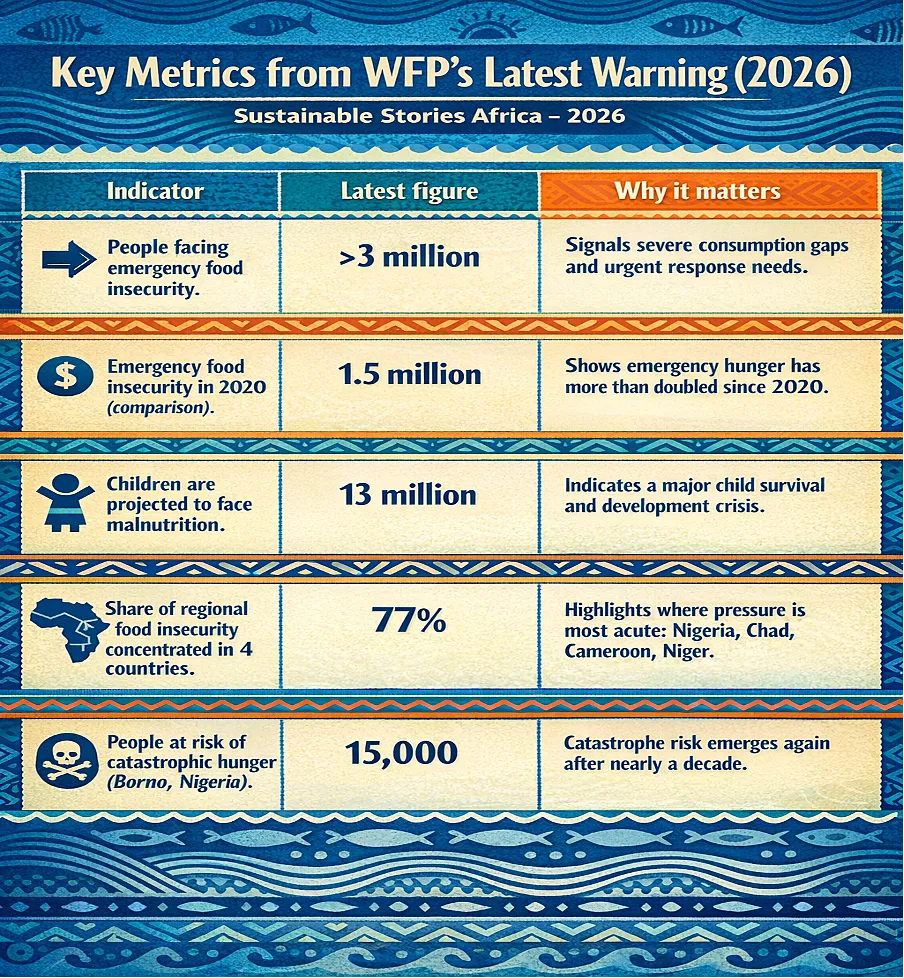
Key Metrics from WFP's Latest Warning (2026)
| Indicator | Latest figure | Why it matters |
|---|---|---|
| People facing emergency food insecurity | >3 million | Signals severe consumption gaps and urgent response needs |
| Emergency food insecurity in 2020 (comparison) | 1.5 million | Shows emergency hunger has more than doubled since 2020 |
| Children projected to face malnutrition | 13 million | Indicates a major child survival and development crisis |
| Share of regional food insecurity concentrated in 4 countries | 77% | Highlights where pressure is most acute: Nigeria, Chad, Cameroon, Niger |
| People at risk of catastrophic hunger (Borno, Nigeria) | 15,000 | Catastrophe risk emerges again after nearly a decade |
What Works When Support Holds
WFP says it urgently needs $453 million over the next six months to sustain humanitarian assistance. Where aid is sustained, outcomes improve.
In Mali, reduced rations coincided with a 65% surge in acute hunger (IPC 3+) since 2023, compared with a 34% decrease in communities receiving full rations. Continued insecurity has disrupted supply lines, and 1.5 million vulnerable people are on track to face crisis hunger.
In Nigeria, funding shortfalls forced WFP to scale down nutrition programmes, affecting over 300,000 children; malnutrition in several northern states has worsened from "serious" to "critical."
WFP expects to reach 72,000 people in February, down from 1.3 million assisted during the 2025 lean season. In Cameroon, 500,000+ vulnerable people risk losing assistance soon.
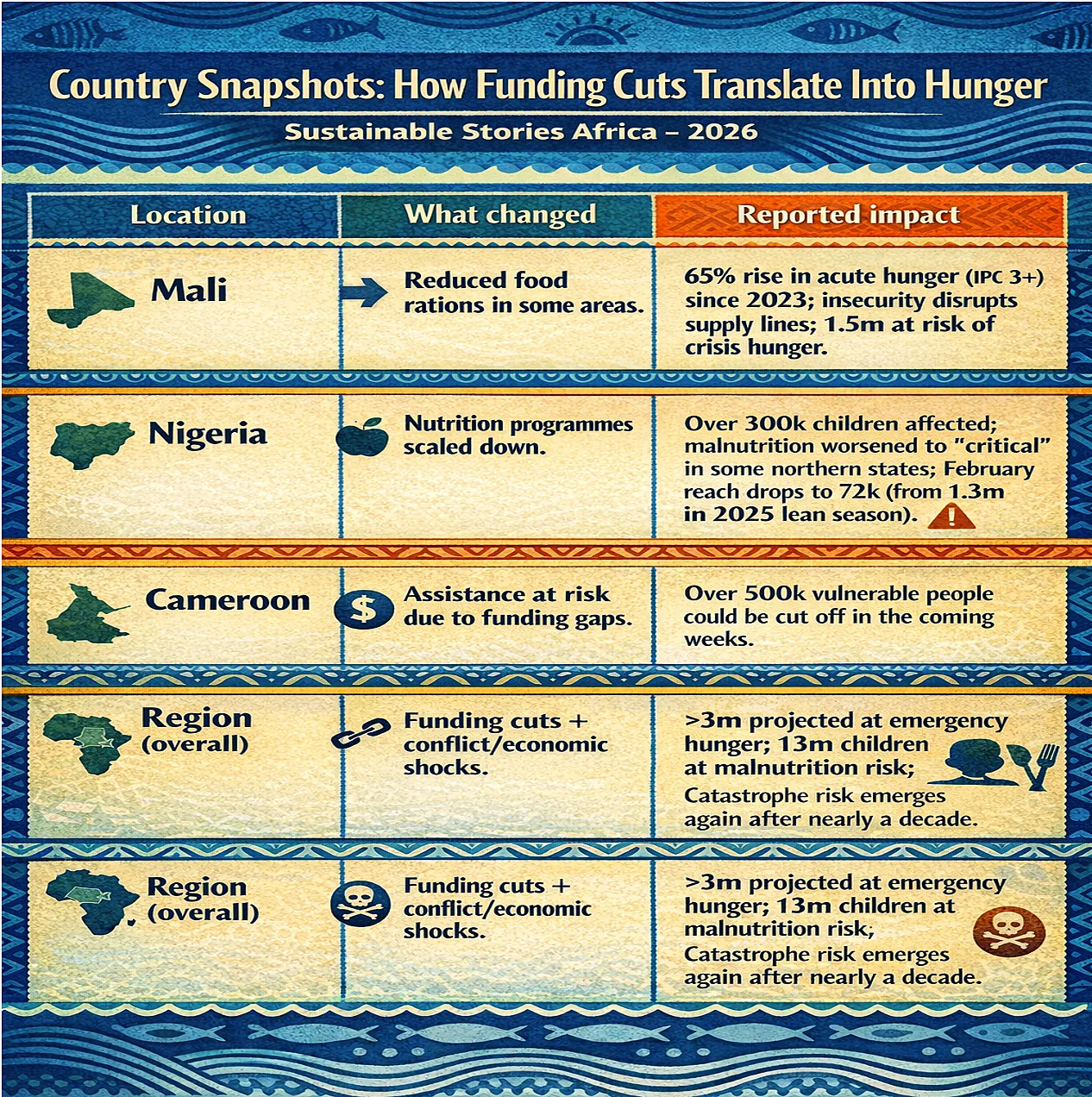
Country Snapshots: How Funding Cuts Translate Into Hunger
| Location | What changed | Reported impact |
|---|---|---|
| Mali | Reduced food rations in some areas | 65% rise in acute hunger (IPC 3+) since 2023; insecurity disrupts supply lines; 1.5m at risk of crisis hunger |
| Nigeria | Nutrition programmes scaled down | Over 300k children affected; malnutrition worsened to "critical" in some northern states; February reach drops to 72k (from 1.3m in 2025 lean season) |
| Cameroon | Assistance at risk due to funding gaps | Over 500k vulnerable people could be cut off in the coming weeks |
| Region (overall) | Funding cuts + conflict/economic shocks | >3m projected at emergency hunger; 13m children at malnutrition risk |
A Call for a 2026 Shift
WFP says breaking the cycle requires more than emergency food: it needs preparedness, anticipatory action, and resilience-building.
"To break the cycle of hunger for future generations, we need a paradigm shift in 2026," Longford said, urging governments and partners to invest early, before crisis becomes a catastrophe.
Path Forward – Invest Early, Prevent Catastrophe
The priority is predictable financing for food, nutrition, and resilience programmes, especially in hotspots where needs are accelerating faster than budgets.
WFP's "paradigm shift" agenda centres on preparedness and anticipatory action, strengthening local capacity so communities can absorb shocks without sliding into emergency hunger.
Culled From: https://news.un.org/en/story/2026/01/1166776