Nigeria's largest listed companies have crossed a meaningful threshold. 15 of NGX30 firms produce standalone sustainability reports for the year ended December 31, 2024, and nine earn an "Excellent" rating on Sustainable Stories Africa's 25-point ESG framework.
However, beneath the numbers, three critical gaps. The absence of full external assurance, weak Scope 3 disclosure, and a zero just-transition planning threaten to undermine that progress as mandatory IFRS S1/S2 reporting approaches in 2028.
- The question is no longer whether Nigeria's corporate elite takes ESG seriously. They do.
- The question is whether they are building for accountability or for appearance.
As this landmark SSA review reveals, it is still both, and the window to fix that is closing fast.
Nigeria at a Crossroads on ESG
Nigeria's corporate sustainability story has long been told in fragments, scattered disclosures, selective metrics, and ESG sections buried in annual reports few read closely. That era is ending.
All 15 companies profiled in the SSA NGX30 Sustainability Report Review 2024 have issued standalone sustainability reports consecutively from 2022 to 2024, signalling that ESG is no longer a footnote but increasingly embedded in how Nigeria's most prominent listed firms assess performance, risk, and long-term impact.
Sustained across three reporting cycles, this consistency reflects deliberate boardroom choices about transparency, investor confidence, and access to capital in a largely voluntary reporting market.
The review arrives at a pivotal moment. Nigeria's Financial Reporting Council (FRCN) is advancing a phased SRG 01 roadmap aligned with IFRS S1 and S2, voluntary to 2027, mandatory from 2028, and the Securities and Exchange Commission’s (SEC) Road Map request, with a deadline of October 15, 2026.
The question is no longer whether companies report. It is whether they report with the credibility global capital demands.
Nine Stars and a Structural Silence
Nine companies earned SSA's Excellent rating. None articulated a just-transition plan. That contradiction is the story.
MTN Nigeria and Seplat Energy jointly led the 15-company cohort with 23 points out of 25 on SSA's five-category framework, which assessed Framework Alignment, Materiality, Data Quality, Transparency, and Impact Orientation.
Stanbic IBTC has already received the FRCN's in-principle approval to adopt voluntary IFRS Sustainability Disclosure Standards from 2025. These are meaningful milestones.
However, across all 15 companies reviewed, three structural gaps are so widespread they constitute a systemic failure:
- External assurance over sustainability data is rare
- Scope 3 emissions disclosure remains weak or absent
- Outcome-level social metrics are still underdeveloped.
Most critically, no company explicitly articulated a just-transition plan, that strategic document that would tell Nigeria's workers, farming communities, and oil-delta residents what corporate decarbonisation means for their livelihoods.
For a country targeting net-zero by 2060, whose energy transition will reshape livelihoods from the Niger Delta to northern agricultural belts, that silence is not neutral.
It is a material gap and central argument of this article.
Who Leads, Who Lags, and What the Data Actually Show
Strong performers are redefining what Nigerian ESG looks like; however, the gaps tell a harder story.
Among the NGX30 cohort, the reporting leaders are setting a high bar.
- MTN Nigeria's 2024 Sustainability Report stands as one of the clearest examples of ISSB/IFRS S1 and S2 alignment, mapping governance, strategy, risk, and metrics to IFRS requirements, including climate-scenario analysis and financial-effects disclosures.
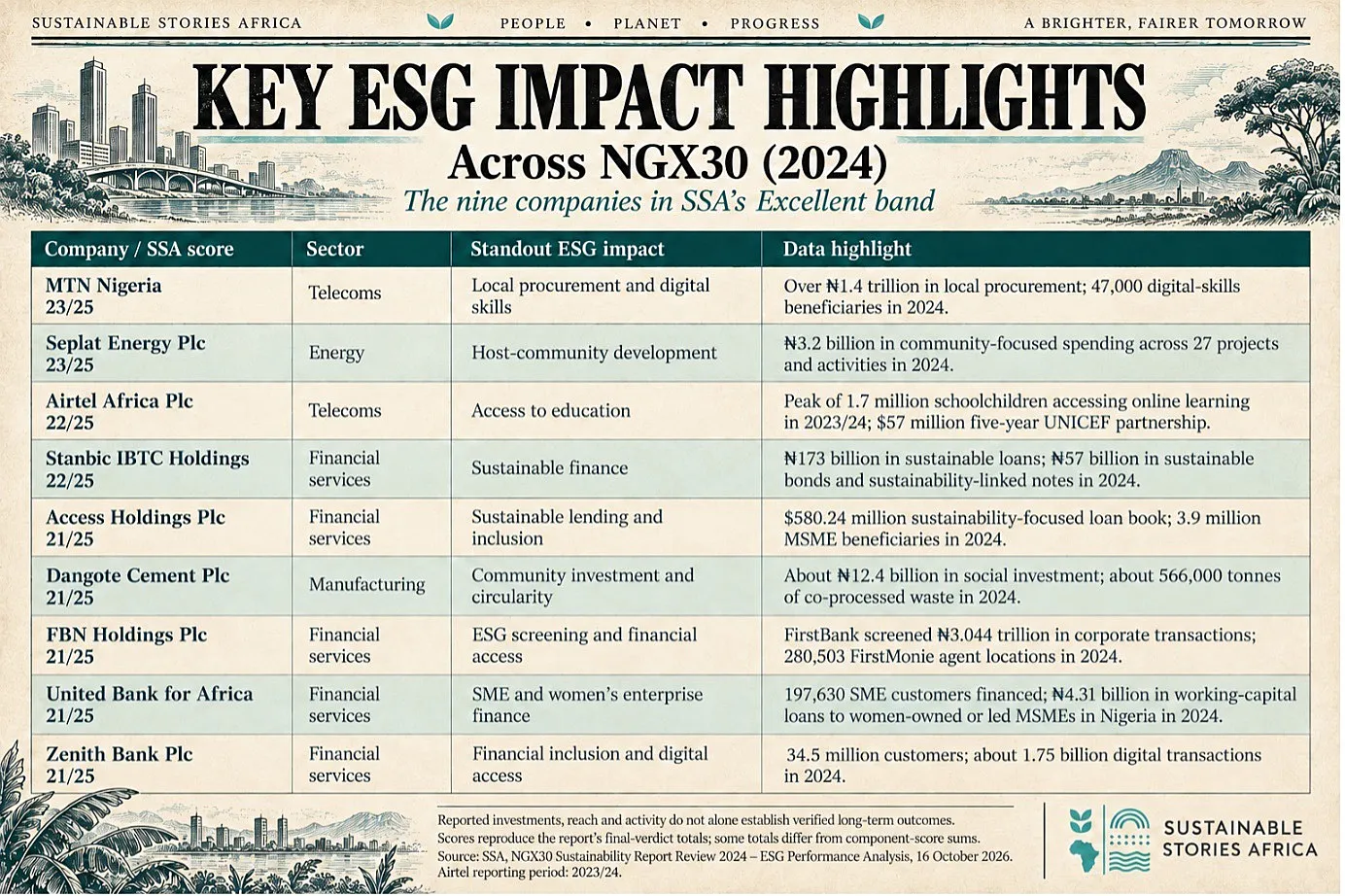
- Seplat Energy, awarded Best in Sustainability Reporting by ICAN/NGX, engaged 175,000 stakeholders through PIA-aligned community governance frameworks and disclosed Scope 1, 2, and six Scope 3 emission categories with clear baselines.
- Dangote Cement invested N12.4 billion in community development in 2024, a 427% increase from N2.4 billion in 2023, reaching 119,637 beneficiaries during its Sustainability Week.
- Zenith Bank grew its customer base to 34.5 million, processed 1.75 billion digital transactions, reached 7.7 million people through financial awareness initiatives, and secured PwC's limited assurance on sustainability data.
- Airtel Africa completed a full double materiality assessment in Q4 2024, ranking 16 material topics and committing to net-zero by 2050 with a 62% Scope 1 and 2 intensity reduction target by 2032.
- Access Holding Plc, sustainability-focused loan book’s growth from $278.54 million in 2023 to $580.24 million in 2024, and adopted IFRS S1 and S2, organising disclosures around governance, strategy, risk management, and metrics and targets.
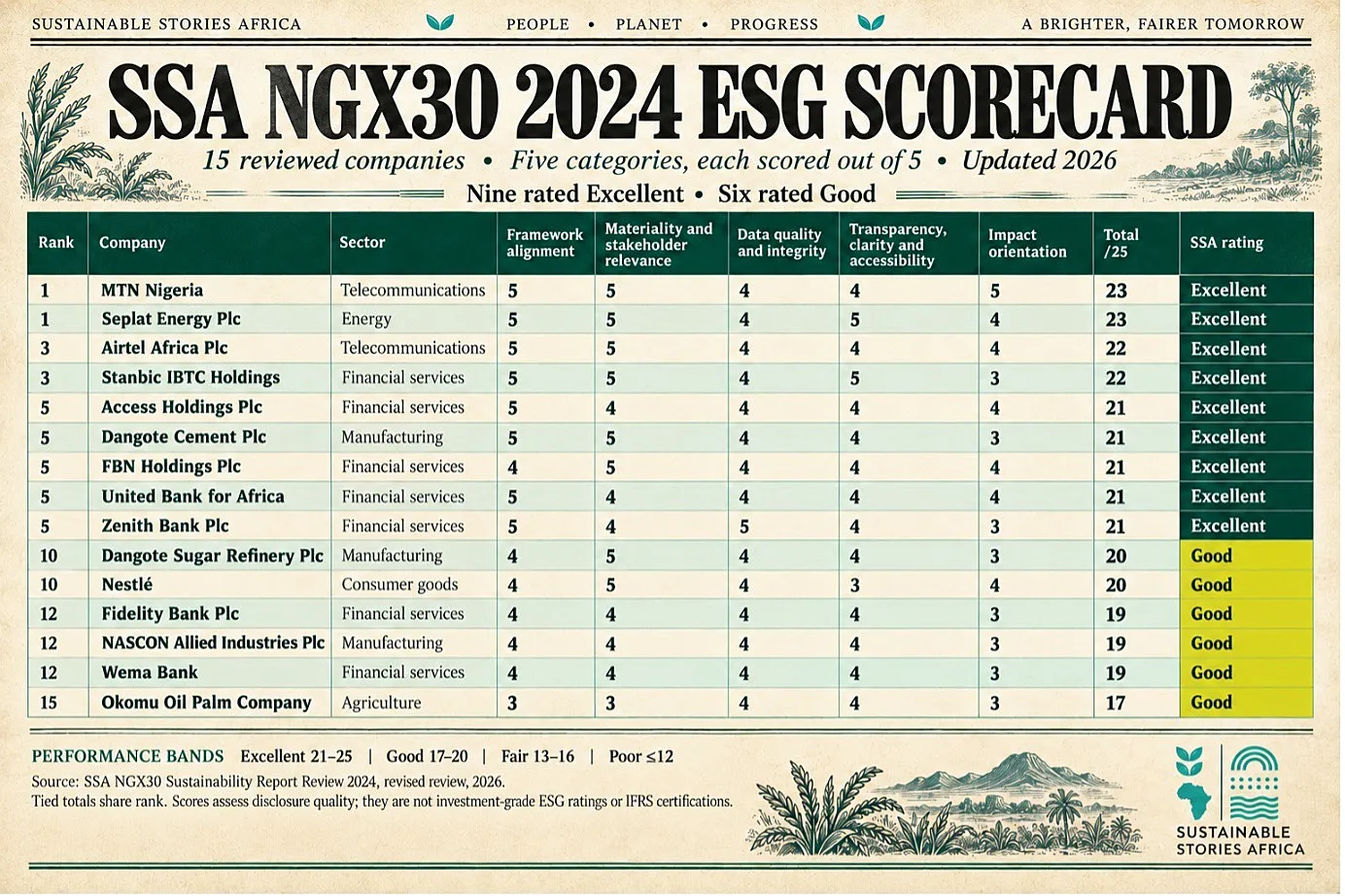
Meanwhile, other companies in the cohort lag on the basics: no external assurance, no Scope 3 data, and social performance figures that stop at outputs.
How many people attended a programme, rather than outcomes: whether lives actually changed.
What Nigeria Stands to Gain and Lose
The prize for getting this right is immense. The cost of getting it wrong is greater.
Nigeria is not reporting ESG in a vacuum.
- The global capital architecture is shifting decisively toward sustainability-linked finance.
- The Climate Bonds Initiative.
- The IFC green bond frameworks
- ESG-screened institutional portfolios increasingly make disclosure quality a gating factor for capital access.
Companies that cannot demonstrate credible, third-party assured, scope-complete ESG performance will not simply score lower on analyst screens; they will be structurally excluded from the next wave of development finance.
The opportunity, however, is equally significant.
- Dangote Cement's N12.4 billion social investment, underpinned by 2,222 stakeholder engagements and a 40-topic materiality matrix, is a strategic hedge against community relations risk across 10 operating countries.
- Seplat Energy's PIA-aligned community governance structures are converting regulatory obligation into a genuine social licence.
For Nigeria's banking sector, the stakes are higher still.
- Zenith Bank's ESG-integrated credit decisions.
- Stanbic IBTC's early IFRS S1/S2 adoption
- UBA's pan-African sustainability framework signals that finance can lead the just transition, rather than merely fund it retrospectively.
If Nigeria's corporations arrive at the 2028 IFRS mandatory deadline with unassured data and no just-transition strategies, they will have squandered what we call "the benchmark moment", the opportunity to write Nigeria's sustainability story on its own terms.
What Must Happen, and Who Must Make It Happen
Progress without accountability is performance. Here is the specific agenda for change.
For Nigeria's corporations, regulators, and investors, the path forward is clear and urgent:
For Nigeria's corporations, regulators, and investors, the path forward is clear and urgent:
Boards and CSOs
- They must commission third-party limited assurance over sustainability data, covering GHG emissions, energy consumption, and key social metrics, as a governance obligation, not a future ambition.
- Zenith Bank and Seplat Energy demonstrate it is achievable within Nigerian market conditions.
Scope 3 disclosure
- It is equally non-negotiable.
- MTN Nigeria's methodology transparency shows that honest, explained Scope 3 reporting builds trust.
- Reporting only Scope 1 and 2 is analogous to a hospital tracking surgical outcomes but not post-discharge mortality.
Just-transition planning
- They must move from rhetoric to strategy.
- No reviewed company has explicitly mapped how decarbonisation will affect livelihoods or community economies.
- The Petroleum Industry Act's community governance frameworks offer a ready architecture for companies like Seplat to lead.
The FRCN/SEC
- It must complement the SRG 01 roadmap with structured capacity-building: sector-specific guidance, peer-learning forums, and regulatory sandboxes for developing-tier companies before the 2028 deadline.
- SEC has started that transition with the request for framework development submission deadline.
- Institutional investors should use the review as a credible benchmark: engaging laggards through stewardship, conditioning capital on disclosure improvements, and rewarding leaders with sustainability-linked instruments.
Path Forward – The Work Nigeria Cannot Defer
Disclosure is the beginning, not the destination.
The SSA NGX30 Sustainability Report Review is a mirror, and Nigeria's corporate leadership has seen its reflection. The foundations are real:
- Nine highly rated companies and three consecutive years of standalone sustainability reporting
- Early IFRS S1/S2 movers and community investments running into billions of naira
However, the road to Nigeria's 2060 net-zero ambition and the 2028 mandatory reporting deadline runs directly through three critical gaps: external assurance, Scope 3 honesty, and just-transition commitment.
These gaps will not close on good intentions. They will close with disclosed targets, verified data, and the political courage to tell exposed communities exactly what the plan is for them.
The benchmark has been set. The clock is running.