
Every business spends money. But not every expense tells the same story about performance, efficiency or risk.
An accounting explainer from FinPolNomics breaks down expenses, cost of sales, operating expenses and other losses, showing why accurate classification can help businesses understand profit, protect margins and make smarter decisions.
Accounting Clarity Builds Stronger Businesses
For many African entrepreneurs, the first sign of business pressure is not always following their sales.
It is confusing: money is going out, profit is shrinking, but the reason is not immediately clear. Was the problem the cost of producing goods? The rent and salaries needed to run operations? Or a one-off loss outside normal trading?
That distinction matters. FinPolNomics’ latest “Accounting & Finance Nuggets” explainer sets out a practical framework for understanding four common categories: expenses, cost of sales, operating expenses and other losses.
The message is simple but commercially important: every cost reduces profit, but not every cost explains performance in the same way.
In African and emerging markets, where small firms face inflation, currency volatility, financing constraints and tax compliance pressure, accounting literacy is more than bookkeeping.
It is a governance tool, a survival skill and a pathway to better investment readiness.
Why Cost Labels Now Matter
A bakery selling more bread but earning less profit is not necessarily failing; the real story lies in understanding where costs are rising.
Rising flour prices, higher delivery costs, increased electricity bills or asset losses each affect profit differently and demand a different response.
This is the core insight behind separating business spending into four practical categories: expenses as the broad umbrella; cost of sales covering direct production costs; operating expenses reflecting business running costs; and other losses capturing non-core setbacks outside normal trading activity.
The profit path follows a clear sequence: revenue minus cost of sales equals gross profit; gross profit minus operating expenses equals operating profit; with other losses further reducing the final figure.
For business owners, investors, finance teams and regulators, these distinctions are not academic.
They determine how margins are assessed, how tax obligations are reviewed and how lenders evaluate true business health.
What Each Spending Category Reveals
Expenses form the broadest category. All costs incurred to earn income and run the business, spanning the cost of sales, rent, salaries, utilities, depreciation and finance costs. They show the whole spending picture, reducing profit and ultimately equity.
However, total expenses alone are too broad for management action. Knowing "costs are rising" without knowing where leaves businesses unable to decide whether to renegotiate suppliers, adjust pricing or review overheads.
Cost of sales sharpens that picture. It captures the direct cost of goods sold or services delivered, such as raw materials, direct labour, inventory consumed and allocated production overhead.
Matched against revenue, it determines gross profit and answers a precise question: what did it cost to produce what was sold? For a bakery, if flour, sugar and bakers' wages rise faster than revenue, the business may appear busy while losing margin on every sale.
Operating expenses tell a separate story; the cost of running, supporting and growing the business after production. Office salaries, rent, marketing, distribution and depreciation sit here, below gross profit, helping determine operating profit.
Finally, other losses capture non-core, incidental setbacks, such as asset disposal losses, foreign exchange losses, impairment and one-off casualties.
They reduce profit but fall outside normal trading activity, answering a distinct question: what value was lost beyond core operations?
Accounting view of profit path
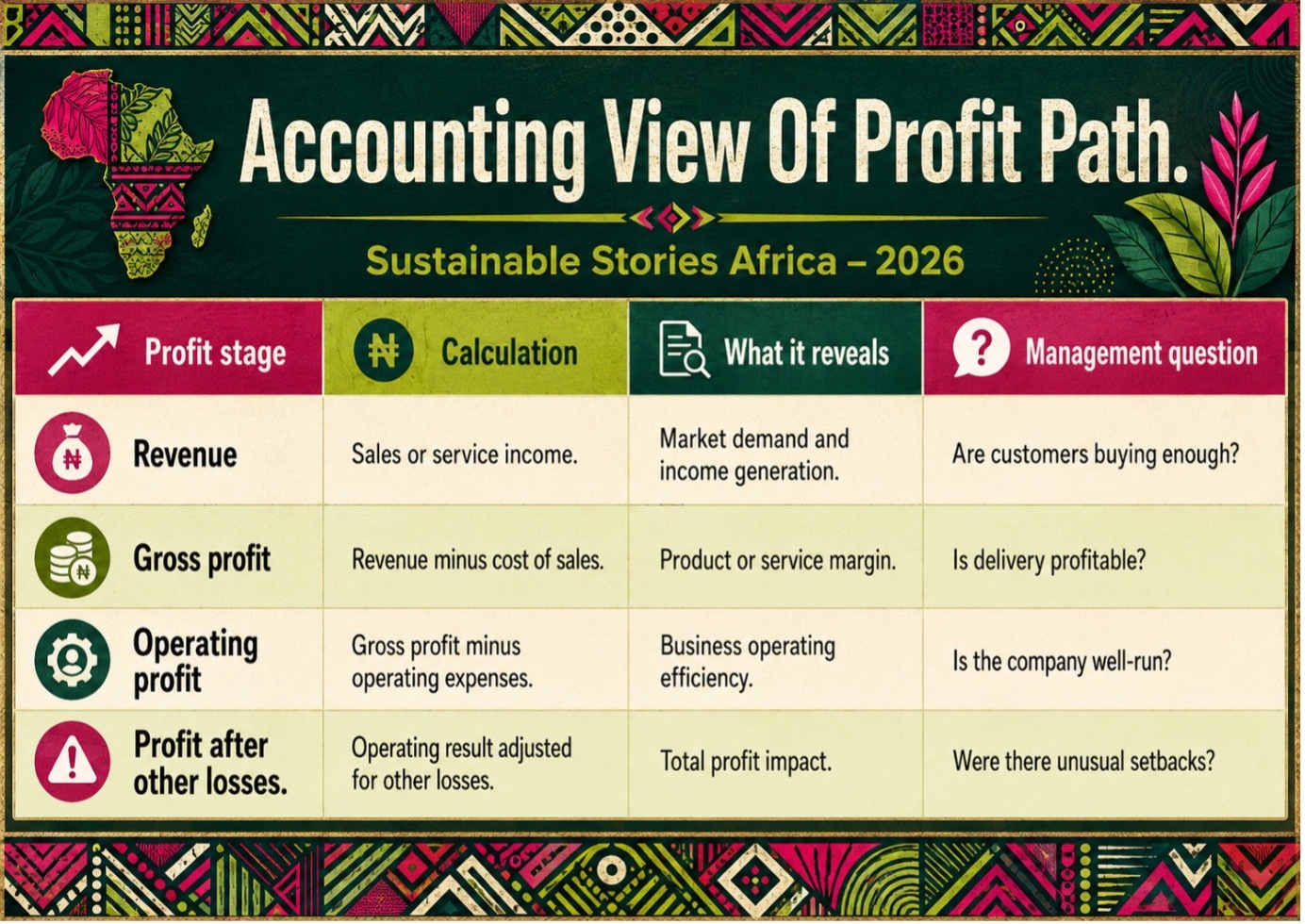
This framework matters because businesses can fail for different reasons even when the final profit number looks the same.
- A firm with weak gross profit may need pricing reform, supplier renegotiation, better production efficiency or tighter inventory control.
- A firm with healthy gross profit but weak operating profit may need to examine rent, staff structure, marketing spend, distribution costs or administrative waste.
- A firm hit by other losses may need stronger risk management, asset controls, insurance, foreign exchange planning or impairment review.
For investors, lenders and boards, the classification helps separate structural weakness from temporary shocks.
Where Businesses Often Misread Profit
One of the most common accounting mistakes in small and medium-sized businesses is treating all spending as a single undifferentiated expense. It may work for basic cash tracking, but it undermines sound decision-making.
The distinction matters because different cost pressures demand different responses. Rising input costs driven by currency depreciation signal margin pressure, requiring local sourcing, price adjustment or product redesign.
Increasing administrative overhead points to operational inefficiency, not pricing failure. Meanwhile, a foreign exchange loss or asset disposal below book value is a risk management issue, not a reflection of core business performance.
For African businesses specifically, this clarity is critical. Operating in environments shaped by high energy costs, unstable exchange rates, rising interest rates and infrastructure gaps, owners need a clear income statement to pinpoint whether pressure is coming from production, operations, finance or non-core losses, and respond accordingly.
Why Better Classification Builds Trust
Good accounting builds trust beyond the business itself. Banks need reliable financial statements to assess repayment capacity, investors need margin clarity to evaluate profitable growth, and regulators need consistent reporting for tax and compliance oversight.
For employees, better financial management means more sustainable businesses and more secure livelihoods.
In ESG and governance terms, proper expense classification strengthens corporate transparency, particularly for growing firms seeking formal finance or institutional partnerships.
For small businesses, the practical value is equally compelling. Rising sales alongside faster-rising cost of sales signals that scaling may deepen losses. Strong gross profit paired with uncontrolled operating expenses points to process reform rather than expansion.
Practical lessons for business leaders
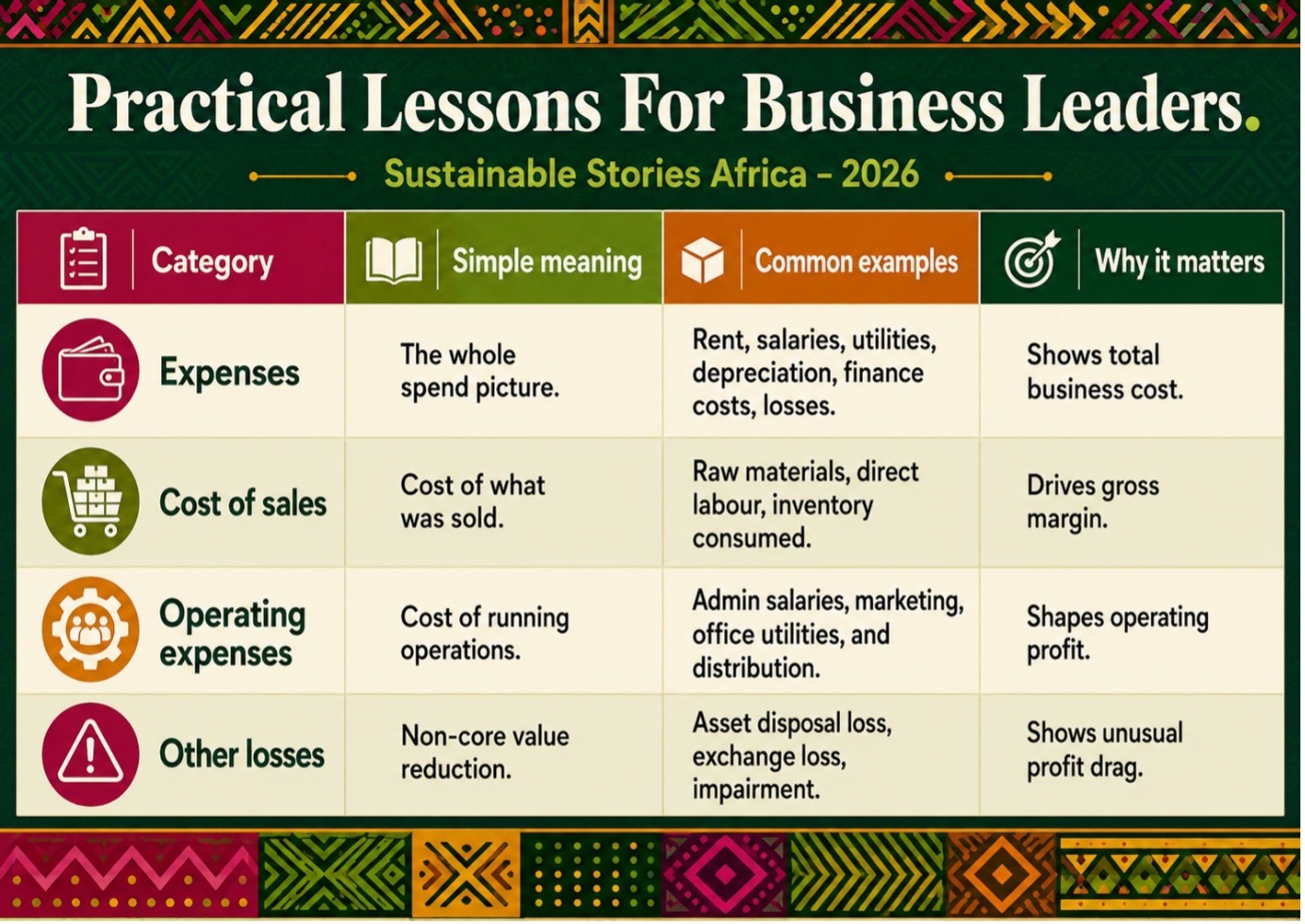
Correct classification turns accounting into a management dashboard, prompting better questions: where did the profit pressure originate, production, operations or exceptional losses?
For policymakers and enterprise-support organisations, this matters deeply. Finance without financial literacy increases vulnerability. Accounting education should be treated as core to enterprise resilience, credit readiness and sustainable business growth.
What Institutions Should Do Next
Several practical steps can help turn accounting clarity into business resilience.
- First, SME training should simplify income statement literacy. Entrepreneurs do not need to become accountants overnight, but they should understand revenue, cost of sales, gross profit, operating expenses, operating profit and other losses.
- Second, lenders and development partners should support financial management tools that help small businesses classify costs correctly. Digital bookkeeping platforms, templates and advisory support can make the process less intimidating.
- Third, business associations should promote sector-specific examples. A bakery, logistics company, fashion brand, farm, media firm and solar installer do not have identical cost structures. Training becomes more useful when examples reflect real operating environments.
- Fourth, accountants and consultants should present financial statements as decision tools, not only compliance documents. The goal is not just to file accounts; it is to help business owners understand what the numbers are saying.
- Finally, entrepreneurs should review their profit path regularly. Monthly tracking of revenue, cost of sales, gross profit, operating expenses and other losses can reveal problems early, before cash flow stress becomes a crisis.
Path Forward – For Smarter Accounting
Accounting clarity should become part of Africa’s business resilience agenda.
Firms need simple, consistent tools to classify costs, track margins, and understand profit pressure before problems deepen.
For entrepreneurs, investors and policymakers, the priority is practical literacy: know what was spent, where it was spent and why it matters.
That discipline can protect margins, strengthen governance and support more sustainable enterprise growth.