Infrastructure risk is not a box completed before procurement. It is a changing set of uncertainties that affects design, price, finance, public liabilities, service performance and community trust.
A good assessment combines data and judgment, distinguishes inherent from residual exposure and allocates each risk to the party able to influence it.
Maximum transfer is not the goal; controlled whole-life value is.
Risk quality shapes every project decision
A risk register can look comprehensive and still be useless.
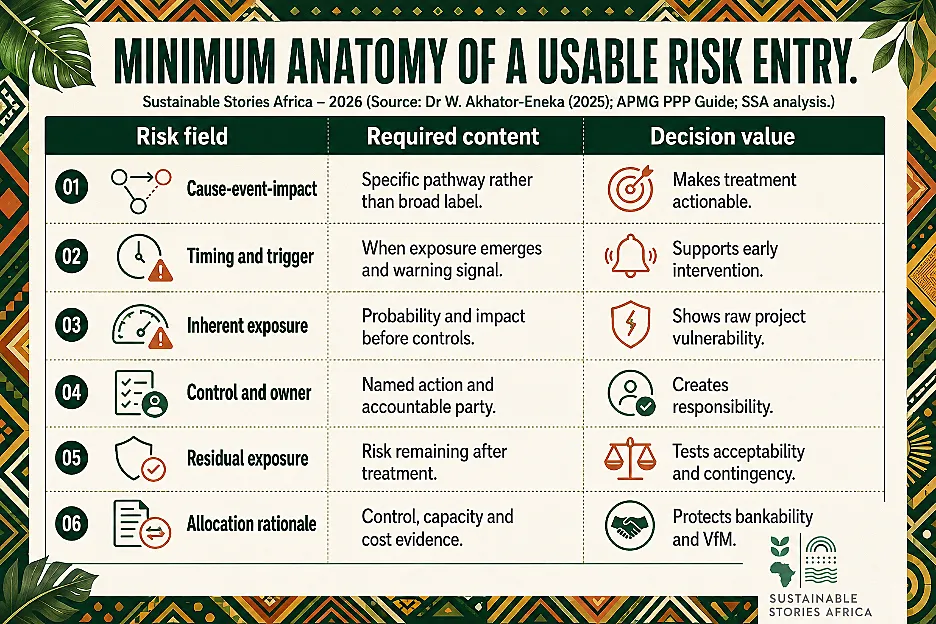
- Generic labels such as construction risk, demand risk or political risk reveal little unless the project defines the event, cause, consequence, timing, owner, existing control, probability, impact, treatment, trigger and residual exposure.
Dr W. Akhator-Eneka's source essay argues that weak assessment is itself a major organisational risk.
- It describes qualitative and quantitative methods, the relationship between probability and loss, acceptable exposure, prioritisation and the need to document a risk profile.
- The strongest idea is that mitigation cannot work when measurement targets the wrong problem.
PPP practice adds another layer: allocation.
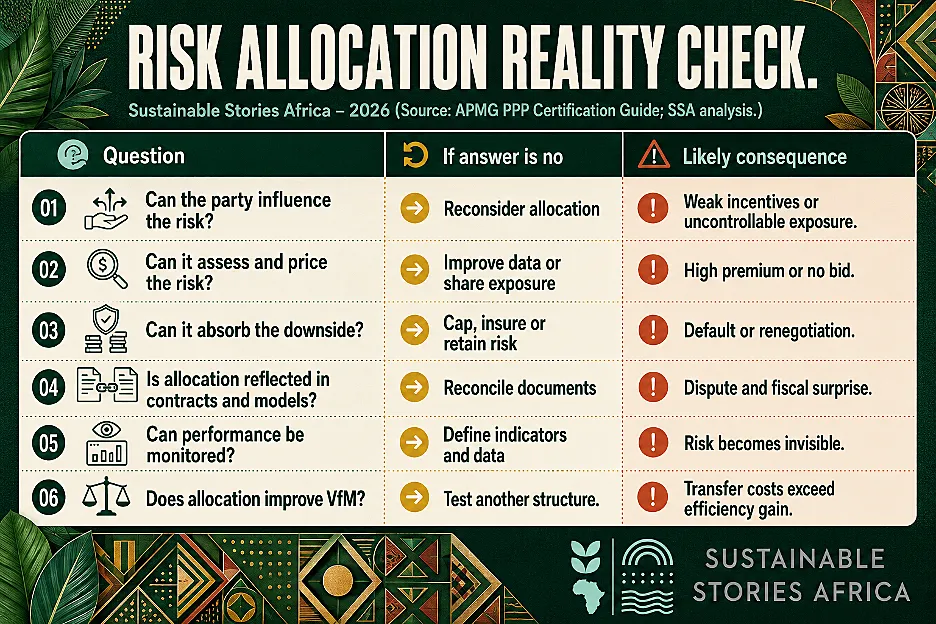
- Transferring a risk contractually does not make it disappear.
- If the private party cannot control, absorb or finance it, the risk returns through higher prices, weak bids, renegotiation, default or service failure.
- Assessment and allocation must therefore be treated as connected, evidence-led decisions.
Generic risk matrices create false confidence
Colour-coded heat maps can hide weak assumptions.
- A low-probability event may have catastrophic fiscal or safety consequences; a frequently occurring delay may be manageable.
- Ordinal ratings should not be multiplied and treated as precise financial values without understanding the method.
- Correlated risks can also overwhelm a project even when each appears acceptable alone.
African infrastructure projects face interacting exposures: inflation, foreign exchange, interest rates, land acquisition, permits, utility relocation, demand, payment arrears, political change, climate hazards, community opposition, contractor capability and supply chains.
The issue is not to place all items on one list, but to model the pathways through which they affect cost, time, revenue and service.
Assessment needs evidence, ownership and scenarios
The process begins with context and objectives.
- Teams identify events through workshops, data, site studies, market sounding, reference projects and stakeholder engagement.
- Each risk is described in cause-event-impact form.
- Inherent exposure is assessed before controls; treatment options are defined; residual exposure is then reassessed and assigned to a named owner.
Quantitative tools may include sensitivity analysis, scenario analysis, expected values, schedule-risk modelling or simulation, depending on data and decision importance.
Qualitative assessment remains useful for reputation, institutional capability, human rights or emerging risks that resist reliable quantification.
The range of uncertainties and confidence in data should be shown openly.
Allocation follows control and capacity.
- Construction performance may sit with the private partner, while discriminatory changes in law usually remain public.
- Some risks are shared through thresholds, relief events, indexation or insurance.
- The contract, financial model, payment mechanism and government fiscal-risk register must describe the same allocation.
Risk velocity and duration matter as part of probability and impact.
- A cyber incident or flood may require an immediate response; demand underperformance may accumulate slowly; land disputes can block the project before finance closes.
- The monitoring plan should match the speed at which exposure can become irreversible and the time available for effective intervention.
Better risk choices improve project resilience
Accurate assessment improves design and pricing before procurement.
- Drainage capacity can respond to climate scenarios; land and resettlement can be resolved early; currency exposure can be reduced through local-currency finance or indexed support; demand uncertainty can influence revenue structure.
- Controls become part of the project rather than responses after failure.
It also improves accountability.
- A documented rationale explains why government retained a risk, what budget or contingency supports it and which indicators trigger intervention.
- Lenders and bidders can price clearer obligations.
- Communities gain when social and environmental risks are monitored alongside commercial exposure instead of being treated as peripheral.
Better data can narrow the gap between perceived and actual risk.
- Sponsors should record forecast and realised construction costs, delays, claims, payment performance, demand, service failures and climate incidents.
- A national evidence base helps future projects price risks from local experience rather than importing assumptions from markets with different institutions and currencies.
Keep the risk register alive throughout
Sponsors should appoint risk owners at both project and institutional levels, align the register with the financial model and contract, and require review at every approval gate.
- Material risks need quantified contingencies, early-warning indicators, treatment deadlines and escalation rules.
- Independent challenge should test optimism bias and missing correlations.
During delivery and operations, the team should update probability, impact, controls and residual exposure using actual data.
- Contract changes should trigger reallocation and VfM review.
- Lessons from incidents, near misses, claims and disputes should enter the institutional database so future projects stop repeating the same blind spots.
Boards and approval committees should receive a short top-risk report that states trend, ownership, treatment status, contingency and decision required.
- Escalation must focus on exposures that can change the business case or public service, not simply the longest list.
Risk reporting succeeds when it changes decisions before the event.
Path Forward – Price uncertainty before it prices failure
PPP sponsors should replace static risk registers with integrated, evidence-led risk systems connected to design, finance, contracts, safeguards and fiscal reporting.
The objective is not to transfer the most risk. It is to place each exposure where it can be controlled at the lowest sustainable whole-life cost while protecting public service.