A PPP is not Value for Money simply because private capital enters the transaction or the bid appears cheaper.
Government must test whether the arrangement produces better risk-adjusted, whole-life outcomes than realistic alternatives.
The Public Sector Comparator can inform that judgment, but data quality, optimism bias and qualitative factors matter.
The benchmark is a tool; Value for Money is the conclusion, and it must survive the contract.
Public value is more than price
Public authorities often reach for PPPs when budgets are tight; however, financing availability does not prove value.
- Private finance carries a cost, contracts are expensive to prepare, and long-term commitments can restrict future budgets.
- The relevant question is whether private participation, performance incentives and risk allocation create benefits large enough to justify those costs.
Dr W. Akhator-Eneka's explainer defines Value for Money as the optimum combination of whole-life cost, quality, risk allocation, innovation and service performance compared with conventional public procurement.
- It distinguishes the Public Sector Comparator, the estimated risk-adjusted cost of public delivery, from the wider decision on whether PPP procurement is preferable.
Official PPP guidance supports that distinction.
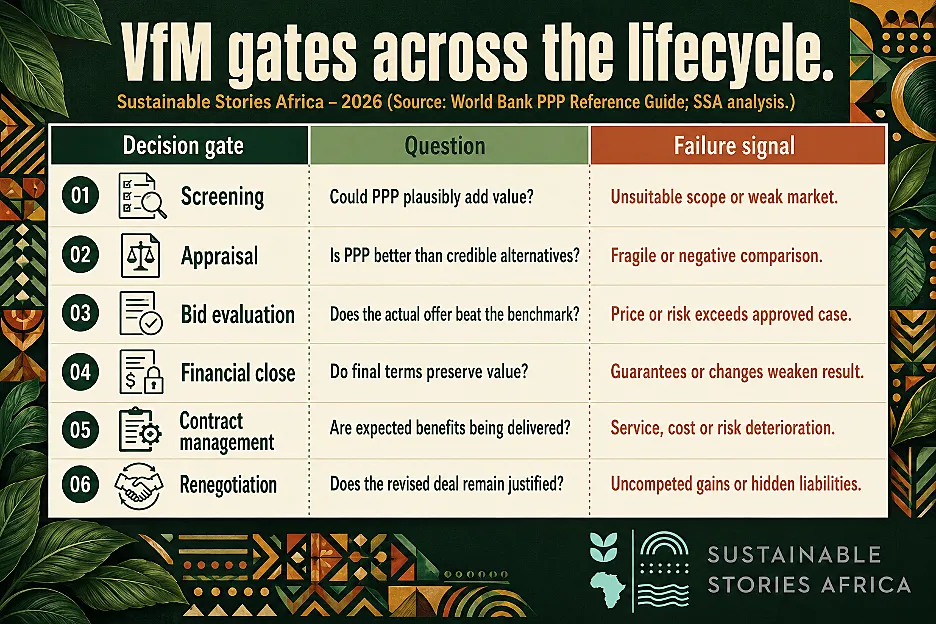
- VfM is tested before procurement to assess the option and again when bids reveal actual price and risk.
- It should also be protected through financial close and contract management.
A positive spreadsheet result at appraisal is not a permanent certificate.
Cheap financing can conceal expensive obligations
A government may avoid an immediate capital outlay yet accept twenty or thirty years of availability payments, guarantees, termination liabilities or foreign-exchange exposure.
- A user-pays concession may appear self-financing until demand falls or tariffs become politically unaffordable.
- The fiscal burden has not disappeared; it has changed timing, form and uncertainty.
VfM analysis prevents the financing question from replacing the procurement question.
- It asks whether the project should proceed, whether PPP is the best delivery option, and whether the final transaction still offers superior public value.
- It also exposes a central warning: risk transfer creates value only when the receiving party can manage the risk more efficiently than government can.
A robust comparison needs two lenses
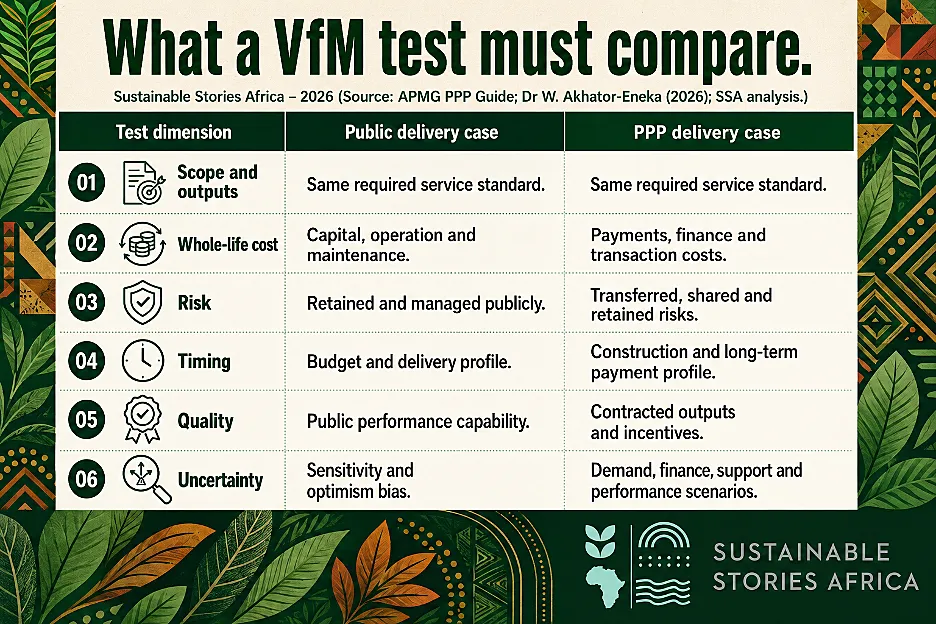
The quantitative lens compares risk-adjusted whole-life costs.
- A Public Sector Comparator estimates public design, construction, financing, operation, maintenance and retained risks on a like-for-like basis.
- The PPP reference case adds transaction costs, private financing, government support, retained risks and expected payments.
Both require the same scope, service standards, timing and discount assumptions.
- The qualitative lens asks whether outputs can be specified and measured, competition is credible, innovation is possible, lifecycle maintenance matters, institutional capacity exists, and whether the contract can adapt without destroying value.
Environmental and social outcomes, service reliability, distributional effects and transparency may resist simple monetisation but remain material to public value.
Sensitivity testing is essential.
- Decision-makers should examine demand, inflation, exchange rates, delays, construction cost, refinancing, residual value and performance deductions.
- A small headline advantage that disappears under plausible scenarios is not a robust VfM case.
- The comparison should state confidence ranges, not present uncertain forecasts as precise facts.
The analysis must also distinguish affordability from VfM.
- A project can create net economic benefits and still be beyond the government's fiscal capacity or households' ability to pay.
- Conversely, an affordable annual payment does not prove the PPP is better than another route.
Both tests are necessary, and neither should be manipulated by stretching assumptions beyond the evidence.
Good VfM protects citizens and budgets
When used honestly:
- VfM can direct PPPs toward projects that benefit from whole-life design, measurable performance and contestable private capability.
- It can also stop unsuitable transactions before costly procurement.
Saying no to a PPP may be the smart outcome when the public option or another partnership structure is better.
For citizens, the test links engineering and finance to service quality, access and affordability.
- A hospital PPP should be judged by availability, maintenance and patient-support standards, rather than only construction cost.
- A road concession should consider safety, travel time, maintenance, tariff burden and government exposure.
- Public value becomes visible through outcomes.
Distribution matters as well.
- A project may produce positive aggregate benefits while placing disproportionate cost on low-income users, displaced communities or future budgets.
- A credible qualitative assessment should show who gains, who pays and which mitigation is built into the structure.
Public value is not fully measured when distributional harm remains off-model.
Publish assumptions and retest every change
Governments should publish the methodology, scope, base assumptions, risk valuations, discount-rate rationale, qualitative assessment and sensitivity results, with commercially sensitive details protected narrowly.
- Independent review should challenge optimism bias and confirm that the PSC is a credible alternative, rather than an artificially weak benchmark designed to favour the PPP.
VfM should be a gate at screening, appraisal, bid evaluation, final negotiation and material contract change.
- Renegotiations, refinancing and new guarantees can alter the original balance.
- Contract managers need a benefits register that tracks service, cost, risk and public commitments against the approved business case.
Decision bodies also need consequences for failure.
- If the final bid does not meet the approved threshold, government should be prepared to re-scope, retender or use another procurement option.
- A comparator has little integrity when political commitment makes rejection impossible.
The ability to stop is part of the discipline that gives the test meaning.
Path Forward – Make value a living public test
Nigeria's PPP sponsors should treat VfM as a transparent lifecycle discipline, supported by independent review and realistic public-sector alternatives.
The decisive question is not whether private finance is available. It is whether the chosen structure keeps delivering better, affordable and accountable public outcomes after uncertainty, bids and contract changes are considered.