Africa's infrastructure problem is not only a shortage of projects or finance. Many proposals reach the market without integrated expertise, environmental and economic context, risk treatment, feasibility, credible finance, disciplined cash flow or governance.
Dr W. Akhator-Eneka's seven-step framework is an author-developed response to those silos.
Its value lies in the sequence; its credibility will depend on transparent tools, independent testing and better project outcomes.
Seven decisions shape one project outcome
Infrastructure teams are frequently assembled by discipline.
- Engineers design, financiers model, lawyers draft, environmental specialists assess impacts, and public officials secure approvals.
However, a project fails as a single system: misjudged demand undermines cash flow; weak governance corrupts procurement; an unaffordable tariff defeats finance; poor maintenance erodes the asset.
The source essay traces Dr W. Akhator-Eneka's framework to a question raised during a 2017 conference at Ankara University: why do projects fail despite expertise, financing opportunities and good intentions?
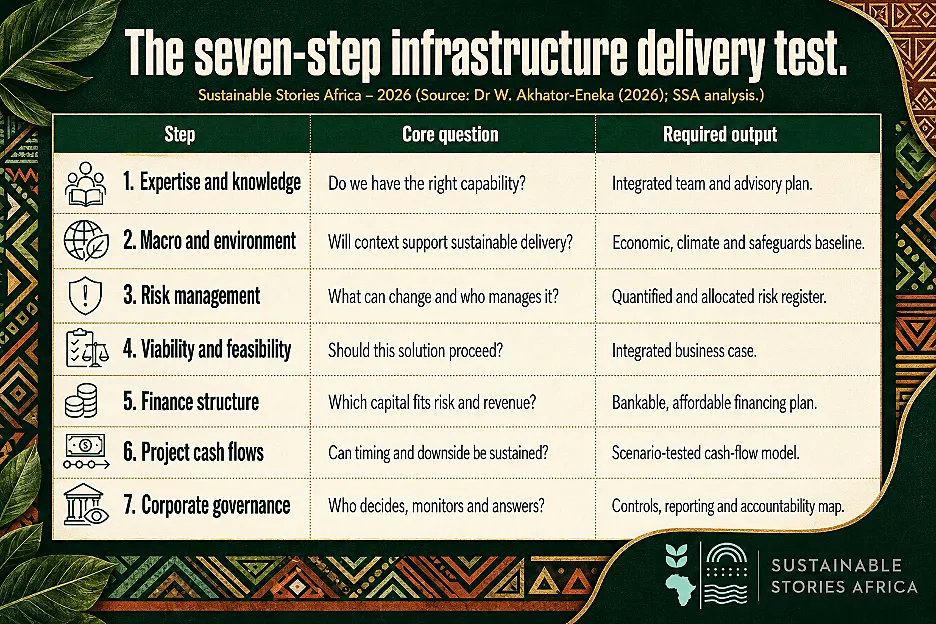
He identifies seven connected areas, expertise and knowledge; macroeconomics and environmental impact; risk; viability and feasibility; finance structure; cash flows; and corporate project governance.
The framework should be understood as the author's synthesis, rather than an official replacement for government stage-gate systems or international PPP guidance.
Its editorial relevance is the discipline it imposes: a project should not advance because one component looks attractive while the rest remain untested.
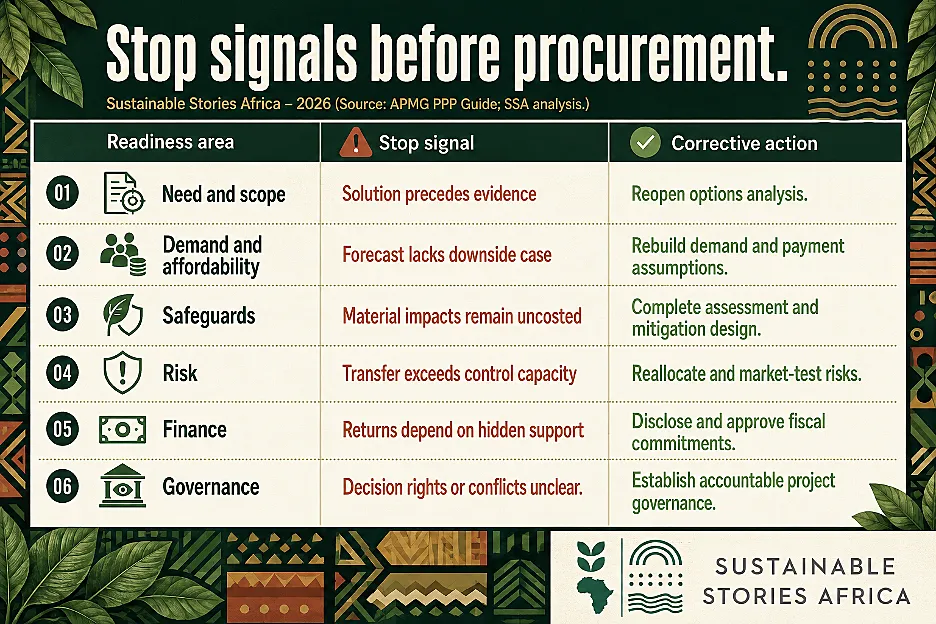
Infrastructure failure usually begins before construction
Projects rarely become unviable only when machinery reaches the site.
- Weakness may begin with an unclear service need, incomplete expertise, political assumptions, ignored environmental impacts, optimistic demand or a financing structure copied from another sector.
- By procurement, those weaknesses are expensive to correct and may be hidden inside bids and guarantees.
The seven-step model makes the pre-construction period visible.
- It asks sponsors to assemble the knowledge required to define the problem, understand the economic and environmental context, identify uncertainties, establish feasibility, design finance, test cash generation and set accountable governance before treating the project as ready.
Each step must challenge the others
Expertise comes first because a sponsor must know which questions and specialists the project requires.
- Macroeconomic and environmental analysis then tests inflation, exchange rates, growth, household income, climate exposure, land and ecosystem effects.
- These conditions influence demand, cost, safeguards, resilience and the ability of users or government to pay.
Risk assessment identifies uncertainty and assigns treatment.
- Viability and feasibility determine whether the proposed solution is technically deliverable, economically justified, environmentally and socially acceptable, legally possible, commercially credible and institutionally manageable.
- Finance structure then combines equity, debt, public support or concessional instruments in a way the project's revenue and risk can sustain.
Cash-flow analysis tests timing rather than headline totals: construction drawdowns, operating revenue, maintenance, debt service, reserves, taxes and downside scenarios.
Corporate project governance establishes decision rights, reporting, controls, conflicts management, board oversight and accountability. None of the seven can be signed off without reconciling it to the others.
The order is iterative rather than mechanical.
- A risk finding may change the technical solution; the revised solution may alter environmental impact and capital cost; financing terms may expose an affordability gap; governance constraints may require a simpler delivery model.
The project should loop back until the components tell one credible story.
Connected preparation can attract better capital
Investors do not finance infrastructure needs alone; they finance structured rights, revenues and risk.
- A project that shows credible demand, permits, safeguards, contractual allocation, sponsor capability and downside resilience can attract more suitable capital and reduce expensive uncertainty premiums.
- Better preparation may also reveal that grant finance or conventional procurement is more appropriate than a PPP.
Communities benefit when environmental and social impacts, affordability and service outcomes are embedded before finance is finalised.
Governments benefit when governance and cash-flow controls reduce abandoned projects, uncontrolled variations and hidden fiscal exposure.
- The framework's best promise is therefore not faster approval, but earlier discovery of weaknesses.
Earlier discovery saves more than transaction costs.
- It can protect land rights, prevent unaffordable user charges and redirect public support toward a smaller or phased solution that delivers more reliable service.
- A disciplined framework should make redesign an expected outcome of preparation, rather than a sign that the original project team failed.
Turn the framework into auditable gates
To move from concept to institutional tool, each step needs a standard output, an approval owner and a rejection criterion.
- Expertise could require a capability plan; context an economic and safeguards baseline; risk an allocated register; feasibility an integrated business case; finance a term sheet and affordability model; cash flow a downside-tested model; governance a control and disclosure plan.
Pilot projects should be reviewed by independent experts and affected stakeholders.
- Results should compare forecast and actual cost, time, service, affordability, environmental performance and fiscal exposure.
The author also proposes foundation, managerial and executive learning levels; these should map to demonstrable competencies rather than attendance alone.
The methodology should also state its relationship to existing public-investment, procurement and PPP rules.
- Where a required output already exists, the framework should integrate or strengthen it rather than duplicate paperwork.
- Where it introduces a new test, sponsors should explain the decision problem and who is authorised to act on the result.
Path Forward – Test the sequence on real projects
The seven-step framework can add value if it becomes a transparent preparation discipline rather than another label applied after decisions are made.
A live pilot, published templates and independent evaluation would show where the method improves readiness, where it duplicates existing controls and how it should adapt across sectors.