
CP3P gives practitioners a common language for PPP frameworks, appraisal, structuring, procurement and contract management.
However, infrastructure competence is demonstrated through decisions, rather than certificates.
The professional pathway after examination should combine supervised practice, cross-disciplinary casework, ethical standards, continuing learning and evidence of public outcomes.
Africa needs certified professionals, but more; it needs institutions able to use and challenge their expertise.
Certification starts rather than finishes competence
Public-private partnerships sit where public policy, finance, economics, engineering, law, procurement, environmental and social safeguards, stakeholder expectations and long-term operations meet.
A qualification can establish shared principles, but no examination can reproduce every political, fiscal, market and community tension a practitioner will confront.
Dr W. Akhator-Eneka's July 2026 essay argues that CP3P should be a platform for professional excellence rather than an end point.
- It presents lifecycle learning, real cases and an author-developed seven-step framework as ways to connect theory with project work.
- The central proposition is sound: isolated knowledge must become applied judgment.
That shift matters in Africa, where public agencies often rely on small transaction teams and external advisers.
- The professional challenge is not only increasing the number of certified people.
- It is building organisations that retain knowledge, review advice, manage conflicts and remain capable throughout contracts that may last decades.
Real PPP work tests ethical judgment
A practitioner may face pressure to label an immature project bankable, transfer a risk the market cannot manage, suppress a fiscal commitment, overlook a community impact or accept a weak bid to maintain a political timetable.
- Technical knowledge identifies the issue; professional ethics and institutional support determine the response.
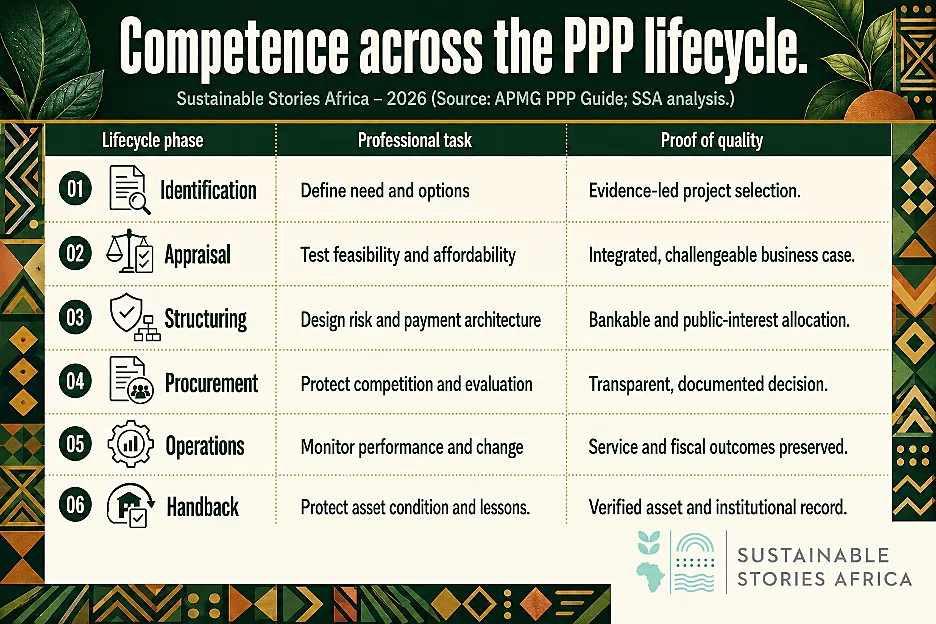
Competence also changes by phase.
- Project identification needs options and public-value judgment.
- Appraisal needs integrated evidence.
- Structuring needs risk, payment and contract design.
- Procurement needs integrity and market discipline. Contract management needs performance data, change control, negotiation and institutional memory.
A professional strong in one phase may still require supervision in another.
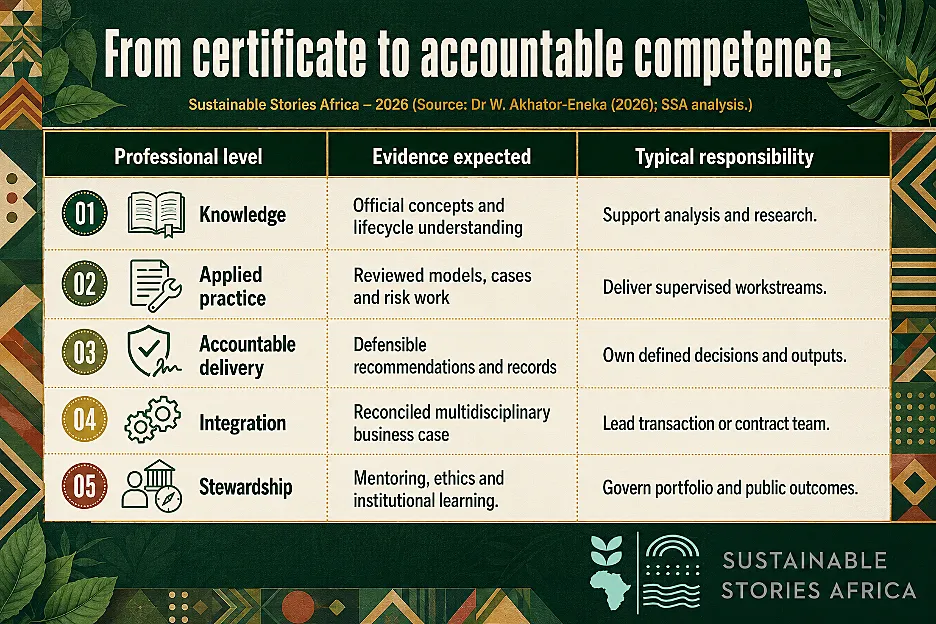
A career pathway needs progressive evidence
The first level is knowledge:
- Understanding the official guide, terminology and lifecycle.
The second is applied analysis:
- Reviewing a feasibility study, financial model, risk matrix or procurement plan under supervision.
The third is accountable delivery:
- Owning workstreams, documenting advice, engaging stakeholders and defending recommendations before an approval body.
Senior competence adds integration and stewardship.
- Leaders must reconcile specialist inputs, recognise when evidence is insufficient, design governance, manage advisers, disclose uncertainty and prepare institutions for operations.
- They should also mentor junior staff and create records that outlast individual appointments.
A professional portfolio can make this progression visible.
- It might include anonymised decision memos, model reviews, risk-allocation rationales, stakeholder plans, procurement evaluations, performance dashboards and lessons learned.
- Assessment should examine reasoning, evidence and ethical handling, rather than simply project value or job title.
Portfolios need appropriate confidentiality controls, but secrecy should not excuse unverifiable experience claims.
- Employers can use redacted samples, supervisor attestations, simulated cases and structured interviews.
- The aim is to establish what the practitioner personally analysed, decided or delivered inside a multidisciplinary assignment.
Stronger professionals strengthen public institutions too
A capable internal team can commission better advice, reject weak assumptions and negotiate from an informed position.
- This reduces the risk that government becomes dependent on transaction advisers during procurement and unprepared once the contract moves into operations.
- Institutional competence is one of the strongest protections against poor renegotiation.
For investors, credible public counterparts shorten avoidable rework and clarify decision pathways.
For communities, professionals trained in public value and safeguards can connect consultation to scope, affordability and monitoring.
For the practitioner, continuing competence expands a career from examination success to trusted responsibility.
Stronger professional networks can also spread lessons across sectors and countries.
- Communities of practice should discuss cancelled projects, failed procurements, renegotiations and operations, rather than only financial closes.
- Learning from what did not proceed can improve future screening and reduce the incentive to treat every cancellation as institutional embarrassment.
Employers must build supervised practice systems
PPP units, development banks and advisory firms should pair certification with rotations across identification, appraisal, structuring and contract management.
- Each rotation needs a supervisor, defined competencies, work samples and reflective review.
- Continuing professional development should cover updates in climate resilience, disclosure, fiscal risk, digital infrastructure and dispute prevention.
Professional bodies and training providers should publish ethical rules, complaints processes and evidence-based outcome data.
- Course marketing should separate official certification requirements from proprietary methods.
Governments should maintain multidisciplinary career paths so trained staff are retained, and experience is not lost after a transaction closes.
- Public institutions should pair this with knowledge systems: standard review templates, decision repositories, model archives, contract summaries and handover protocols.
- Otherwise, individual competence walks out of the door when staff transfer.
Professional excellence is durable only when the institution can retain, challenge and reuse what its professionals know.
Path Forward – Build careers around public value delivered
CP3P should sit inside a broader professional system of supervised practice, portfolio evidence, ethics, continuing learning and institutional capability.
The most meaningful credential is a record of decisions that protect affordability, fiscal sustainability, competition, service quality and community outcomes across the full PPP lifecycle.