Nigeria's infrastructure financing toolkit has expanded beyond annual budgets to include multilateral loans, domestic bonds, Sukuk, PPPs, guarantees, pension-backed credit and blended finance. More instruments, however, do not automatically produce more service.
The central task is matching each project's risk, revenue, currency, maturity and public value to suitable capital.
Finance should follow a prepared project and transparent fiscal strategy, rather than substitute for them.
More capital tools require stronger discipline
Dr W. Akhator-Eneka's source essay describes a broad shift from the classical public-expenditure model toward structural-adjustment reforms, borrowing, development frameworks, multilateral lenders, bond markets and PPPs.
That history reflects a persistent reality: public budgets alone have struggled to meet infrastructure needs, while every alternative introduces its own cost, risk and governance demands.
- Loans can accelerate delivery but create debt-service obligations.
- Bonds can mobilise domestic savings but require credible repayment and disclosure.
- PPPs can combine private finance and performance incentives, but government may still carry guarantees, availability payments and political risk.
- Blended finance can improve project economics, but scarce concessional capital must be catalytic and transparent.
Nigeria's policy challenge is therefore not choosing one superior instrument.
- It is building a financing architecture that moves projects from credible preparation to suitable capital, competitive delivery, fiscal reporting and sustained service.
- Instrument diversity only creates resilience when the underlying projects and institutions are strong.
Financing gaps are also preparation gaps
Investors frequently cite insufficient bankable projects rather than insufficient need.
- A proposal may lack reliable feasibility, permits, land, safeguards, revenue evidence, risk allocation, procurement strategy or a capable sponsor.
- Financing cannot repair these omissions cheaply; it prices them through higher returns, guarantees or refusal.
Currency and maturity compound the problem.
- Infrastructure produces long-term, often local-currency benefits, while equipment or debt may be foreign-currency funded.
- Short domestic deposits cannot safely finance decades-long assets without refinancing or liquidity support.
- Macroeconomic volatility can turn an apparently affordable capital structure into a fiscal or tariff shock.
Each instrument solves a different constraint
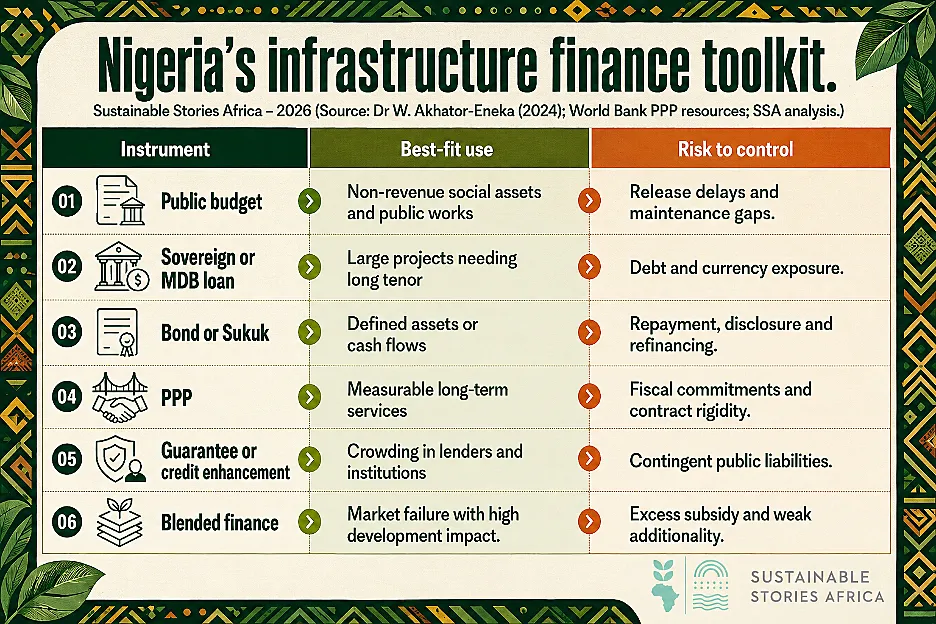
Budget finance offers direct public control and suits social projects without cash revenue, but competes with recurrent expenditure and may suffer delayed releases.
Sovereign or multilateral loans provide tenor and technical support; however, they increase debt exposure.
Bonds and Sukuk can mobilise capital-market investors when cash flows, assets and reporting are credible.
PPPs bundle responsibilities and may use user charges, availability payments or mixed revenues.
- They are procurement and service arrangements, rather than merely funding sources.
- Development-finance institutions can lend, invest, guarantee, advise or mobilise other capital.
- Credit enhancement can help institutional investors accept project or subnational exposure.
Blended finance combines concessional and commercial resources to address specific market failures.
- Grants can fund preparation; guarantees can reduce political, credit or currency risk; subordinated capital can absorb first losses; viability-gap support can close a transparent affordability shortfall.
- The instrument should target the constraint rather than subsidise all risks indiscriminately.
Asset recycling and value capture can add to the menu where governance is strong.
- Government may concession or monetise a mature asset and reinvest proceeds in new infrastructure, or recover part of the land-value increase created by transport and services.
Both require credible valuation, transparent use of proceeds and protection against one-off fiscal fixes.
A diversified toolkit can improve resilience
Matching finance to project characteristics can reduce overreliance on sovereign debt and expand local participation. Revenue-generating energy, transport or digital projects may access project finance, while social infrastructure may require tax-backed payments or grants. Portfolios of smaller assets can be aggregated to reach institutional scale.
Local-currency credit, refinancing platforms, guarantees and transparent project bonds can connect pension and insurance capital to infrastructure without forcing investors into unmanaged construction risk. Development partners can support early stages and new climate technologies, then reduce concessionality as projects and markets mature.
A diversified portfolio also needs limits. The same public balance sheet can be exposed through sovereign loans, guarantees, state-owned enterprises, availability payments and foreign-exchange support even when each transaction uses a different label. Consolidated reporting is essential to prevent financing diversity from concealing concentrated fiscal risk.
Build one pipeline with financing windows
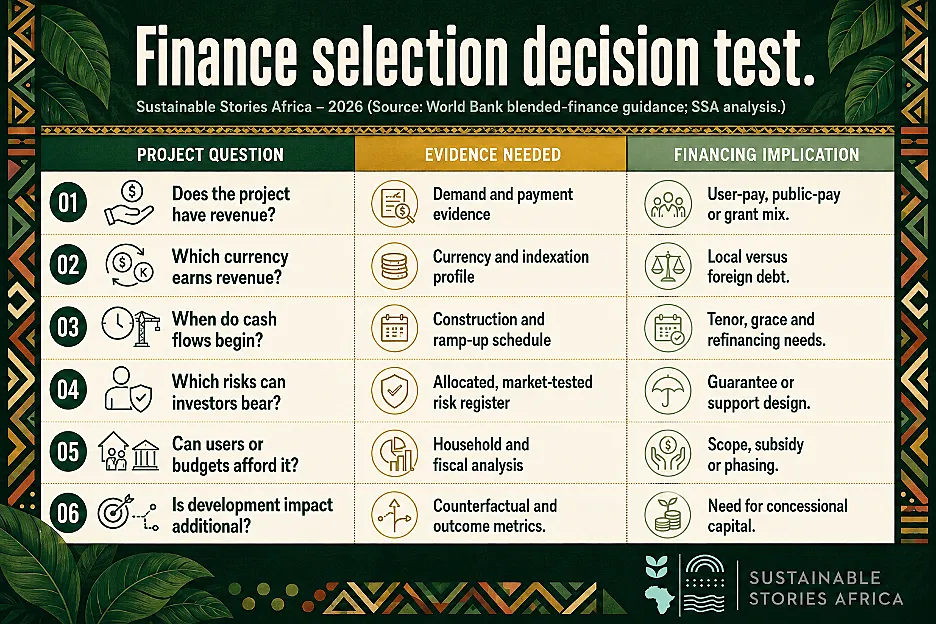
Nigeria should maintain a transparent national and subnational project pipeline with common readiness criteria.
- Project-development facilities can fund feasibility and transaction work on a recoverable or performance basis.
- At defined gates, projects should be routed toward budget, loan, bond, PPP, blended or hybrid windows based on evidence.
Government must publish debt, guarantees, availability payments, revenue support and termination exposure in a consolidated fiscal-risk view.
- Local-currency mobilisation should be prioritised where feasible.
- Post-completion and contract performance data should inform pricing and selection, gradually replacing perceived risk with evidence.
Project sponsors should conduct market sounding without enabling potential bidders to design policy to their advantage.
- Feedback can test tenor, risk, procurement and scale, while government retains competitive neutrality and public objectives.
- Standard documents can reduce transaction costs, but sector and project differences still require disciplined adaptation.
Path Forward – Match capital to projects, not slogans
Nigeria needs a disciplined financing portfolio, not a contest among PPPs, bonds, loans and budgets. Each instrument should solve a defined project constraint at transparent cost.
The pipeline will become investable when preparation, fiscal reporting, procurement and performance evidence are as developed as the financing menu.