Nigeria's housing challenge is commonly framed as a unit deficit, but estimates vary and can obscure the real financing problem.
Developers need long-term capital; households need payments that fit incomes; sites need land, infrastructure and secure approvals.
Housing PPPs can combine public assets and private capability, but affordability does not emerge automatically.
It must be designed into land cost, product size, tenure, subsidy, finance, allocation and lifecycle management.
Housing finance must start with households
A housing project can be technically complete, commercially sold and still fail as affordable-housing policy if the intended households cannot access it.
High interest rates, short mortgage tenors, irregular incomes, title costs, infrastructure charges and inflation can push a nominally affordable unit beyond the reach of low- and middle-income earners.
Dr W. Akhator-Eneka's source paper reviews PPP concepts, housing demand and supply pressures, project-management needs and finance mechanisms.
- It argues for blended public and private resources, including public land, mortgage institutions, state housing corporations, banks, pension capital, real-estate vehicles and development finance.
The World Bank's emerging-market housing PPP study offers a useful guardrail: structuring housing partnerships around a specific need and context, and PPP is not the only form of public-private collaboration.
The choice of tenure, subsidy and contract should follow evidence about households, rather than an assumption that private finance will produce affordability by itself.
The unit deficit hides affordability mismatches
Nigeria's housing-deficit figures differ across official statements, industry reports and time periods because methods, definitions and geographic coverage vary.
- A single national number cannot show how many households need rental housing, serviced land, incremental building finance, social housing, student accommodation or market-priced ownership in each city.
The financing mismatch is clearer.
- Developers borrow short and build long.
- Mortgage lenders face limited long-term funding and credit data.
- Many households earn informally or cannot provide conventional deposits.
- Public land may be available but lack title, roads, drainage, water or power.
Currency and material-price volatility make fixed sale prices difficult to maintain.
Finance must connect supply and demand
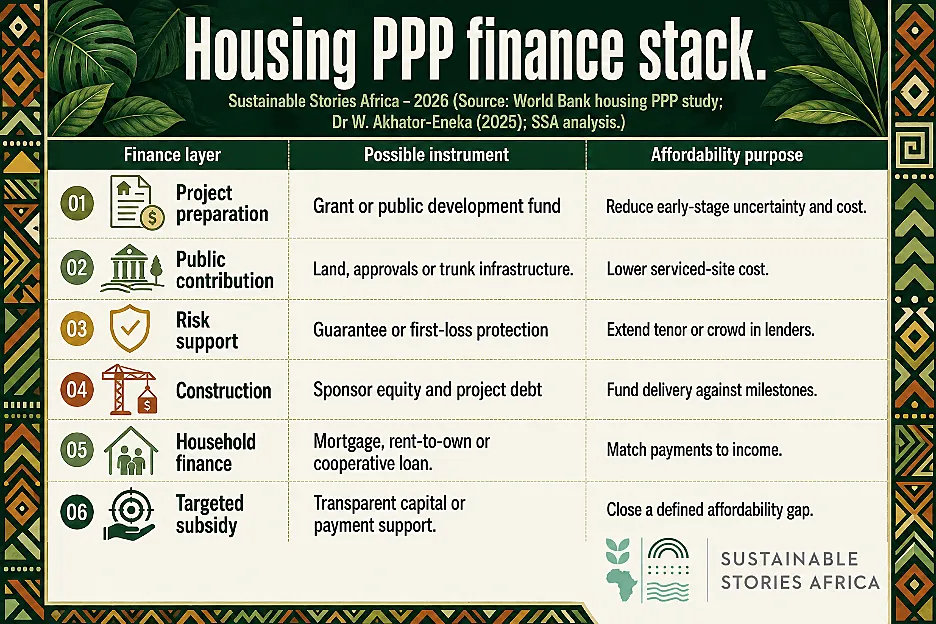
Supply-side finance covers land preparation, design, approvals, construction and infrastructure.
- It can include sponsor equity, construction loans, housing funds, project bonds, guarantees and development-finance facilities.
- Demand-side finance enables households to rent or buy through mortgages, rent-to-own, cooperative savings, micro-housing loans, employer schemes or targeted support.
A PPP can reduce costs through public land, trunk infrastructure, planning coordination, tax relief or credit enhancement, while private partners design, finance, build, market or manage the scheme.
However, every public contribution has value and should be disclosed.
- The contract should state how that value lowers household cost, increases units or improves service, rather than merely raising developer returns.
Blended finance can use grants or concessional funds for project preparation, first-loss protection, longer tenor or specific affordability gaps, crowding in commercial capital where risks are clearer.
Minimum concessionality matters: scarce support should be targeted, transparent and tied to measurable development outcomes rather than permanently subsidising a weak commercial model.
Finance also depends on the project's sales and allocation process.
- If units are reserved without verified buyers.
- If off-plan deposits fund construction without protection
- If public beneficiaries cannot meet final payments, cash flow can collapse late.
Escrow, milestone certification, transparent waiting lists and lender prequalification help align construction finance with credible demand.
Well-designed partnerships can widen housing access
A credible structure can separate land and infrastructure risk from construction and sales risk, match capital tenor to the project and offer multiple tenure options.
- Mixed-income development may cross-subsidise targeted units if allocation and resale controls are enforceable.
- Rental and rent-to-own products can reach households excluded from traditional mortgages.
The wider benefits extend beyond units.
- Serviced sites, transport access, energy efficiency, water, sanitation and community facilities affect household cost and quality of life.
- Climate-smart design can reduce utility bills and future damage.
- Transparent beneficiary selection and post-occupancy management protect both public legitimacy and asset performance.
A portfolio approach can unlock institutional capital.
- Standardised developments across multiple sites, with common documentation, performance data and credit enhancement, may diversify project-specific risk.
However, aggregation should not conceal weak locations or repeat unsuitable designs; each site still requires local demand, land, service and environmental evidence.
Measure affordability before allocating public support
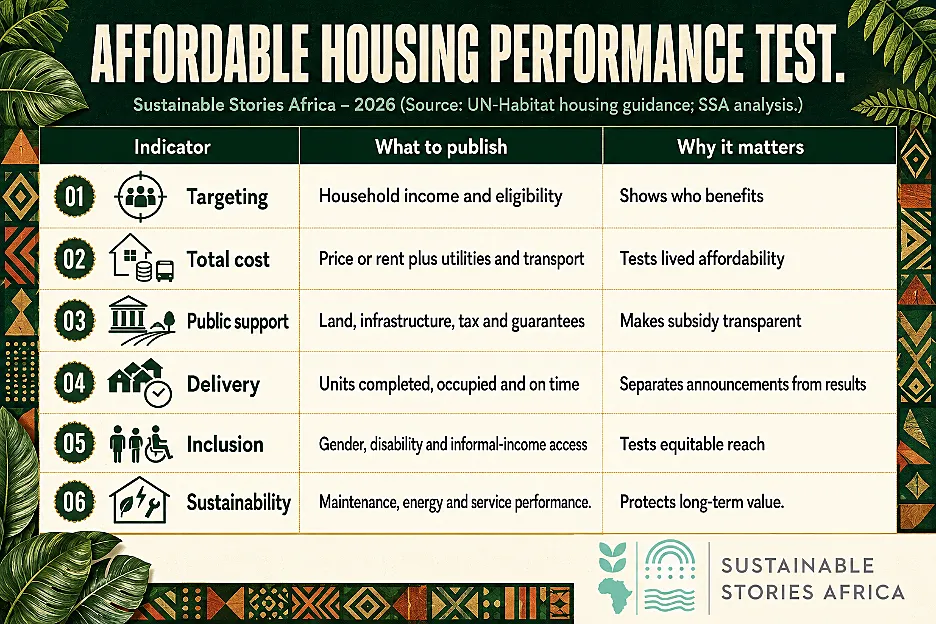
Government should start with a local housing-needs and affordability assessment based on income distribution, tenure, household size, transport cost and informal employment.
- It should compare delivery options and publish the value of land, infrastructure, guarantees, tax relief and other support.
- Competitive selection must test both price and social outcomes.
Contracts should define eligible households, unit specifications, payment ceilings, allocation procedures, completion milestones, defect responsibilities, service standards and monitoring data.
Finance partners need products for irregular but verifiable incomes.
- Independent audits should track who received units, total household cost, vacancy, resale, maintenance and subsidy per outcome.
Policy should also protect the subsidy after allocation.
- Resale restrictions, shared-equity arrangements or time-limited covenants can prevent immediate windfall gains, but controls must remain simple enough to enforce and should not trap households in illiquid assets.
- The design should balance public recovery, mobility and household wealth creation.
Path Forward – Finance homes people can actually afford
Nigeria should stop treating every housing gap as the same market.
Local data must identify the households, tenure and affordability problem before committing land or subsidy.
The strongest PPP will combine transparent public support, suitable long-term capital and enforceable household outcomes. Units built are an output; sustained access is the result.