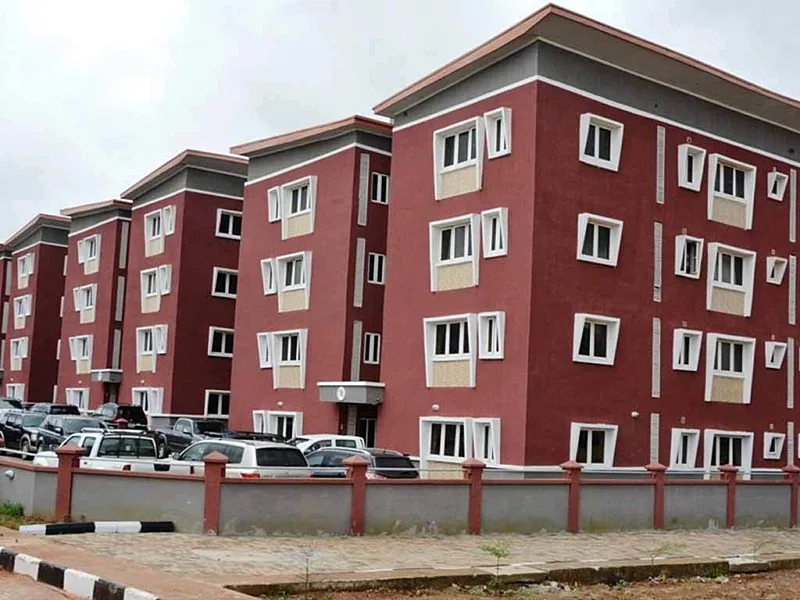
Traditional public procurement remains a legitimate way to deliver infrastructure. Government defines and finances the asset, consultants design it and contractors build it.
Its weakness is not public delivery itself, but fragmented responsibility and underfunded lifecycle management.
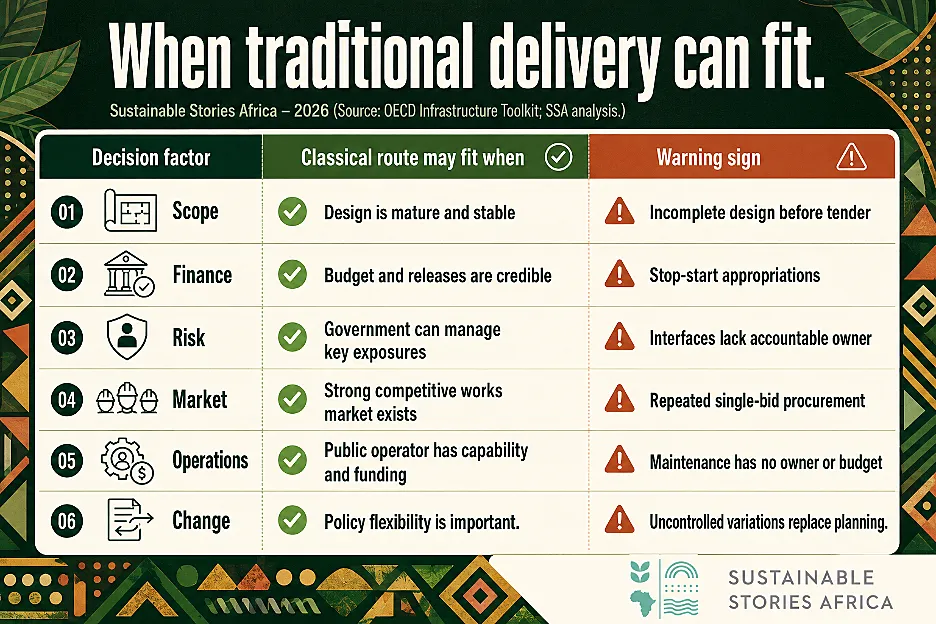
Nigeria's experience shows why procurement choice must follow project needs. Classical delivery can work when scope, budget, capability and maintenance are credible; it fails when lowest price, variations and political cycles replace whole-life value.
Traditional procurement still shapes public infrastructure
Before PPPs became a prominent policy option, infrastructure was largely financed through public budgets and delivered through works contracts.
Dr W. Akhator-Eneka's source series places Nigeria's classical period broadly between independence and the mid-1980s, before debt pressure, economic reform and new financing models expanded the menu.
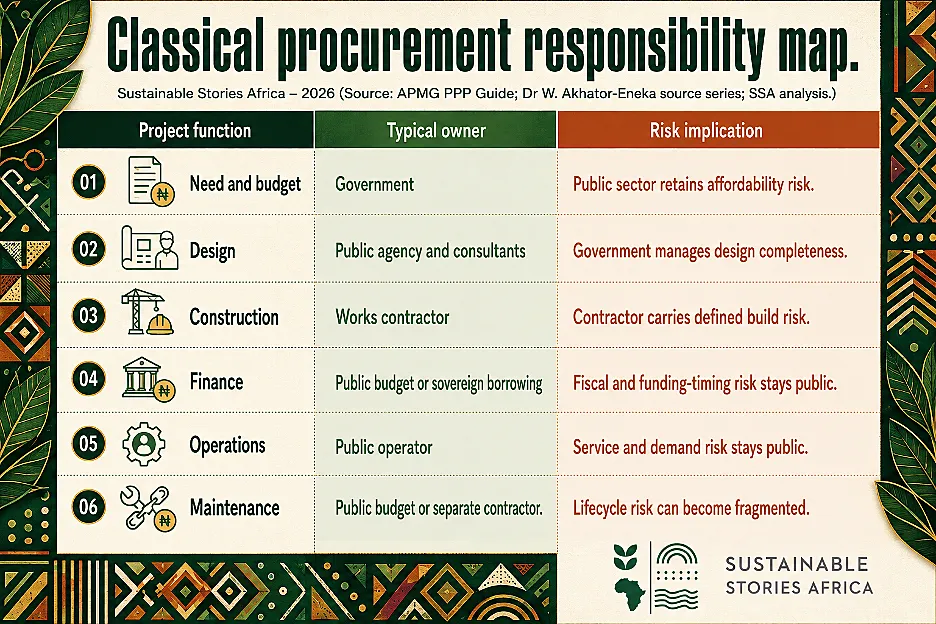
In a common design-bid-build arrangement, government decides the need, appoints designers, funds construction, tenders the works and retains ownership, operations, demand and long-term maintenance risk.
- The contractor is paid for delivering the specified asset rather than financing and operating a service over decades.
This model is sometimes presented as the outdated opposite of PPP. That is misleading.
Traditional procurement can be simpler, cheaper to transact and appropriate where government can fund the project, specify the asset and manage performance.
The real test is whether the chosen route aligns responsibility, incentives and capability with the project's risks and public outcomes.
Public control does not guarantee public value
Government ownership can protect policy control and avoid private financing costs; however, budget-funded projects remain vulnerable to optimistic estimates, incomplete design, delayed releases, political interference, weak competition, variations and poor maintenance.
- A contractor may meet the construction specification without being responsible for how the asset performs later.
Separating design, construction and operations can weaken accountability.
- Designers may not bear buildability risk; contractors may optimise initial cost; operating agencies inherit an asset they did not help specify; maintenance becomes an annual budget request.
- The public sector retains interface risks even when it has contracted out individual tasks.
The classical model has clear strengths
Traditional procurement suits projects with mature designs, predictable interfaces, strong public capacity and no clear advantage from bundling finance or operations.
- Competitive works tendering is widely understood.
- Government can change service policy more easily than under a long-term PPP contract, and sovereign borrowing may cost less than private project finance.
It can also be preferable where revenues are uncertain, services should remain fully tax-funded, or technology and user needs may change rapidly.
- Smaller rehabilitation projects may not justify PPP transaction costs.
- Emergency works and projects with overriding public-security considerations can require direct public control, subject to procurement law and oversight.
These strengths disappear when readiness is weak.
- Tendering incomplete designs encourages claims and variations.
- Selecting only the lowest initial price can undermine quality and maintenance.
- Appropriations that stop and start extend schedules and cost.
- The project needs an approved whole-life budget, not merely a construction allocation.
Contract packaging matters.
- A single large works contract may simplify interfaces but reduce local competition; many small packages may widen participation but leave government managing coordination risk.
- Procurement strategy should consider market capacity, schedule, technical interfaces and the sponsor's ability to supervise, rather than only an administrative preference for one tender form.
Whole-life management can modernise public works
Classical procurement can adopt stronger lifecycle disciplines without becoming a PPP.
- Government can use independent cost review, reference-class forecasting, design reviews, performance specifications, digital project controls, maintenance funding, asset registers and post-completion evaluation.
- Design-build or performance-based maintenance contracts can address selected interfaces.
The opportunity is procurement pluralism.
- A country does not progress by replacing every public works contract with PPP.
- It progresses by choosing among public finance, design-build, management contracts, concessions, leases, PPPs and blended structures based on service need, risk, market capability and value.
Public works can also support local capability when qualification, packaging and payment systems are designed fairly.
- Prompt certification and payment reduce contractor financing pressure; transparent evaluation rewards competence; performance records improve future selection.
- Local-content objectives should build sustainable capability rather than shield poor performance or inflate cost.
Choose procurement through evidence, not ideology
Every major project should pass an options appraisal before procurement.
- Government should compare scope, finance, risk, delivery time, adaptability, whole-life cost, service quality, market competition, institutional capacity and fiscal exposure.
- The preferred model should have a written rationale and approval gate.
For traditional projects, agencies must complete design and land work before tender where possible, publish budgets and awards, control variations, certify milestones independently and ring-fence maintenance.
- Completion reports should compare forecast and actual cost, time, quality and service outcomes, feeding evidence into future estimates.
Audit should move beyond procedural compliance.
- Reviewers should test whether scope changes were justified, competition remained effective, the asset meets intended service, defects are closed, and maintenance funding exists.
- A project can follow procurement steps yet still deliver poor value if the selected asset or contract was wrong.
Path Forward – Modernise public procurement before replacing it
Nigeria should treat classical procurement as one delivery option that requires stronger readiness, whole-life budgeting and transparent performance, rather than as an automatic default or automatic failure.
The best route is the single one that delivers the justified service at sustainable cost with clear accountability. Procurement form must follow project reality.