
Blended finance uses limited public or philanthropic resources to mobilise commercial capital for projects with strong development value but an unattractive initial risk-return profile. It is not a synonym for any mixed funding package.
In corporate PPPs, catalytic tools can bring firms into energy, transport, water, digital and social infrastructure.
The safeguard is minimum concessionality: public support must solve a defined barrier, deliver measurable impact and avoid privatising gains while socialising losses.
Catalytic capital must prove public value
Many African infrastructure projects offer large social benefits but struggle to reach financial close.
Preparation is incomplete, early technologies are unproven, revenues are uncertain, local-currency finance is scarce or political and credit risks exceed commercial tolerance.
Corporations may see opportunity yet remain unable to invest on acceptable terms.
Blended finance responds by combining concessional public or philanthropic capital with development-finance and commercial resources. Grants, guarantees, subordinated debt, patient equity, viability-gap support or technical assistance can improve the risk-return profile and bring additional capital into a transaction. Corporate PPPs provide the contractual and operating structure through which private capability can deliver public services.
According to Dr W. Akhator-Eneka, the scale is already material.
- IFC reports that since 2010 it has committed $6 billion in contributor funds across 653 projects, mobilising $34.9 billion in additional financing in 104 countries.
Those figures demonstrate potential, not automatic success.
- Every deal must show why concessionality is needed, who benefits and how the market can eventually operate with less support.
Not every funding mixture is blended finance
A transaction does not become blended simply because government and a company both contribute.
- The defining feature is catalytic development finance that changes the behaviour of commercial investors and mobilises capital that would not otherwise enter on similar terms.
- There must be a credible counterfactual and causal link.
The danger is using cheap public capital to improve returns on projects that were already commercially viable, absorb risks a sponsor should manage or support politically favoured companies without competition.
- Poorly designed blending can distort markets, hide fiscal costs and create permanent dependence rather than build investable sectors.
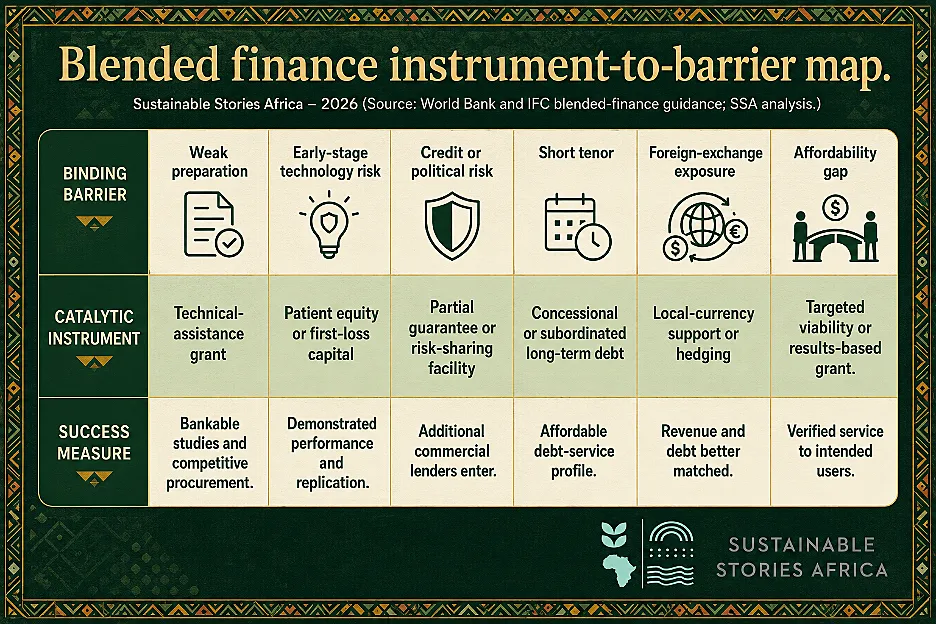
Instruments must target the binding barrier
Technical-assistance grants can fund feasibility, safeguards, legal work and transaction design where preparation is the barrier.
- A first-loss layer or partial guarantee can absorb defined credit, political or portfolio risk.
- Subordinated or longer-tenor debt can improve repayment capacity.
- Results-based grants can reward verified connections, service or climate outcomes.
Local-currency solutions matter when project revenue is earned in naira or another domestic currency.
- Foreign debt may carry lower nominal interest yet create severe devaluation exposure.
- Guarantees, swaps, domestic bond enhancement or DFI-supported local lending can align the liability with revenue, though each instrument has cost and contingent risk.
Corporate PPP structures then assign design, construction, finance, operations, performance and handback responsibilities. Public authorities retain policy, affordability, oversight and fiscal duties.
- A corporate social-responsibility donation is not a PPP unless a long-term, performance-linked arrangement exists.
- Similarly, a PPP is not blended finance unless catalytic capital is demonstrably mobilising investment.
The capital stack should preserve incentives.
- If concessional funds absorb every early loss, sponsors may take weak projects forward or underinvest in due diligence
- Private equity should remain genuinely at risk, and guarantees should include caps, fees, conditions and recovery rights
- Catalytic support is most effective when it reduces a barrier without removing commercial discipline.
Good blending can build future markets
Well-targeted support can help establish records in solar mini-grids, climate-resilient water, low-income housing, health services, broadband or waste systems.
- Once technology, payment and performance evidence improves, perceived risk may fall, competition can grow and concessional support can reduce.
- The goal is replication and market creation.
Communities can gain earlier access to essential services and stronger environmental outcomes, while corporations gain a structured entry into new markets.
Governments can stretch limited capital further if mobilisation is real.
- However, leverage ratios should not overshadow service quality, affordability, additionality, gender, climate and distributional impact.
Blended programmes can also help smaller businesses enter infrastructure value chains through credit lines, guarantees and aggregation.
- However, corporate participation should not unnecessarily displace local firms.
- Procurement and technical assistance can build local capability while requiring the lead sponsor to meet clear environmental, social and governance standards.
Demand transparency, competition and minimum concessionality
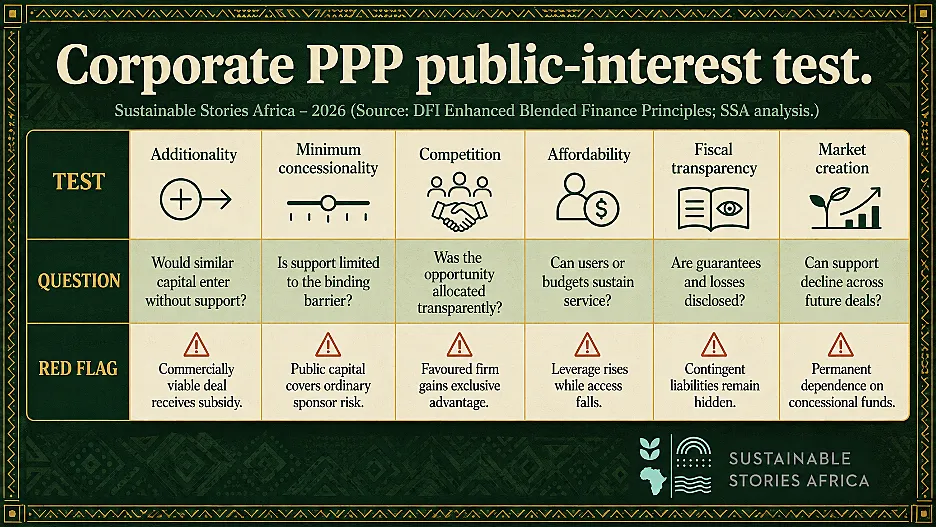
Each transaction should publish the development objective, market failure, commercial counterfactual, value and form of concessional support, expected mobilisation, beneficiaries, risk allocation and exit pathway.
- The DFI enhanced principles emphasise economic rationale, crowding-in with minimum concessionality, commercial sustainability, reinforcement of markets and high standards.
Governments should account for guarantees and support as fiscal exposure, test procurement competition and prevent related-party advantage.
- Independent evaluation should report both committed and actually mobilised capital, alongside service, affordability and environmental outcomes.
- If a project cannot explain why subsidy is additional and temporary, the blend should be redesigned.
An exit strategy should form part of the project approval process.
- The agreement should state what evidence would allow concessional pricing, guarantees or grants to decline in later projects.
- If the sector remains dependent, evaluators should distinguish persistent structural barriers from poor project preparation or rent-seeking that public support is unintentionally preserving.
Path Forward – Use subsidy to create investable markets
African sponsors should reserve blended finance for well-prepared projects where a defined market failure blocks strong development value.
Concessionality should be transparent, minimal and linked to measurable results.
Long-term success is not a larger subsidy pool. It is corporations and investors financing repeated infrastructure transactions on increasingly commercial, competitive and accountable terms.